Colin Moreshead · · 3 min read
Dot is bringing wearable tech to the visually impaired
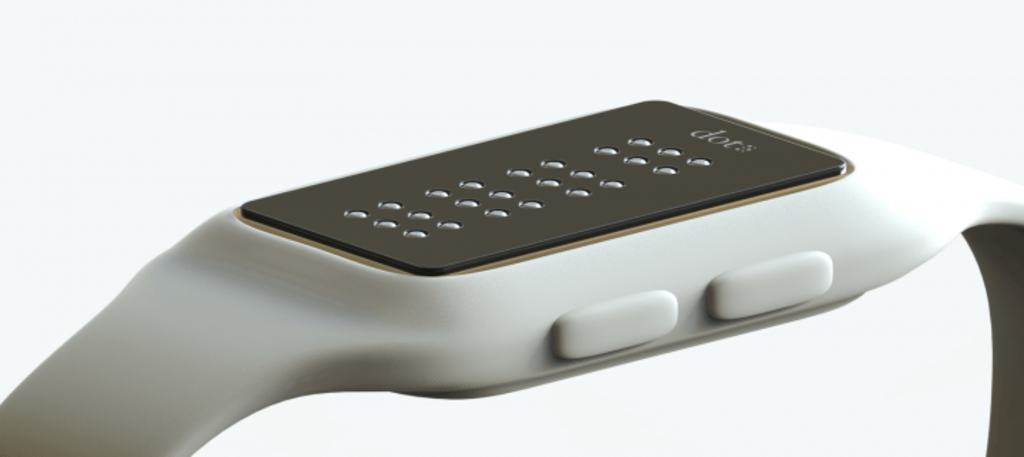
Braille literacy is in a state of crisis. Well under half of the world’s visually impaired population can read using Braille, and the number is in decline even as literacy for the sighted soars. The digital revolution has only widened this gap; paper-based Braille cannot keep up with the explosion of content and information available through screens.
There are devices designed to help the visually impaired navigate digital content in real time, but users have plenty of reasons for dissatisfaction. Most interfaces are bulky, keyboard-based contraptions that can cost more than US$10,000. That’s a pretty hefty price tag for a device that can’t be used out and about. Enter Dot.
The South Korean startup, pitching today at Tech in Asia Tokyo 2015, has developed a module of Braille cells that can display four characters at a time with raised bumps. Scrolling like a marquee, Dot’s module can display messages of any length at speeds of up to 100hz in real time. The device is based on the company’s proprietary haptic technology, involving the transmission of information by touch and vibration.
A modular approach

By packaging its modules in a smartwatch, Dot is punching a hole in the wall that keeps the visually impaired from information and text on the fly. The Dot smartwatch will go on sale this December in the United States for approximately US$280, undercutting many other wearables like the Apple Watch. Out of the box, the watch will connect to smartphones via bluetooth to display everything from text messages to a Twitter feed using voice commands.
The first production run of 10,000 watches will be on American wrists by year’s end, but Dot co-founder Eric Kim is thinking big about other applications for his company’s module in the long term. Soon to come is a potential “Braille Kindle,” which could be used in mathematics education. Another potential driver of demand is what Kim calls “public Braille,” which would bring active text to locations like stores and bus stops.
“We already have test modules installed at ATMs and train stations here in Seoul, all places that used to have only stationary Braille,” says Kim. “For the first time, you’re able to read your bank account balance in private or check for updates on the next train.”
Pre-programmed public Braille in places like government buildings doesn’t sound quite as trendy as a new smartwatch, but Kim tells Tech in Asia that public infrastructure updates could be Dot’s biggest market for the module. And in the meantime, there are 285 million people in the world with severe visual impairment – Dot surely hopes they all have at least one wrist free.
Today, at Tech in Asia’s Arena, Kim impressed the judges with his presentation of Dot’s business. Judge James Riney, the new head of 500 Startups Japan, showed some concern with Dot’s choice to start with a smartwatch, and not the “Braille Kindle” Kim mentioned. Kim defended his company’s choice, stating that miniaturization and low price points that open up new markets are Dot’s top priorities – larger, more exciting devices will have to follow.
This is part of the ongoing coverage of Tech in Asia Tokyo 2015, our annual conference taking place on September 8 and 9.
Dot Incorporation
Dot Incorporation is creating active braille smartwatch to help more blind people have access to affordable education and effective communication.
- Location
- Korea, Republic of
- Founded
- 2014
- Employees
- 11 – 50
- Website
- www.dotincorp.com
- Latest Funding
- US$600k / Seed
- Hiring
- 0 positions
Stay updated on the go with our mobile app.
Get latest insights with smoother, more personalized experience through TIA mobile app.
Recommended reads
 Indonesian AI startup goes global
 Forrest Li on scaling Sea, building smarter bots, and founder grit
 An AI assistant that joins sales calls and scores team skills
 SGX’s CEO says it doesn’t need a unicorn to win
 SMEs want AI too, but not the kind Big Tech is selling
 Oatside’s alt-milk rise hits a profitable gear
 Alibaba’s financial health in 12 charts
 Asia’s telcos bundle AI into mobile plans. Will it pay off?
 M-Daq chases bigger clients as revenue falls, losses grow
 VC tracker: Accel raises US$3.5b, including US$550m for India





Editing by Steven Millward
(And yes, we’re serious about ethics and transparency. More information here.)