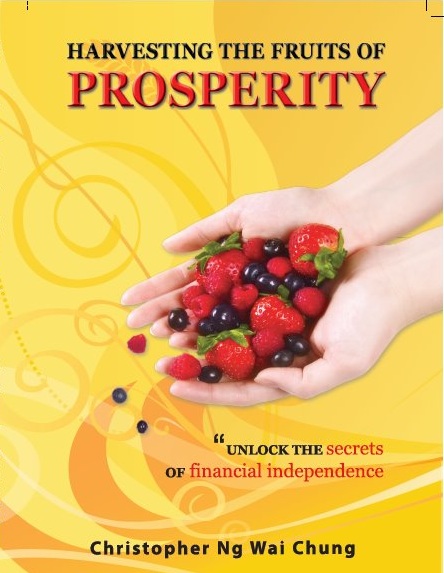
Finally, Christopher Ng Wai Chung, the author of “Growing your tree of prosperity” has now released his second book Harvesting the Seeds of Prosperity. This book can now be found on sale at the World Book Fair’s Marketasia stall in Suntec City at about $22.90. In a special tribute, he has decided to spoil part of his latest book Harvesting the Seeds of Prosperity in the most intelligent Singaporean blogs in cyberspace. The book details his manifesto in reaching a state of Financial Nirvana, the ability to live within one’s investment income while still keeping day job to grow his portfolio even bigger. In this special post, he will share excerpts from his book, centering on the notion of human capital.
About the author: Christopher Ng Wai Chung, 32, is an IT Project manager who dabbles in personal finance and wealth management. His own blog can be found in treeofprosperity.blogspot.com. He can be reached at this email address.
In chapter 5, in a section on retirement planning and the CPF, we examine a radically new way of looking at Human Capital.
The Notion of Human Capital
Let us have a short discussion on a radically new definition of the concept of Human Capital.
We may well be in the cusps of a Copernican revolution in wealth management.
In the next 5 to 10 years, a lot of Finance PhDs will be crowned because of various inroads made into the concept of Human Capital. While this idea is still currently being refined and investigated by academics worldwide, it would do laymen and finance readers great benefit to gain a simple introduction to this idea.
Human Capital is defined as the present value of a person’s future labour income. It is how much you will earn for the rest of your life adjusted to present day dollars. Put in another way, Danny Phua, 25, a fresh graduate who has just recently earned his business degree from a local university, would have a much larger pool of Human Capital than his retiree father, who probably has much larger pool of Financial Capital. For the younger people, there is simply so much money which has yet to be made.
The latest idea in financial planning is that a person’s wealth does not simply consist of simply his assets minus his liabilities but should be conceptualised as a sum of two components – his Financial Capital and his Human Capital.
So why is this idea so important to the academics who dwell deep within their ivory towers?
It turns out that many PhD certificates given out to the most brilliant minds in finance will be based largely on the complex mathematical models that will be hatched to figure out how to quantify a person’s Human Capital which in turn can be used to determine how much insurance to have, what investments to buy and what kind of financial instruments to engineer.
Human Capital and the Five Pillars of Personal Finance





Stay updated on the go with our mobile app.
Get latest insights with smoother, more personalized experience through TIA mobile app.