 Samantha Cheh · · 6 min read
Engaging customers in smartphone-obsessed Asia Pacific

Many countries in Asia Pacific may have come late to the internet game, but the people in this diverse region were quick to leapfrog desktop computers in favor of mobile devices, giving rise to one of the world’s more vibrant mobile digital ecosystems.
GSMA’s 2020 report on the mobile economy predicted that Asia Pacific would come to represent almost half the world’s new digital citizens, with an estimated 700 million fresh users expected to come online by 2025. Southeast Asia alone accounted for 11% of global app downloads in 2020.

Photo credit: thekaikoro / 123RF
Asia Pacific’s mobile internet market offers plenty of opportunities, but it’s not enough to just build apps – not in this hyper competitive atmosphere. Companies that want to reap the rewards of a mobile-first region need to pair their innovations with robust and thoughtful customer engagement strategies.
“Customer engagement is really about being with the customer and supporting them all the way through their journey,” says Andy Carvell, partner and co-founder of mobile growth consultancy Phiture.
In his view, customer engagement is all about creating opportunities for users to interact with a product or a piece of content from the beginning all the way through to onboarding and beyond.
Mobile, he says, is especially fruitful for these kinds of interactions because it makes users reachable at any point in their lives – and if companies are smart and responsible about this opportunity, they can not only build strong habits among their customers but also support them in getting the most value from a product.
Fighting for attention in a crowded field
The most successful customer engagement strategies, says Chye Yien, a senior strategic business consultant with customer engagement platform Braze, rely on the ability to contextualize experiences for more personalized journeys at scale.
Carvell notes that users’ attention and time have become limited resources while the costs of building an app have fallen, creating a highly competitive environment.
“Attention is the currency of this generation. It’s not enough to have a great product – you need to stay top of mind with the consumer,” he stresses.
“It’s not about tapping the user every five minutes but understanding what can actually bring value in different contexts throughout their day, and crafting those engagements to provide that value at the right time.”
Chye adds that customer engagement is key to building sustainable businesses.

Chye Yien, senior strategic business consultant at Braze / Photo credit: Braze
“While acquisition is essential to growth, we’re increasingly seeing that brands that leverage stand-alone efforts to ‘buy the customer’ are struggling to gain true sustainable usage,” she says. “Sustainable business growth is about trying to form a habit beyond the organic momentum of usage.”
From her perspective, customer engagement helps businesses extend the relationship they have with the customers they’ve acquired.
“The more positively these relationships evolve, the more returns they get from the customers,” she adds. “Business growth becomes meaningful and sustainable.”
Challenges in connecting the dots
Getting customer engagement right is easier said than done, however.
One of the challenges that companies might face, Chye notes, is working in silos across an organization, be it in terms of people or processes.
This can create friction, which results in lost market opportunities and high opportunity costs, especially for businesses in Asia Pacific where intense competition has led to higher customer expectations.
Attention is the currency of this generation. It’s not enough to have a great product – you need to stay top of mind with the consumer.
Chye says companies are under more pressure than ever to get their products right and go to market as quickly as possible. Consumers, on the other hand, have even higher expectations than before when it comes to digital interactions with brands, making the margin for error extremely low.
“The activation phase might just be the only time you reach 100% of all customers acquired. Thereafter, depending on how the first interaction goes, customers might or might not allow the conversations to continue,” she explains.
However, Carvell warns, companies shouldn’t blow up these fears out of proportion. He says many companies tend to overcorrect by completely avoiding any customer engagement for fear of creating bad experiences, when in reality, they need to be actively running tests to gather data that can support the ongoing optimization of their customer engagement efforts.
“Data is really the friend that can guide them into avoiding making big mistakes,” he says, suggesting that it might be worth losing a single customer if it means creating richer experiences for the next 10,000 users.
Testing in the right direction
Carvell stresses that companies that want to succeed in their customer engagement efforts need to start by understanding where their customers are coming from and avoiding dependence solely on quantitative data. Instead, they should acknowledge the value of qualitative information gleaned from surveys, user testing, interviews, or focus groups.
“You can’t build a strong customer engagement strategy unless you understand your users well – and for me, the simplest way to do that is to talk to them,” he says. “You’d be surprised how many companies don’t talk to their users. When you’re pairing quantitative data with qualitative data, that’s when the real magic happens.”

Photo credit: 123RF
Furthermore, as companies scramble to tailor existing products to suit customers in new and foreign markets, testing becomes foundational. Carvell says that through testing, he learned that apps that perform well in Asian markets tend to be cluttered with features, unlike their counterparts in Europe, which favor a cleaner, stripped-down look.
“There needs to be an organizational culture where teams are empowered to take calculated risks to run experiments. The teams that perform much more poorly are the ones that are afraid of annoying users,” he says.
Chye echoes the sentiment. According to the Braze 2021 Customer Engagement Review, companies with “ace” customer engagement are ones that value a culture of experimentation and conduct small and rapid tests that allow them to learn quickly and reap benefits over time.
Technology as an enabler
Trying to navigate these challenges and taking the necessary steps to run experiments and tailor their products to meet customers’ needs can be overwhelming for companies, but Chye says technology can help make them easier.
“The right technology partner can help you scale faster while giving you flexibility and adaptability so that you can run today and be ready for whatever change might come,” she shares.
The Braze customer engagement platform was designed with this enabler role in mind. Through the platform, companies can easily and instantly communicate with their customers across a range of social and communication channels to create rich, contextualized experiences.
Braze works with Phiture to marry its customer engagement technology with Phiture’s consultancy services. In one scenario, Braze customer Soundcloud, the global music-sharing platform, was facing struggles with its onboarding flow: Users driven to the platform through social media channels weren’t receiving “Welcome Emails” and were being lost in the process.
Phiture stepped in and started running rapid tests that uncovered the conflict in the flow. It helped finetune Soundcloud’s onboarding process, which led to the number of daily emails sent rising by over 600% within a single day, as well as average increases in Plays and Likes on the platform.
At the end of the day, what’s most important is for businesses to ensure that they keep the customer at the core of everything that they do.
“A strong customer engagement strategy ultimately comes from a strong understanding of your users,” concludes Carvell.
Braze, the leading provider of customer engagement solutions, and mobile growth consultancy Phiture have partnered up to help their users strategize and execute effective campaigns with the help of technology that is scalable, flexible, and adaptable.
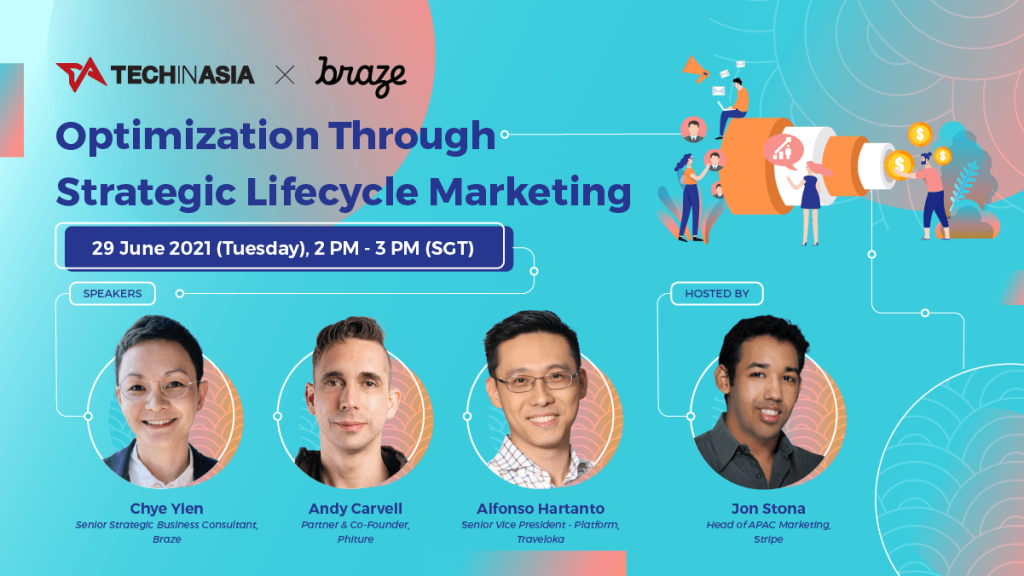
Join representatives from both companies as they meet in conversation with Tech in Asia to discuss the future of mobile-first customer engagement in Asia Pacific. Sign up for the event here.

This content was produced by Tech in Asia Studios, which connects brands with Asia’s tech community. Learn more about partnering with Tech in Asia Studios.
Stay updated on the go with our mobile app.
Get latest insights with smoother, more personalized experience through TIA mobile app.
Recommended reads
 5 key takeaways from Meta’s report for D2C startups
 GoTo takes a knife to costs, but market remains unconvinced
 How Indonesia’s small businesses can export globally
 Grab is leveling the playing field for MSMEs with its merchant super app
 This startup makes durian season last all year with freeze tech
 Why ‘too expensive’ is just a decoy for leaving customers
 The startup uses AI to add mini-games into apps
 Zimplistic flips to a profit in 2021 after troubles
 Why SaaS is dying and service as software is rising
 How to stop your startup becoming a ‘franken-org’





Editing by Stefanie Yeo, Nathaniel Fetalvero, and September Grace Mahino
(And yes, we’re serious about ethics and transparency. More information here.)






📅 Upcoming Events
22 October 2026
Payoneer x CSPN Summit 2026