Jum Balea · · 4 min read
Investors think there’s plenty of series B capital, but startups need to step it up
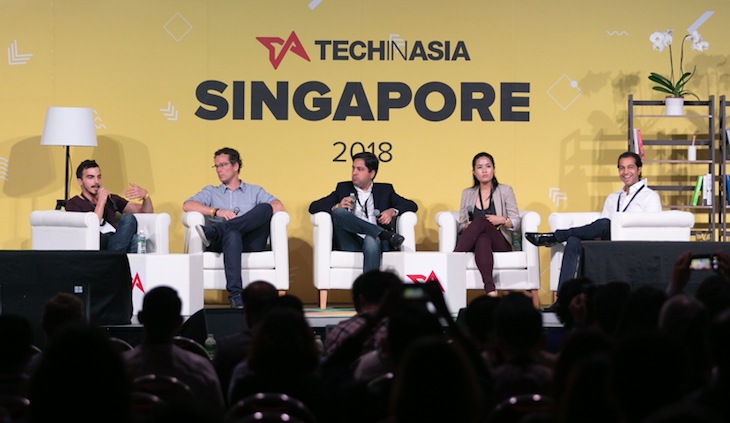
From L-R: James Riney, 500 Startups managing partner and head of Japan; Pieter Kiemps, principal at Sequoia Capital; Pravan Malhotra, VC head-Asia at IFC; Pauline Andriejanssen, investor at B Capital Group; and Ozi Amanat, founder of K2 Global / Photo credit: Henzy David / Tech in Asia
The supposed series B gap, where funding is sparse for firms maturing out of the early stage, has been a concern for Southeast Asia’s startup ecosystem for the past couple of years.
But investors speaking onstage at Tech in Asia Singapore 2018 debunked this notion.
Rather, they say the challenge lies in finding “superstar” companies they’d really want to bet on.
“I never really understood what ‘series B crunch’ really meant. I believe it alludes to the fact that there’s an oversupply of underperformers and undersupply of overperformers,” comments Pauline Andriejanssen, an investor at Facebook co-founder Eduardo Saverin’s B Capital Group. “I believe there’s a lot of capital flowing into this market.”
Ozi Amanat, founder of K2 Global – which has invested in firms like Uber, Airbnb, Alibaba, and Singapore-based Paktor – points out the same thing. “Companies in Southeast Asia shouldn’t worry about capital – there’s plenty coming in. They should just worry about performing and outperforming.”
So how do these investors evaluate and judge growth-stage startups asking for their money? Here are some key things they’re looking at.
Character of the founders and their team
Whenever it performs due diligence on any company, the first thing B Capital figures out is whether the founders have the persistence to carry out their vision, according to Andriejanssen.
“People often underestimate how [persistence] fades out after a while. You get the humdrum and you get sick of the business… That’s something that we really, really focus on. We want to make sure our founders can, as our managing partner calls it, ‘crawl through glass,’” she explains.
For Pieter Kemps, principal at Sequoia Capital, the founder’s ability to lead is a crucial thing. It’s no longer just about being a doer. “Being able to delegate and empower folks should grow into your role as a CEO, where you sufficiently understand what’s going on but can also focus on fundraising, the overall vision, on high level executions, and so on.”
The actual numbers
Also on the panel was Pravan Malhotra, who heads venture capital for Southeast Asia and Asia at the International Finance Corporation. For him, a series B-worthy company is one with a business model that’s already coming together. “The revenue model may not be there yet but they’re working towards it and they clearly have a path towards that.”
On the flipside, Amanat says it would be wise to look at what the company has done rather than whatever financial projections laid out in an Excel sheet it uses in pitches. “Really show me your actuals. It’s time for that dream to actually be fluid, in motion, or you’re gonna have to strip away that dream and say it’s not working for you.”
Kemps takes a more balanced view, saying it’s a mix of how far a startup has come and how much further it seeks to go.
“If you invested in a company [valued at] US$600 million, then basically you’re saying that you still believe this company can grow four, five times. It may not be the 10x or 100x that you dream in the seed stage, but you have to see that upside,” he contends.
Terms of the investment





Stay updated on the go with our mobile app.
Get latest insights with smoother, more personalized experience through TIA mobile app.