Erik Crouch · · 4 min read
This Uber-esque startup wants to fix the world’s worst daily commute

Every day, hundreds of thousands of people cross the border from Shenzhen, in mainland China, into Hong Kong. For many, this is a daily commute – and one that can involve hours of wasted time dealing with crowds, customs officials, and traffic. But one person’s harrowing commute is another’s business opportunity.
There are a number of companies operating fleets of vans that make the border crossing each day. Due to the smaller number of people on board, van crossings can be quicker and easier than busses or trains. They have the added bonus of being able to bring travellers to specific stops, instead of dropping them at airports or massive bus depots.
The big problem, though, is that most van companies are stuck in the past – they require reservations to be booked via phone which, in addition to being generally unwieldy, severely limits options for non-Chinese speaking commuters who travel between the cities.
Nightmarish 5-hour trip
That inspired a team to build Easiway. The company’s app works like Uber – it partners with existing companies to automate the process of hailing a van and crossing between the cities. Users simply open the app (in English, Chinese, Japanese, or Korean) select a time, choose pick-up and drop-off locations, and click “book.”
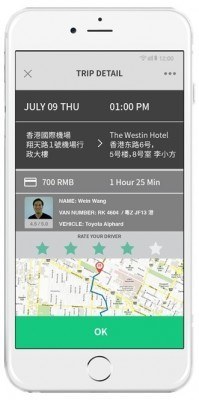 Easiway claims that their service shortens the trip between Shenzhen and Hong Kong by at least 50 minutes, with greater time savings during particularly busy times.
“Given that there will be less traffic, Easiway van passengers take only around 10 minutes for two immigration checks and the total trip usually takes an hour,” Euna Lee, a member of Easiway’s PR team tells Tech in Asia. “If you use public transportation in a holiday season, you would end up using four to five hours, while with Easiway, between two to three hours.”
Two or three hours sitting in a van may not sound like everyone’s ideal way to spend time during the holidays, but it’s arguably the least-bad option when the alternative is four or five hours on a crowded public bus.
Easiway’s fare depends on users’ pick-up and drop-off locations, but typically runs at around US$120 for a six-person van, making for US$20 per person if the van is full. Users can pay via Unionpay, Alipay, or credit card.
By contrast, a bus between depots in Hong Kong and Shenzhen can be cheaper: prices vary, but if your tolerance for waiting for buses and customs officials is high enough, it’s possible to make the crossing for less than HK$100 (US$12.90).
Complications
“In the beginning, we thought Easiway would be a simple application that connects passengers and van drivers traveling across Hong Kong and Shenzhen,” says Euna. “But in reality, it was more complicated than that.”
Van companies are set in their ways. “Even after Easiway opened, the [van] companies wanted to allow customers to keep on making reservations by phone to retain their loyal customers,” says Euna. That was a problem, because there was no way to link the phone-based reservations with those made via the app. “So we created a manager tool where managers can push reservations made by phone calls to the driver’s application,” says Euna.
“Upon requests made by owners of rental companies, we also created a CEO tool which shows how the company is being operated,” Euna continues. “The tool displays various types of information, such as revenue growth rate, gas price changes, and booking rates.”
On to Macau





Stay updated on the go with our mobile app.
Get latest insights with smoother, more personalized experience through TIA mobile app.