- Premium Content It takes our newsroom weeks - if not months - to investigate and produce stories for our premium content. You can’t find them anywhere else.
 Aditya Hadi Pratama · · 5 min read
Indonesian mobile coffee firm carts $250k from Beenext, others
In Indonesia, supply chain networks don’t end at mom and pop shops or warungs. Instead, there are smaller-scale merchants who wheel around mobile carts in residential areas to sell food items, beverages, groceries, and even home appliances.
Compared to warungs that are stuck at a fixed location, a mobile cart offers more convenience for customers who don’t want to leave their homes in order to purchase goods. For the seller, it’s also a cheaper alternative because they don’t have to pay rent.
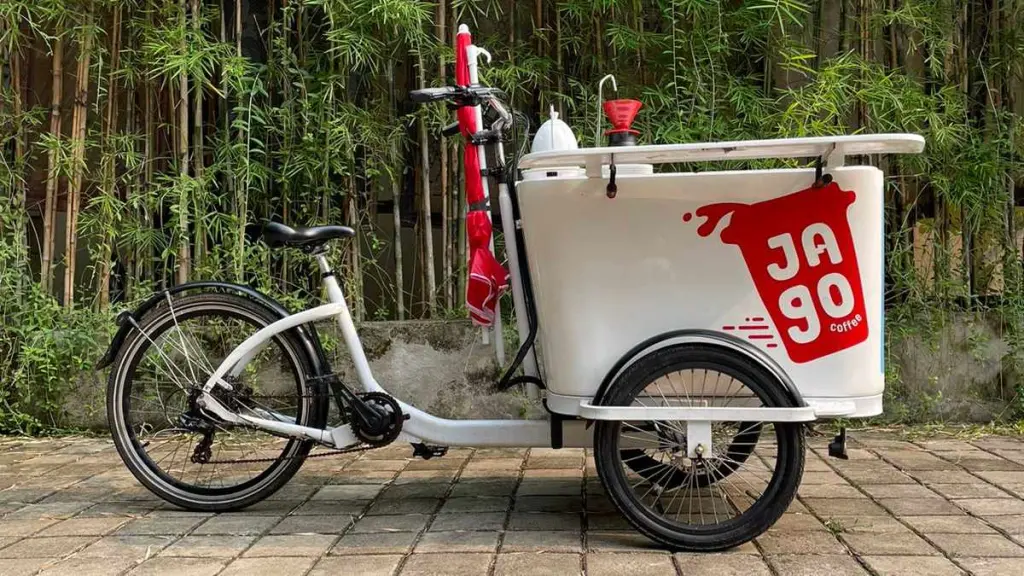
Jago Coffee cart / Photo credit: Jago Coffee
Yoshua Tanu, co-founder of premium coffee chain Common Grounds, realized that mobile carts could be combined with technology to create a new type of retail business that could provide a better service at a lower cost.
Together with Christopher Oentojo, his relative who was the vice president of product at Gojek at the time, Tanu founded Jago Coffee in early 2020.
The fledgling startup allows users to order ready-to-drink coffee via the Jago Coffee app. When riders arrive at the destination, they turn their mobile carts into a “mini cafe” and – if the customer orders a hot beverage – they brew the drink on the spot. The carts also come equipped with a mobile freezer to store cold beverages.
When there are no orders, riders can stay at a location and serve customers who come directly.
Jago Coffee recently raised a US$250,000 pre-seed funding round from Beenext, investment company Prasetia Dwidharma, and coffee entrepreneur Hidenori Izaki. The company plans to use the fresh funds to increase its number of mobile carts from 20 to 280 by next year. It also wants to pilot new product categories outside coffee with other food and beverage brands.
A journey to find an efficient business model
As a coffee entrepreneur, Tanu has tried to find a more efficient business model to sell the beverage. According to the co-founder, building offline coffee shops is not all too scalable, as the model is complex and involves high costs.
“To open a new coffee shop, we may need 800 million rupiah (around US$56,000) for rent and renovation. There is also a limitation on where we can put the new shop,” Tanu told Tech in Asia.
The mobile cart concept is more affordable because a ready-to-operate cart only costs US$2,500, allowing the company to use the same amount of money to open more “coffee shops,” while being more flexible on where they reach customers as well.
Jago Coffee’s main expense is for cost of goods sold (COGS). Electricity and rental fees – if needed in some areas – are much lower compared to what an ordinary coffee shop usually shells out. The carts, which operate on electricity, only consume a limited energy supply when recharging and occupy very little space.
The company can also lower overhead costs even further, as the rider also doubles as the barista. That’s why every rider only needs to sell a few cups per day to break even. And with the company’s profit-sharing scheme, riders can receive take-home pay for the next cups of coffee sold once they reach the breakeven point.
“In my calculation, a rider can get 5 million rupiah (around US$350), which is similar with minimum regional salary in Jakarta, if they sell 20 to 25 cups a day,” said Tanu.
More than just coffee
Stay ahead in Asia’s tech landscape
This is premium content. Subscribe to read the full story.
With the low-cost structure, Jago Coffee claims that it can scale the sales of various products through its network of mobile carts.
We know this is not ideal. ⌛ Sign up in 20 seconds. Cancel anytime.
Our subscriber community includes professionals from these companies:





Stay updated on the go with our mobile app.
Get latest insights with smoother, more personalized experience through TIA mobile app.