 Terence Lee · · 5 min read
How Shopee plans to reign supreme in Southeast Asia’s fashion ecommerce scene
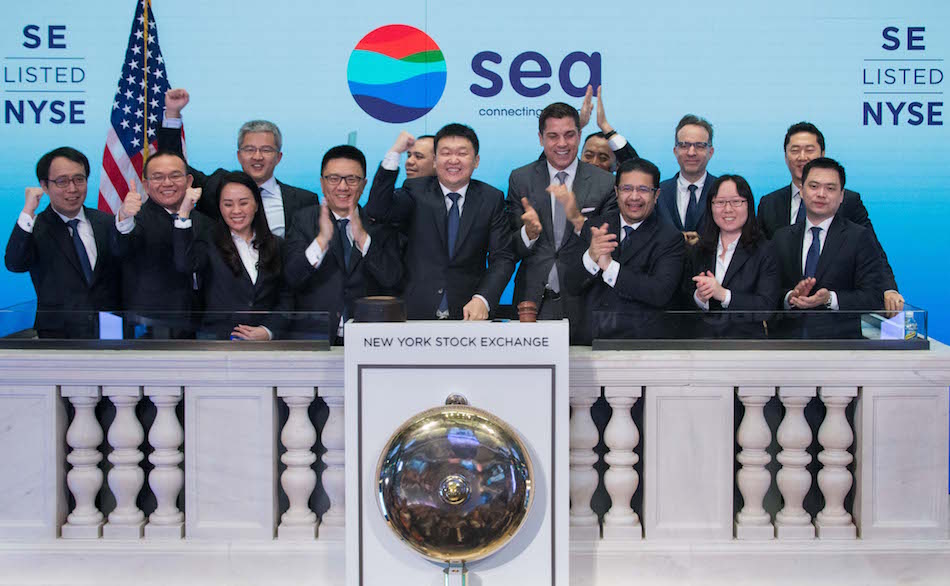
Sea chairman and CEO Forrest Li and president Nick Nash on the podium of the New York Stock Exchange on Friday. Photo credit: NYSE.
As you ride along the highway from Jakarta’s airport to the city, a giant billboard bearing the Shopee orange peeks from the horizon. “The number one online shopping destination,” it proclaims in Bahasa.
Shopee’s climb to the top of the Southeast Asian ecommerce heap has been rapid. The strategy that brought it to where it is today will guide it into the future.
And it’s not just about having a massive marketing budget. “The asset-light model is, we believe, ideally suited to the level of logistics infrastructure development of our region,” said Nick Nash, president of Singapore-headquartered Sea, who spoke at Tech in Asia Jakarta 2017. The conglomerate that runs Shopee, Sea concluded the most valuable public listing of a Southeast Asian internet company on the New York Stock Exchange.
 Logistics in Indonesia is one of the least economical in the world because of traffic jams and poor port efficiency. And given that the country is an archipelago, supply chains are long and fragmented. It could take as long as 18 years for the country to reach the level that Japan enjoys today.
Shopee is trying to overcome that by allowing anyone to sell on its marketplace. The strategy has resulted in 1.6 million active sellers listing 74 million products as of the end of June. By crowdsourcing sellers from all over Southeast Asia and then giving them logistics, marketing, and payments support, Shopee says it can more efficiently meet consumer demand than a centralized and asset-heavy model – and without the high costs.
This empowers small business owners, who in turn provide jobs for the community. For example, an entrepreneur has hired half his village to make handbags and sell them on Shopee, not just nearby but throughout Indonesia.
“There is a key structural advantage from being asset-light: our sellers are highly distributed and decentralized across the region, rather than having to rely on one or a small number of mega-warehouses in larger cities,” says Nash.
“The very practical result is a more efficient path from seller to buyer as opposed to the potentially longer transit times under a hub-and-spoke model.”
Lazada, the Alibaba-owned marketplace dominating the business-to-consumer segment, runs 15 warehouses in Southeast Asia.
Why Shopee went consumer-to-consumer
Beyond overcoming logistical constraints, the approach goes hand-in-hand with Shopee’s focus on fashion ecommerce. Because sartorial tastes are fickle and unique to each individual, fashion marketplaces manage a high amount of stock keeping units (SKUs).
“Just for a moment, put yourself in the shoes of the fashion merchandising executive who leads all product selection for an asset-heavy ecommerce firm. No matter how big your team, no matter how smart they are, there is almost no way that a direct purchasing or direct procurement team can come up with 74 million wonderful products for customers to buy. The supply chain management alone on the inbound side (from the factory) is almost impossible to manage,” says Nash.
He contends that fashion in Southeast Asia is especially diverse. “I love to say that the accents in Indonesia change every 50 kilometers and the language spoken changes every 250 kilometers. Now imagine how that filters down to tastes, consumer preferences, and in this specific case, fashion preferences.”





Stay updated on the go with our mobile app.
Get latest insights with smoother, more personalized experience through TIA mobile app.










📅 Upcoming Events
22 October 2026
Payoneer x CSPN Summit 2026