J.T. Quigley · · 5 min read
After tackling the recruitment industry in Japan, this entrepreneur is making hiring and job search free

What’s the founder and CEO of one of Japan’s fastest-growing startups to do after turning the domestic job recruitment market on its head? Attack a new vertical? Early retirement in the tropics, perhaps? For Soichiro “Swimmy” Minami, founder and CEO of BizReach, the answer was to go back to the drawing board.
“I’m happy with what we’ve done over the last six years, but about 12 months ago I started thinking about what we could be doing for the next six years,” he tells Tech in Asia. “I looked at our business, our mission to increase transparency and efficiency, and I looked at the market to see what I could do if I started again from scratch. I asked myself, ‘If I had the team and funds, what would be the ideal solution for a company looking for hiring solutions?’”
Minami revealed his startup’s solution – dubbed Stanby – at a press conference in Tokyo this morning. Stanby is a cloud-based recruiting management platform that aims to aggregate every online job listing in Japan and supplement those with information from offline job postings. The magic bullet? It’s free for both companies and job seekers to use.
Whereas BizReach was born as an executive-level recruitment platform, Stanby will be for everyone – but with an emphasis on small-to-medium-sized businesses (SMEs). According to a recent report by Japan’s Ministry of Economy, Trade, and Industry, 36 percent of SMEs – accounting for 70 percent of all companies in Japan – said they were struggling with hiring. More than half of those said difficulties stemmed directly from the exorbitant cost of recruiting.
“Stanby was released in hopes to fix extremely high hiring costs in Japan,” Minami says. “Through [it], we hope to activate and make transparent the Japanese labor market, and hence help revitalize the Japanese economy.”
Google inspired
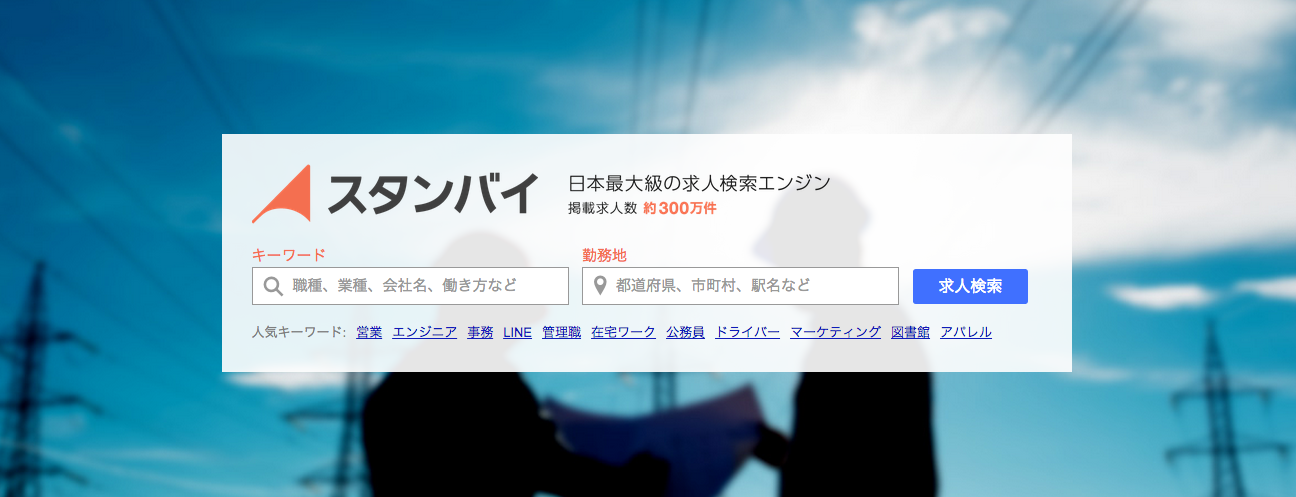
Stanby doesn’t look like a traditional job portal – it more closely resembles a search engine like Google. A search bar in the middle of the screen gives two options: job and location. This aesthetic isn’t a mistake.
“After looking at various benchmarks across the internet, the answer was Google,” Minami explains. “They don’t make money from the people looking for a job, they make money from the ad space around it where companies can advertise other information.”
He continues:
Traditional job sites provide real estate for companies to post job ads. We’re creating an intersection where companies and job seekers come to us [for job information] in the same way that Google brought everyone who was looking for something. The business model is similar to Google, where we will allow advertisers to advertise around the job search results […] like Adwords. The user interface is very similar to an actual search engine, the UI/UX is a lot like what Google provides because that’s what people are used to when trying to find information.





Stay updated on the go with our mobile app.
Get latest insights with smoother, more personalized experience through TIA mobile app.