- Premium Content It takes our newsroom weeks - if not months - to investigate and produce stories for our premium content. You can’t find them anywhere else.
 Jofie Yordan · · 7 min read
Rural areas hold key to reviving Indonesia’s struggling warung startups
Penny, a mom and pop store owner in Jakarta, has been running her business for 27 years. She and her husband decided to open a warung – the term for a mom and pop store in Indonesia – after they got married.
For decades, Penny has used a distributor agent to supply her shop’s products, mainly fast-moving consumer goods. That explains her reluctance to switch to another supplier, and especially to learn how to order products through an app.
Indeed, many startups have tried to digitalize warungs in Indonesia in the last decade. However, several players have exited the market, while those that remain are focused on B2B ecommerce in rural areas.
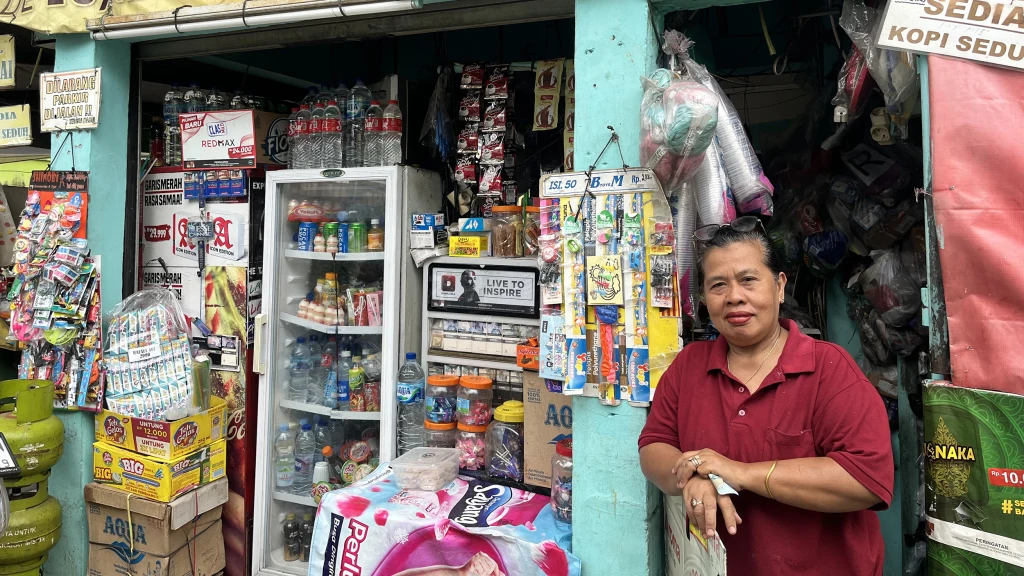
Penny, a warung owner in Jakarta / Photo credit: Tech in Asia
Ula decided to exit the FMCG distribution business in late 2023 despite raising US$141 million in total. GoTo and Unilever’s joint venture GoToko was closed in May 2023, while Mitra Tokopedia has stopped its FMCG offerings. GudangAda, which has raised US$135 million so far, denied shutdown rumors and is diversifying into new categories.
Yet players like Mitra Bukalapak, Super, and Dagangan remain active. In particular, Mitra Bukalapak contributed to its parent firm’s positive adjusted EBITDA result in the first quarter of 2024.
“Many warung digitalization startups focus on growth, so their unit economics don’t make sense because FMCG margins are thin and operational costs are high,” says Rexi Christopher, partner at Indonesia-based VC firm Init-6.
The high operational costs are due to the need for community education, especially in rural areas, as well as for providing incentives or promotions to attract users, and for investments in the supply chain – particularly for those that operate warehouses.
Education is crucial because most small business owners in Indonesia are mostly over 40 years old, and many aren’t tech-savvy.
But despite these investments, traditional distributors remain supreme in Indonesia’s retail market, emphasizing the challenges faced by startups trying to break into the sector.
Is going rural the answer?
For Dagangan and Super, they have a greater focus on rural areas, rather than Tier 1 or 2 cities. Meanwhile, Mitra Bukalapak is present in both rural and urban areas.
Ryan Manafe, CEO and co-founder of Dagangan, believes that startups focused on digitalizing warungs are struggling because many “are not truly present in rural areas.”
They continue to operate in urban areas, where the market is already saturated with conventional distributors and the warungs are already directly served and maintained by principal brands.
The lack of value-add offered by these startups makes it difficult for them to partner with principals in urban areas.
Not so easy
Waiting for profit
Stay ahead in Asia’s tech landscape
This is premium content. Subscribe to read the full story.
Urban areas are already saturated with conventional distributors for mom and pop stores that leave startups little room to work with.
We know this is not ideal. ⌛ Sign up in 20 seconds. Cancel anytime.
Our subscriber community includes professionals from these companies:





Stay updated on the go with our mobile app.
Get latest insights with smoother, more personalized experience through TIA mobile app.