- Insights This article was written by a TIA community member. Insights pieces undergo the same rigorous editorial process that newsroom-produced articles have.
 Jamaur Bronner · · 8 min read
SPACs, M&As, and Asia’s talent future
As a startup, the ultimate ambition is to reach an exit event – whether it’s an inital public offering to become a publicly traded company or an acquisition by a larger enterprise. In the case of M&As, beyond reaching consensus on the price of acquisition (i.e., the company’s valuation), the acquirer and acquiree must also navigate the nuances of integration, fusing two entirely different organizational structures and cultures under one roof.
Southeast Asia as a market is relatively nascent when it comes to startup exit events. The startup wave reached the region later than its counterparts in the US and China, and companies are just starting to reach the scale needed to be attractive acquisition candidates. Thus, many in the startup ecosystem are unfamiliar about when – and whether – to start thinking about M&As, and how to maintain the company DNA after the deal is done.
Even outside of the startup space, other private businesses and family-owned firms are increasingly mulling the prospects of selling their assets to an acquirer in an attempt to upgrade the management team and facilitate succession planning.
In this article, we explore the forecast for M&As in 2021, how SPACs (special purpose acquisition companies, also called blank-check companies) will impact exit events, and potential implications for talent strategies and the leadership landscape.
The Covid-19 slowdown
In late 2019, Golden Gate Ventures, a leading venture capital firm based in Singapore, partnered with Insead to publish a report that analyzed and forecasted the startup exit landscape in Southeast Asia. Of its most surprising findings, the firm predicted that at least 700 startup exits would take place between 2023 to 2025.
It also forecasted that starting 2022, there would be an increase in exits (via M&As or IPOs) and secondaries (i.e., selling preexisting investor commitments to other firms) catalyzed by early venture funds in the region approaching the end of fund life for their inaugural funds.
While many startups in the region might have initially aligned with that forecast and been on track for exit via acquisitions or IPOs in the coming years, the pandemic quickly extinguished market appetite for exits and put the prediction of an imminent critical mass of exit events in doubt.
In September 2020, it was reported that major M&A deals globally had been put on hold due to market volatility amid the crisis, with a decline of 25% in the first half of 2020, according to Euromonitor.
“When the pandemic hit, all deals were put on hold,” said Mark Strecker, managing partner of Sansa Advisors, a sell-side M&A advisory firm for private and typically venture-backed companies. “Some deals, which tended to be in the early phase, were terminated because people could not travel. With M&A deals, you often want to visit management and locations as part of the deal process.”
Michael Lints, partner at Golden Gate Ventures, added: “M&A initially took a hit as acquirers wanted to understand what the economic effect would be. Later in the year, M&A picked up due to availability of dry powder (including debt).”
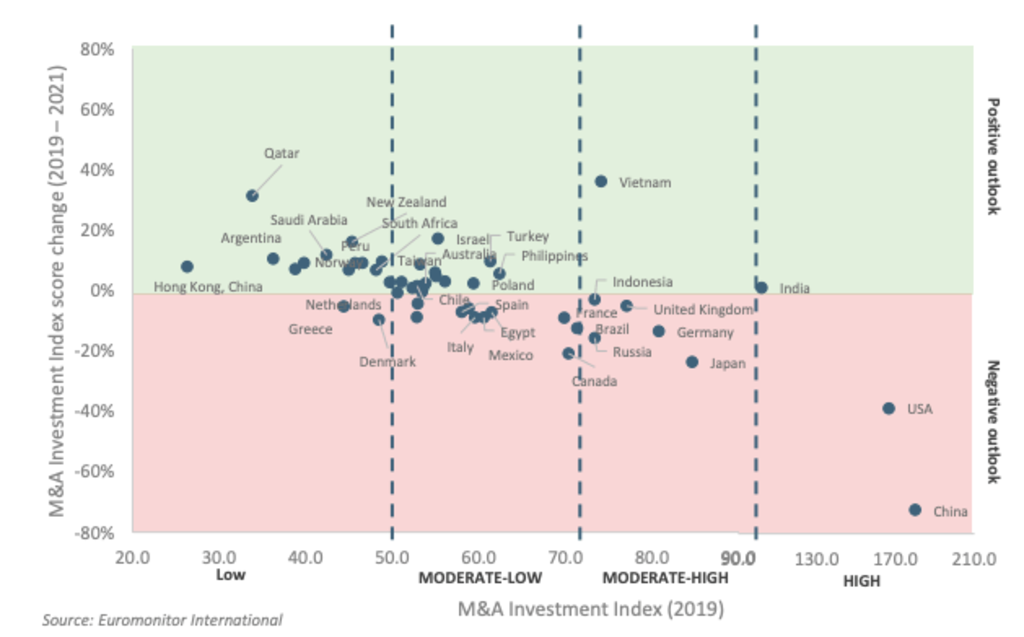
Taking a more nuanced perspective on the landscape, it turns out that exit trends in 2020 varied by market.
The Euromonitor report notes that the political and economic disputes between China and the US led to increased acquisition interest in Southeast Asian businesses, particularly in Vietnam, that support the global supply chain.
“The ASEAN exit market in 2020 was characterized by cross-border M&A (Chinese and US firms picking up regional assets), as well as regional acquihires and tuck-ins,” said Gavin Teo, general partner at series A investor Altara Ventures. “This stands in contrast to the US which saw an IPO boom in both tech and biotech. It also stands in contrast to China and Hong Kong which also had a large number of listings, especially in the back half of the year.”
M&A on the rebound
Asia is SPAC-tacular
The talent imperative





Stay updated on the go with our mobile app.
Get latest insights with smoother, more personalized experience through TIA mobile app.