- Premium Content It takes our newsroom weeks - if not months - to investigate and produce stories for our premium content. You can’t find them anywhere else.
 Terence Lee · · 3 min read
Carousell books $1.73m revenue and $29.8m loss in 2017 as monetization begins

Carousell co-founders Marcus Tan (L), Lucas Ngoo (M), and Quek Siu Rui (R) / Photo credit: Carousell
Carousell, the Singapore-based company running a popular classifieds app of the same name, reported US$1.73 million in revenue and a US$29.8 million loss before tax in 2017, its latest financial statement reads.
The bulk of the expenses went to marketing (US$13.1 million) and staff costs (US$12.7 million).
In 2016, the company’s revenue was negligible, while its loss before tax was US$22 million.
Carousell launched its first money-making feature only in the middle of 2017, so it may take a year or two before it sees significant topline growth.
“Last year, we laid the foundation for monetization, allowing us to start generating revenue in our key markets like Singapore and Hong Kong,” Carousell CEO Quek Siu Rui tells Tech in Asia.
The company declined to reveal its 2018 numbers, but it has seen “healthy growth rates in both revenue and users.” A growing base of users and item listings (see chart below) gives Carousell higher revenue potential.
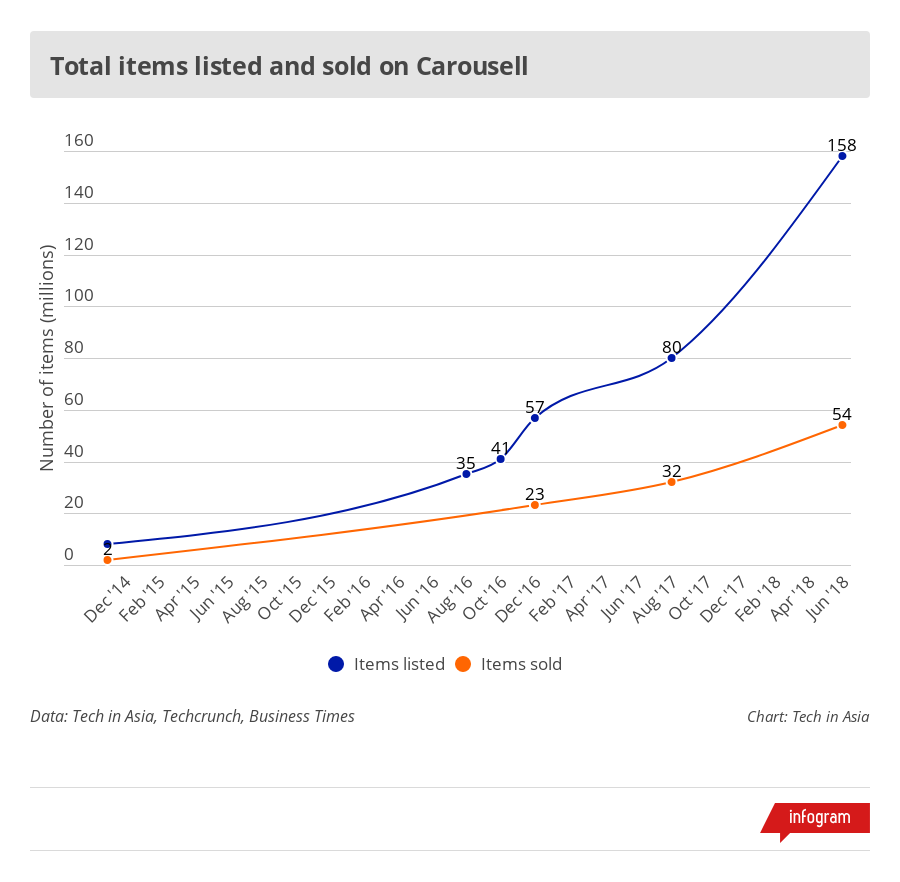
Because a lot of its transactions are completed offline, Carousell often cannot directly measure the number of items sold. Instead, it defines a sold item as a listing that is either marked as sold or a listing which is not marked as sold but with an offer accepted.
Working in Carousell’s favor is the ease and scalability of monetizing its traffic. Its cost of sales was only US$232,000 last year. At just 13 percent of revenue, it fares well against eBay, another asset-light online marketplace.
Meanwhile, Carousell’s marketing cost has stayed constant between 2016 and 2017. While the raw number seems high, it’s comparable with eBay as a percentage of expenses.
Here’s a timeline of the Singapore app’s monetization efforts to date:
August 2016: Hired Winnie Khoo, former managing director of PropertyGuru, to spearhead monetization initiatives. Khoo left in April 2018 after bringing her team to a “seven-digit run rate.”
October 2016: Announced that it acquired used car classifieds site Caarly. It also expanded into properties, jobs, services, and finance – categories Quek considers “high-value.”
Stay ahead in Asia’s tech landscape
This is premium content. Subscribe to read the full story.
In 2016, the company’s revenue was negligible.
We know this is not ideal. ⌛ Sign up in 20 seconds. Cancel anytime.
Our subscriber community includes professionals from these companies:





Stay updated on the go with our mobile app.
Get latest insights with smoother, more personalized experience through TIA mobile app.