 Christopher Quek · · 7 min read
How to think like a VC before asking for funding

Photo credit: WOCinTech
“Your startup is interesting, but come back to me when you have more traction.” This is a common diplomatic phrase made by VCs when they are not keen on investing in you, but keeping the door open just in case you suddenly become a hot investment.
Since my days of pro-bono advisory to over 600 startups, fundraising has been trying, if not vexing and complex for noob startup entrepreneurs. (Hey I have been there myself too.)
Coming full circle from being an entrepreneur who raised funds, to now a VC who raises from Limited Partners (LPs) and assesses startups to invest in, I realise how differently a VC thinks from an entrepreneur.
Here’s a list of 10 questions that a VC would ask, which I hope will give entrepreneurs some insight and demystify how fund raising is done, so that they will be more prepared when speaking to a potential investor.
1. Are you asking for funding within my range?
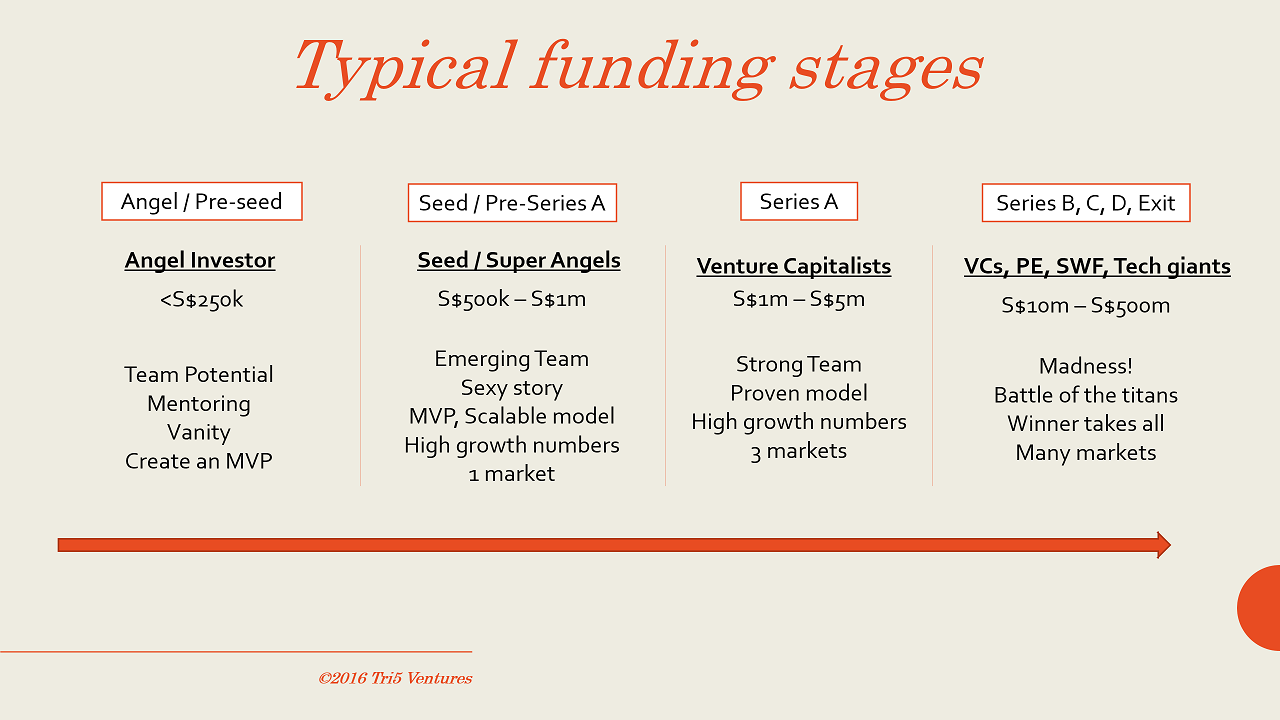
VCs and investors come in different appetite ranges. As you see in the image above, if you are asking for $1m from an angel investor who only invests $25k, he would not be able to afford the amount you are asking for. Likewise, if you approach sovereign wealth funds (they usually invest $20m and above) for funding of $100k, get ready to be scoffed at and ridiculed.
Before reaching out and pitching to an investor, do your due diligence and research. Check their prior investment quantum and see whether your investment size is palatable. When doing your pitch, indicate clearly how much you are asking for.
Remember, as you go for larger quantum of investments, you have to expect your business proposal to be more solid with good facts and results, with many supporting documents on assumptions that you make in your vision and projections. Expect also a longer decision-making process.
2. How do I get my money and returns back?
Many entrepreneurs believe that by promoting an exciting idea, investors will jump into investing. Maybe, if you are some hot and charismatic successful entrepreneur. But for VCs, they are institutional investors who need tangible results.
VCs raise money from a variety of sources like larger pension and hedge funds, high net-worth individuals, family offices, MNC investment arms and so on forth. They have to answer to their LPs on how the money that was invested get returns.
You need to clearly indicate a clear exit strategy or a list of strategies, for example, listing on public markets, trade sale (to who), clear dividend policy, Management Buy-out (MBO), selling of core IP, etc. Without one, VCs would not know how to get their money back.
3. When do I get my money back?
VCs are institutional investors and they have investment funds that have a limited life span, from as short as 5 years to as long as 15 years. It is hard to tell the fund life span as it is usually a closely guarded secret.
4. How much returns can I expect?
5. Is your startup vertical sexy and within my interest?
6. Is your product scaling quickly?
7. Does your startup have a unique and defensible proposition?
8. Is your company capitalisation table toxic?
9. Do I trust you with my money?
10. Who else do you have investing?





Stay updated on the go with our mobile app.
Get latest insights with smoother, more personalized experience through TIA mobile app.












📅 Upcoming Events
22 October 2026
Payoneer x CSPN Summit 2026