
Photo credit: Pixabay.
A few years ago, China’s P2P lending industry was on fire, and not in a good way. A massive explosion of peer-to-peer lending startups was interrupted when a high-profile fraud case brought down one of the market leaders and severely damaged consumer trust in the core concept of people lending cash to total strangers. In the months that followed, things got rough, and the industry went into a slide.
One of the few firms that emerged relatively unscathed was Dianrong. Despite the downturn, it is now one of 15 fintech unicorns in China. It originates more than US$300 million in monthly assets to retail lenders. Onstage at Tech in Asia Singapore 2017, CTO Ling Kong shared the secret of how Dianrong’s tech was able to get the company to that level: Legos.
Ling’s Lego analogy (spoiler alert: Dianrong isn’t built with literal Lego blocks) actually dates back to before the founding of Dianrong. On a trip to the United States, Ling was deeply impressed by the country’s infrastructure. Compared to relatively undeveloped China, Ling said, the US looked “like The Jetsons.” It was an early lesson in the importance of infrastructure, and one that Ling would later apply to software development at Dianrong.
Dianrong’s tech philosophy
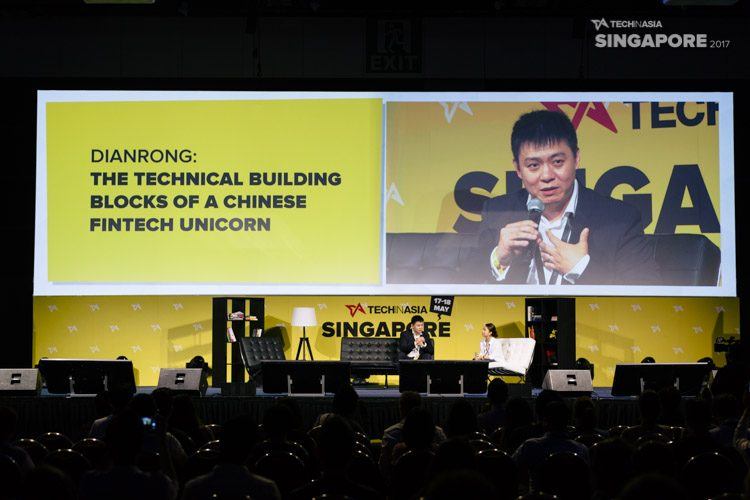
Photo credit: Tech in Asia.
Providing P2P lending services to a market as massive as China’s presents tremendously difficult technical challenges. While folks on the business side were struggling with things like convincing consumers and partners to trust in the concept, Ling and his team were working to build a system that – as of today – processes billions of transactions per day (since a single loan origination may involve many individual investors).
[UPDATE: We have removed a paragraph here about Dianrong’s hiring practices as described by Ling in his presentation. A Dianrong representative subsequently informed us that Ling misspoke.]
Recognizing that a lending startup in China’s fast-moving market needed solid bedrock infrastructure to ensure agile product development, Ling and his team developed Dianrong’s core software into what Ling describes as a series of Lego blocks. Each block handles a specific function, and by mixing and matching blocks, the company’s engineers can very quickly leverage their existing infrastructure to create new products.
For example, Ling said, a recent Dianrong AI loan risk modeling product went “from inception to app store release in only one month” and was built by just 11 people. A competitor or startup without Dianrong’s tech infrastructure – the Legos – would need 200 people to do the same job, Ling said. “The speed of innovation and how fast we can to respond the market [is] how we defend against incoming startups who want to take our space.”
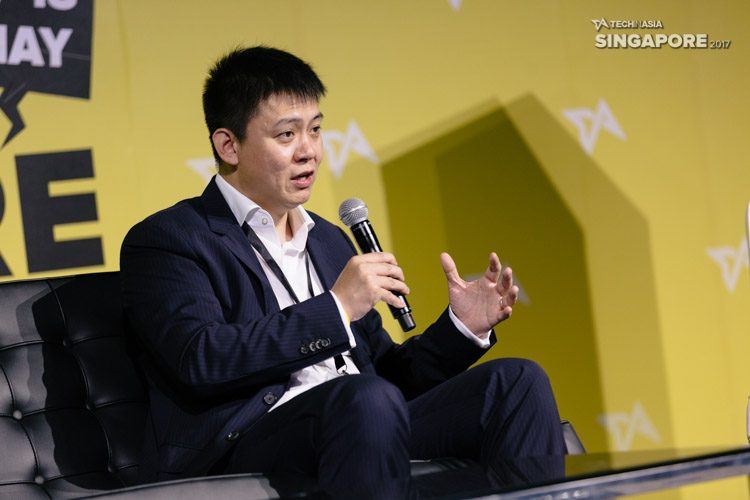
Photo credit: Tech in Asia.
Of course, not every engineer wants to work on a Lego assembly line. In hiring, Ling discovered that Chinese engineers can be split into two basic groups: the hardcore coders who write software because they love it, and the more pragmatic programmers who got into software engineering because they were looking for a promising, stable career. Recognizing that natural divide, Ling split them up. Hardcore coders work on building the “Lego” pieces, more business-oriented engineers combine those pieces to create new products.
Ling said that the inspiration for this organization comes from a rather surprising source: the US military. As Dianrong grew beyond 250 employees, Ling “had a lot of management problems.” To him, the US military was a good model for a large organization that’s able to act effectively thanks to regimentation, specialization, and coordinated support. At Dianrong, Ling sees his product coders as Navy-SEAL-style strike teams that work in small teams to very quickly iterate and release products. The “Lego”-building hardcore coders provide the infrastructure support that equips and facilitates work for the product strike teams.
Fighting the good fight





Stay updated on the go with our mobile app.
Get latest insights with smoother, more personalized experience through TIA mobile app.









📅 Upcoming Events
22 October 2026
Payoneer x CSPN Summit 2026