Michael Tegos · · 6 min read
This Singaporean entrepreneur funded his way into Harvard and a new startup in the US

Photo credit: Matthew W. Jackson
There’s no doubt in anyone’s mind about Singapore being an excellent place to start a business. Stable politically as well as financially, rich in investment and support, and an easy place to set up an enterprise, it sounds like an entrepreneur’s paradise. But for some Singaporeans, it’s not the promised land of entrepreneurship. The original land of promise, the United States, still beckons with its siren’s call.
The call was irresistible for Desmond Lim. The Singaporean entrepreneur moved to the US to complete a master’s degree in public policy, business, and government at Harvard University. He also worked at the MIT Media Lab for a while until earlier this year. “I really wanted to come to the US for school because I felt there was so much more to learn,” he tells Tech in Asia. “I think Singapore is great, I learned so much there, but I feel it’s small – there’s so much more to learn in the world.”
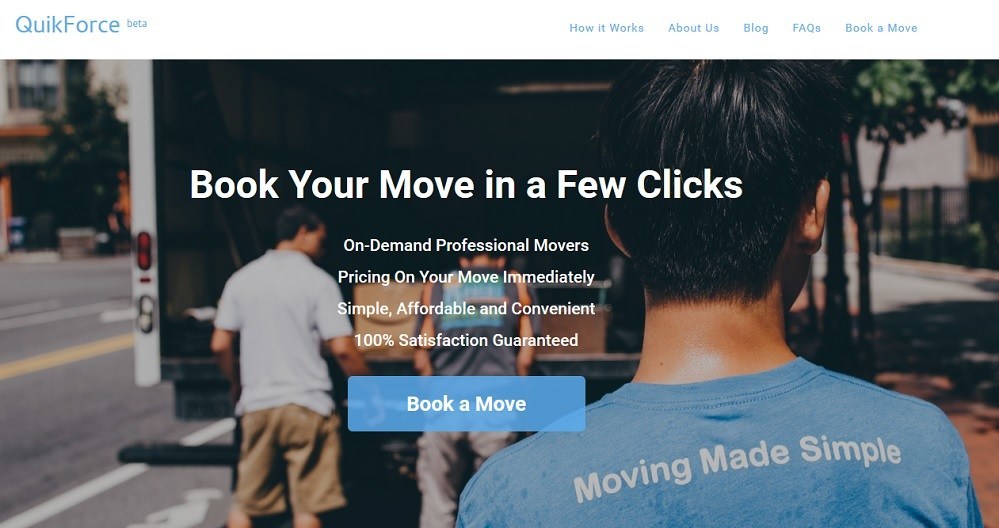
Unlike a lot of his peers, Desmond didn’t choose Silicon Valley for his next step. While living in Boston, he founded a new startup called Quikforce. It connects users to moving companies, allowing them to get the entire process of a move done through the site. It also implemented a software-as-a-service solution for movers that was warmly received by them. The startup is working with more than 50 movers in Boston and recently expanded to Miami. Desmond says it has so far generated more than US$50,000 in revenue and has facilitated over 100 moves.
Quikforce was named after his father’s one-van operation back in Singapore. “My father has been a mover for the past 35 years,” he says. “Both my parents barely finished school, and they don’t know how to use technology to do their job well. That’s why I wanted Quikforce to help people like my dad to do their job better.” In August, Desmond pitched Quikforce at TechCrunch’s NYC Meetup + Pitch-Off in New York, the only startup by an Asian founder there.
College on no money
Desmond knows a bit about enterprise. After finishing high school in Singapore, his family told him they couldn’t afford to send him to university. So he decided to work part-time tutoring other students. It wasn’t long before he surpassed the 35-student mark – the next step was to make money by matching them to other tutors. He did that for two years and made enough to fund his studies.
While studying business and finance at Singapore Management University (SMU), Desmond started a Thai restaurant. He ran the 70-seater with a crew of 10 to 15 people for three years before selling it during his senior year. Following that, he ran a business importing clothes from Thailand and China to Singapore. In the middle of all that, he became the first person in his family to get a university degree.
Back in 2007, as part of a school trip with SMU, he visited various tech companies in Silicon Valley, including Google and Apple. “I held the first iPhone in my hands when it wasn’t even out yet,” he says excitedly. After graduation and a short stint at Merrill Lynch in Singapore, the way pointed across the Pacific.
Different strokes
The US was attractive for a lot of reasons, according to Desmond, not least the potential market size for a business. “Even if I had a tech business that was doing really well [in Singapore], how would I scale it?” he wonders. Of course it’s not like other companies haven’t been able to do it – GrabTaxi co-founder Anthony Tan, whom Desmond knew at Harvard, has done a pretty good job of scaling his company in the region. But taking a company from Singapore and growing it beyond, in different markets, with different languages and cultures, is a considerable challenge, Desmond believes.
On the flipside, the US is a huge market with not that many differences from state to state. Quikforce has recently expanded to Miami and Desmond says he is approached by people from cities like Chicago, Philadelphia, and even New York to expand there. Not that it’s all roses – what differences there are can sometimes be as challenging. “Every state has its own laws and its own quirks,” he says.
For example, even the time of year people move can make an impact on a business trying to work with movers in different cities. In Boston, there’s a surge of moving during the summer as students move into town to attend one of its prestigious universities. New York, on the other hand, has people moving in and out all year round, but due to real estate being limited, sometimes moves are booked very last-minute. “I think as I scale, that will be one of my so-called barriers to growth,” Desmond explains.

Homecoming





Stay updated on the go with our mobile app.
Get latest insights with smoother, more personalized experience through TIA mobile app.