- Insights This article was written by a TIA community member. Insights pieces undergo the same rigorous editorial process that newsroom-produced articles have.
 Jay Kim · · 8 min read
He retired right after college, wants entrepreneurs to have a cookie
This article is part of Tech in Asia’s partnership with The Jay Kim Show where we publish the revised transcripts from the show’s podcast interviews with top entrepreneurs. This is heavily revised from the original show transcripts. For the full interview, go here.
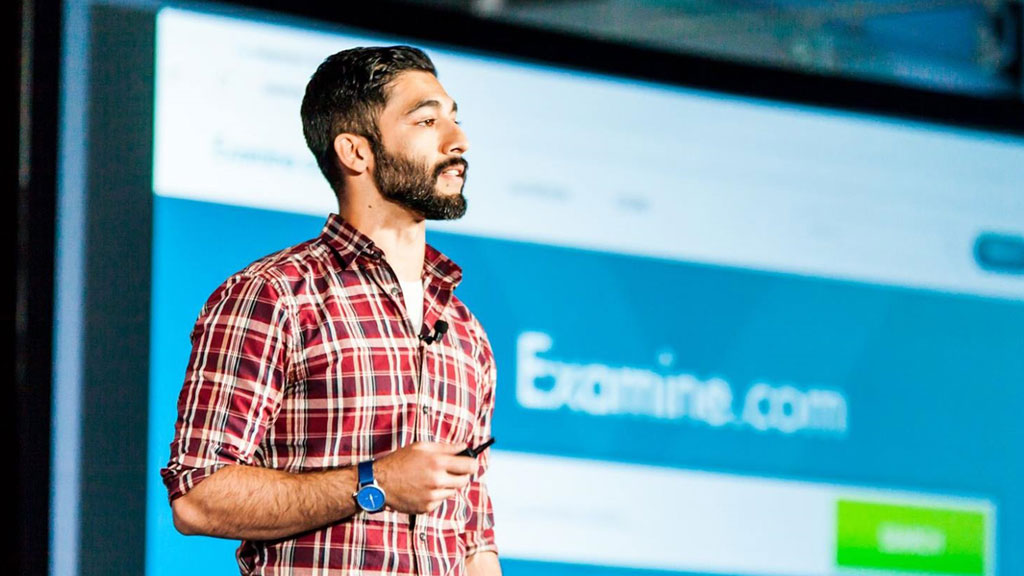
Sol Orwell is the founder of Examine.com, an online encyclopedia on health, nutrition, and supplementation. Sol’s a super interesting guy and probably the only guy I’ve ever met that has ever legally changed his entire name.
Sol and I were actually neighbors growing up. We lived in Saudi Arabia just a few kilometers away from each other.
After college, Sol had some early successes and he basically retired after that. He bought and sold digital currencies, traded domain names, and made enough money to become a digital nomad. He didn’t just stop there; he kept going, building companies on the side.
He’s a Toronto-based writer and public speaker and he loves chocolate chip cookies.
Could you give us a quick background on who you are?
“[…] The quick version is I’m ethnically Kashmiri […]. [I] grew up in Pakistan and moved to Saudi Arabia. I spent two years in Japan [then went] back to Saudi Arabia, and, in eighth grade, we came to Houston. I immigrated to Canada, did high school and university there. Now, when we came to Houston […] I started dabbling online, and a few years in when I was in high school, I started up my first company, which was based around online games. We did content and we did virtual courtesy sales. It did really well. Afterward, I dabbled in a lot of things. I was in domain names, web development, and so forth and we did really well then in local search. This is before Google Maps existed—right around when Yelp was created.
“As I graduated from university, both of these two companies were doing really well and so I decided to retire. Retirement to me […] was always a means to an end, right? […] I want to be independent. I want to do what I want, when I want, and have no one ever tell me what to do, especially nowadays, right? […] As [the businesses] were doing well, I basically spent five years in The States—in Argentina—just [having] a blast, just traveling, and just enjoying myself. Eight years ago, I came back to Canada. I [had] gained a lot of weight. […] But as I lost weight, I realized these supplement companies are ripping us off, right?
“They’re totally misrepresenting science. They’re totally misrepresenting what’s really going on. I realized that there’s an opportunity here for me to say, ‘OK, we’re going to create a company, 100 percent independent. It’ll be like Switzerland again, and we’ll just analyze the scientific research in nutrition and in supplementation.’ […] We now get over two million visitors a month. […] We’ve been in New York Times and on BBC […].
“What I always do with my business is I always put someone else in charge. I always let them become famous because I’ve never wanted to be well known. About 18 months ago, I realized that there are all these people talking about entrepreneurship, but few of them have ever actually done it themselves.
“Best-case scenario, they’re really successful freelancers, but they’ve never dealt with HR, with legal, with managing people, right? This was me [saying], ‘All right, I don’t do coaching. I don’t do consulting. I do find helping people and teaching very interesting, so why don’t I do that?’ That’s what I’ve been up to for the last 18 months. It’s been a lot of fun. It’s something I completely do not monetize. I just do it because I’ve got nothing better to do.”
Tell us about when you decided to “retire”
“[…] I’ve always been very, very independent. To me, […] I don’t want anyone else telling me what to do. I was not born Sol Orwell. I legally changed my entire name because the idea that someone else got to name me and I didn’t get to choose my own name was ridiculous. That’s the kind of mindset I walk around with. To me, money has always been a means to an end. You want to do something fun. You want to do something cool. I was making enough money that I said, ‘OK, I can put someone else in charge. I can pay them more than I pay myself and I can still make a real decent chunk of change. If I’m living in Argentina, my cost of living is one-third of what it is here in Toronto, New York, or wherever and I can enjoy whatever I want.’
“It was never that I had a master plan. I wasn’t like, ‘Oh, I’m going to get into this one day’ or ‘Oh, I need to figure out what I’m doing.’ […] It’s very guru to say, but I was in the moment. My thought was, ‘All right, I’m traveling, I’m meeting interesting people, and I’m eating a lot of food—obviously a little bit too much food. Why don’t we just go with that?’”
Tell us about The Cookie Life
“[…] I think to me, entrepreneurs are way too serious. Too many are so caught up in, ‘How does this make me famous?’ ‘How does this make me money?’ ‘Does this move my bottom line?’ or ‘What’s my value out of it?’ that [they] forget the reason they became an entrepreneur is X, Y, Z.
You have full control of your time. What does your day look like?
If there’s one thing you could be remembered for, what would that be?





Stay updated on the go with our mobile app.
Get latest insights with smoother, more personalized experience through TIA mobile app.









📅 Upcoming Events
22 October 2026
Payoneer x CSPN Summit 2026