- Insights This article was written by a TIA community member. Insights pieces undergo the same rigorous editorial process that newsroom-produced articles have.
 Muhammad Khaidir · · 5 min read
Debunking myths around Indonesia’s VC scene
Indonesia is a fertile land for startups, with more than 2,300 young firms and no less than nine unicorns, according to Statista. Strangely, however, the same can’t necessarily be said for the archipelago’s VC firms.
Data from the Indonesian Financial Services Authority (OJK) shows that Indonesian venture fund products only had 360 billion rupiah (US$23.8 million) in assets under management (AUM) as of September last year. The data also showed that VCs in Indonesia owned only 6.5 trillion rupiah (US$428 million) in total assets.

Jakarta downtown skyline with high-rise buildings at sunset / Photo credit: amadeustx / Shutterstock
In fact, there are only four venture fund products in Indonesia – far behind the 2,124 mutual fund products in the country’s capital market, which have an AUM of 504 trillion rupiah (US$33.2 billion).
These figures may seem solid to the uninitiated, but when compared to other countries, the paucity becomes clear.
According to data from the Monetary Authority of Singapore (MAS), there are 660 funds in Singapore, representing more than 1,300 sub funds. In addition, as of 2021, the MAS reported that Singapore’s asset management industry had an AUM of S$5.4 trillion (US$4 trillion).
Most VC companies from Indonesia fundraise via a VC license from another country, such as Singapore or the British Virgin Islands. Why is this preferable to getting licensed in Indonesia?
There are legitimate reasons for doing so, including simpler and cheaper tax rates, but there are also plenty of unfounded rumors about why Indonesian venture fund schemes aren’t attractive. Hopefully, this article can dispel some of these rumors and provide fresh information for fund managers and investors.
Regulation and structure of venture funds in Indonesia
Venture fund products are regulated by the OJK, which means that they regulate the conduct of venture capital company (PMV) businesses. Venture funds are defined as joint investment contracts (KIB) made between PMVs or sharia venture capital companies (PMVS) with custodian banks.
In terms of definitions and regulations, Indonesian venture funds are similar to venture fund products in other countries. But what about the structure of the venture funds themselves?
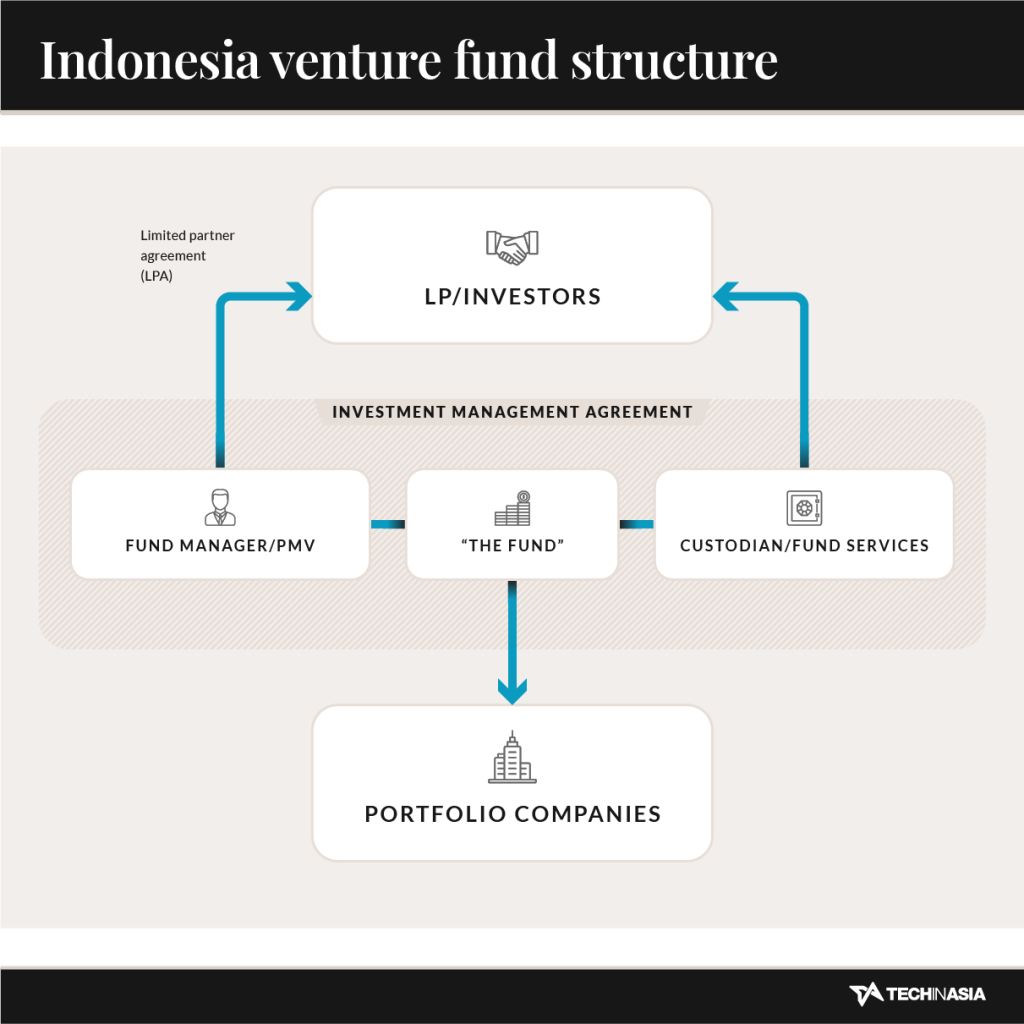
The picture above shows that the structure of venture funds in Indonesia is similar to the limited partner (LP) and general partner (GP) model, which is common globally.
Venture fund products in Indonesia even offer more security because all funds from investors are managed by custodian banks and fund admins. The fund manager focuses on the investment process and portfolio management.
Taxation for venture fund products in Indonesia
Regulatory alterations





Stay updated on the go with our mobile app.
Get latest insights with smoother, more personalized experience through TIA mobile app.