- Insights This article was written by a TIA community member. Insights pieces undergo the same rigorous editorial process that newsroom-produced articles have.
 Jay Kim · · 8 min read
How this beauty entrepreneur moved to China to find suppliers by herself
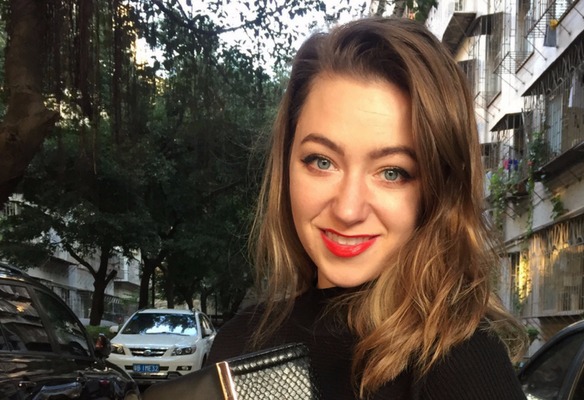
A photo of Megan Cox.
This article is part of Tech in Asia’s partnership with The Jay Kim Show where we publish the revised transcripts from the show’s podcast interviews with top entrepreneurs. This is heavily revised from the original show transcripts. For the full interview, go here.
Megan Cox is one brave entrepreneur who went straight from the US to China to solve her product’s issue. She started a beauty brand in college but struggled to find the right supplier for her products’ packaging. After graduation, she bid her parents goodbye and set off to China, where she’s been living for three years now.
In my conversation with her, Cox shared with me how she came up with her startup’s idea, her determination to find the right supplier for her product, and some interesting pieces of advice for anyone who wants to do business in China.
Here’s her story.
Who is Megan Cox?
I am a 2014 graduate of the MIT (Massachusetts Institute of Technology), and after I graduated, I decided to move to China by myself. That sounds crazy, but I’ve been here for three years now.
I have my own beauty brand, Amalie. I found factories here on the ground, so I work directly with them for my packaging. From there, I set up a consulting firm, Genie Supply, where I help other beauty entrepreneurs get started in China as well.
Was it entrepreneurship that made you move to China?
Yeah, but it was a little bit stronger than that. I started my beauty brand when I was in college, the summer before I graduated. I worked so hard to get all of the customers, but my packaging just wasn’t working, so it was kind of a last-ditch effort.
I told my customers, “I’m just going to go to China and figure this out myself. I’m going to blog about it the whole way, and you guys are going to be involved in the process. But I promise you that I’m committed to solving this issue.”
How did you come up with your business in college?
I was a cheerleader and a dancer, and I used to get eyelash extensions because I was performing all the time. I was like, “I’m just going to get the extensions and keep them on.” But they ended up destroying my natural lashes, so I wanted to regrow them.
When I looked at the products in the market—and being the nerd I am, I always looked at the research in the MIT database—I saw this big gap. I decided to take that research—which was already done by scientists, published, and peer reviewed—commercialized it, and turned it into a product.
So, my first product was called Wink, and it helped regrow lost eyebrows and eyelashes.
Were you generating enough revenue?
Yeah. I would say after my first year, I was doing over six figures, so it was enough for me to live on. But I made a lot of mistakes along the way. So, the money was enough for me to live on, be self-funded, make all those mistakes, and keep going.
How did you source the packaging from China?
Wink is housed in this aluminum tube that you twist to get the liquid to come out. I made the formulation in the US myself in the beginning. And then, I had to get the packaging here because there weren’t any factories in the US. I had to go to China.
Did you already have proof of concept at this point?
What was the experience with Alibaba like?
How was it moving halfway around the world to China?
What led you to not get back on that return flight?
What are the rising trends you see for cosmetics in China?
Do you sell any of your products into China?
What are you working on for the future?
What piece of advice could you give based on your stay in China?





Stay updated on the go with our mobile app.
Get latest insights with smoother, more personalized experience through TIA mobile app.











📅 Upcoming Events
22 October 2026
Payoneer x CSPN Summit 2026