 Stefanie Yeo · · 5 min read
How crowdsourcing and collaboration can bring new tech solutions to the market

Digitalization is shaking up businesses and industries, driving companies to reinvent and transform their operations with tech. As it is, running a business is hard work, and finding the best solutions to meet its needs is just as tricky. After all, keeping up with new technology and choosing the most suitable ones are some of the most common challenges that companies face.
On the other hand, tech startups and providers often find it difficult to get customers to co-innovate with so that they can validate their solutions – the lack of problem-solution fit and product-market fit are usually the reasons why such firms fail.
To bridge this gap, the Infocomm Media Development Authority of Singapore (IMDA) launched the Open Innovation Platform (OIP) – a tool that matches businesses with solution providers – in July 2018.
The platform
“The OIP essentially provides innovation-as-a-service to organisations who are looking to find new solutions to their digital challenges, and connects tech providers to business needs and opportunities,” says Howie Lau, the chief industry development officer of IMDA’s industry development group.
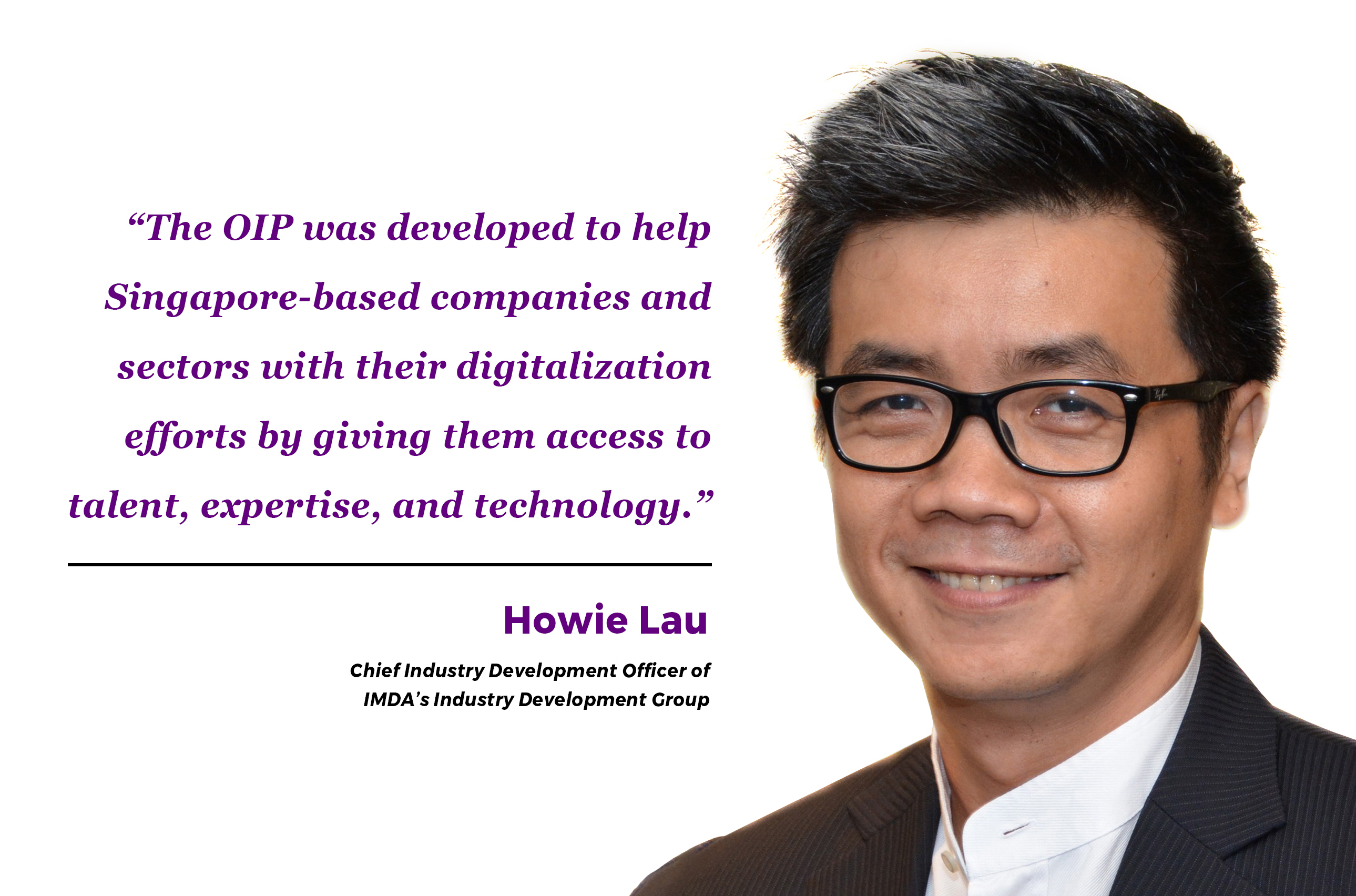
Photo credit: IMDA
It works like a crowdsourcing platform. Companies post about the digital-related problems in their businesses, and solution providers propose their fixes. After an evaluation and selection phase, which is facilitated by IMDA, a match is made.
To date, OIP has hosted about 70 challenges over four innovation calls, and has aggregated a pool of more than 4,000 solvers, primarily tech startups and small and medium-sized enterprises.
Tracking assets with IoT
An example of a partnership the platform has facilitated is one between national carrier Singapore Airlines (SIA) and UnaBiz, which offers services such as consultation for internet of things as well as the prototyping and production of smart devices.
While UnaBiz first joined OIP to find a solution to its own business issues, it later came on board as a solutions provider after experiencing the platform firsthand. This time, it was matched with SIA to conduct a proof of concept for an effective way of tracking unit load devices (ULDs), which are pallets or containers used to carry cargo on aircraft.
As the locations of ULDs around the world could only be updated manually or with electronic messaging from different parties, operational issues included a higher susceptibility to errors and delays in tracking the ULDs.
Conventional methods such as solutions that rely solely Bluetooth were too difficult to scale, too expensive, or too labor-intensive for SIA’s purposes. So UnaBiz’s solution was to combine available localization technologies and create a system that requires minimal network infrastructure and lower maintenance costs but still has the ability to reach at least 60 countries worldwide.
With a diversified range of services from product design to manufacturing, UnaBiz also taps into a wide range of skills and resources from their IoT ecosystem, such as Sigfox, the largest 0G network in the world, which was a key differentiator that made their proposal stand out from the rest.
This new global tracking solution is expected to provide SIA with better visibility over its ULD assets in near real time as they move through the various points across the supply chain, including various airports and off-airport warehouses. It is expected to be more cost-effective and energy-efficient.
Jonathan Tan, UnaBiz’s managing director, explains that through the OIP, the company was able to work closely with the airliner to identify pain points, unique operation issues, and acquire on-the-ground knowledge to produce better solutions.

Jonathan Tan, UnaBiz managing director / Photo credit: UnaBiz
“Good solutions require a synergy between the client’s business and operations knowledge and technology solutions. It’s very hard for a technology company, working on its own, to produce a market-ready solution,” Tan points out.
Boosting productivity through automation
The OIP also engineered the tie-up between digital transformation company Ent-Vision and Teho Ropes & Supplies, a provider of maritime rigging, mooring, lifting, and safety systems.
Teho was struggling with its quotation process for rope purposes to be used on vessels, which was labor-intensive and not integrated with its third-party platforms used by its customers. Teho was looking to automate the customer quotation process, taking into account the corresponding vessel’s specifications and journey pathway. This would enable Teho staff to focus on following up on quotations and building customer relationships in order to increase sales – efforts that improve margins and market competitiveness.
This is where Ent-Vision came in. Leveraging its strengths in natural language processing and machine learning algorithms, the company proposed a solution that allows the majority of standard quotations to be automatically generated for clients. This effectively allows Teho to automate repetitive manual work, freeing service staff to focus on sales and value-added customer services, and also helps the company to achieve fast response and improve sales conversion rate.
The partnership also gave Teho other insights.
“The OIP has provided us different perspectives on solving our digital challenge,” says Guy Blondé, the senior manager of corporate strategy at Teho. “We saw quite a diversity of companies offering different solutions for the same problem statement and made us realise that there are other opportunities to improve our productivity, beyond our initial problem statement and it paved the path for other potential innovative technology projects, accelerating our digitalization process.”
Ent-Vision founder and chief technology officer KH Tan believes that OIP is effective because it brings parties together who are committed to collaborate and solve real issues.
“As a startup, it is difficult to get eyes on our solution, as we do not have a large customer base or much brand recognition from the industry,” he shares. “OIP offers us the opportunity to pitch our innovative solutions to potential clients.”
Crowdsourcing and collaborating towards new solutions
Through the OIP, a diverse mix of businesses across various sectors have requested for assistance to provide innovative solutions to the challenges they face.
Singapore Press Holdings, for example, has partnered with AI startup Fake News Guard to develop a proof of concept of a machine learning-powered platform which helps the public to better assess the veracity of English-language online texts.
In the food and beverage sector, Polar Puffs & Cakes also participated in the OIP’s current innovation call as a problem owner. It seeks to address the operational challenges of managing and enhancing the productivity of its network of community bakers.
Successful applicants will receive monetary rewards from the problem owners.
Launched in 2018, the Open Innovation Platform, developed by IMDA, is a virtual platform that connects and matches problem owners with problem solvers to develop effective tech solutions. It is currently accepting applications for its fourth innovation call.
If you are interested to participate on the OIP as a problem owner, you may also fill up this form and an IMDA representative will get back to you.
For more information on the OIP, visit their website.
Stay updated on the go with our mobile app.
Get latest insights with smoother, more personalized experience through TIA mobile app.
Recommended reads
 TiDB is engineering the infrastructure for AI’s agentic future
 Southeast Asia pulls ahead of global average on AI adoption
 A solo founder’s fix for unreliable generative AI models
 A middleman model makes free patient tracking possible
 Why ‘vibe PMing’ is the future of product management
 Will cars drive the future of AI? This Chinese company thinks so
 Escaping the LLM bubble: AMI Labs goes the physical AI route
 How AI is breaking SaaS where trust matters most
 The hardware secret that gave OpenAI the edge on Anthropic
 How Speechify justifies spending more on AI tokens than salaries





Editing by Winston Zhang, Jaclyn Teng, and Eileen C. Ang
(And yes, we’re serious about ethics and transparency. More information here.)



📅 Upcoming Events
22 October 2026
Payoneer x CSPN Summit 2026