Nathaniel Fetalvero · · 6 min read
How constant innovation helped 2 Singapore-based firms thrive

Blockbuster’s decline is an important tale in the annals of technological history.
Once a big name in the video rental industry, the US-based company failed to innovate and develop new solutions to keep up with the rise of streaming services such as Netflix. Blockbuster went from having 9,000 stores worldwide in the early 2000s to filing for bankruptcy in 2010.

Photo credit: JLRphotography / Shutterstock
The moral of the story is clear: Innovation is essential to the survival of any business.
That’s a notion that Vijay Chandrasekhar, co-founder and CEO of Singapore-based solar cell startup Cosmos Innovation, is acutely aware of. The firm develops advanced solar cell technologies to enhance renewable energy efficiency and sustainability for the solar and semiconductor industries.
“We are seeing some of the most disruptive technology and geopolitical market shifts of our time,” says Chandrasekhar. “Businesses that stay nimble and rapidly evolve will be able to capture new emerging opportunities and thrive.”
Overcoming a pandemic
Chandrasekhar and his co-founder Joel Li learned this lesson early on. In the first few months of Cosmos Innovation’s launch, the company had its first big hurdle: surviving the pandemic.
“Covid-19 hit immediately after we closed our first seed round of financing with leading Silicon Valley investors,” recalls the CEO, who witnessed the seismic shifts the pandemic caused in the tech and startup world. For a startup like Cosmos Innovation, which had limited resources to fall back on in the event of a crisis, the situation could’ve easily spelled doom.
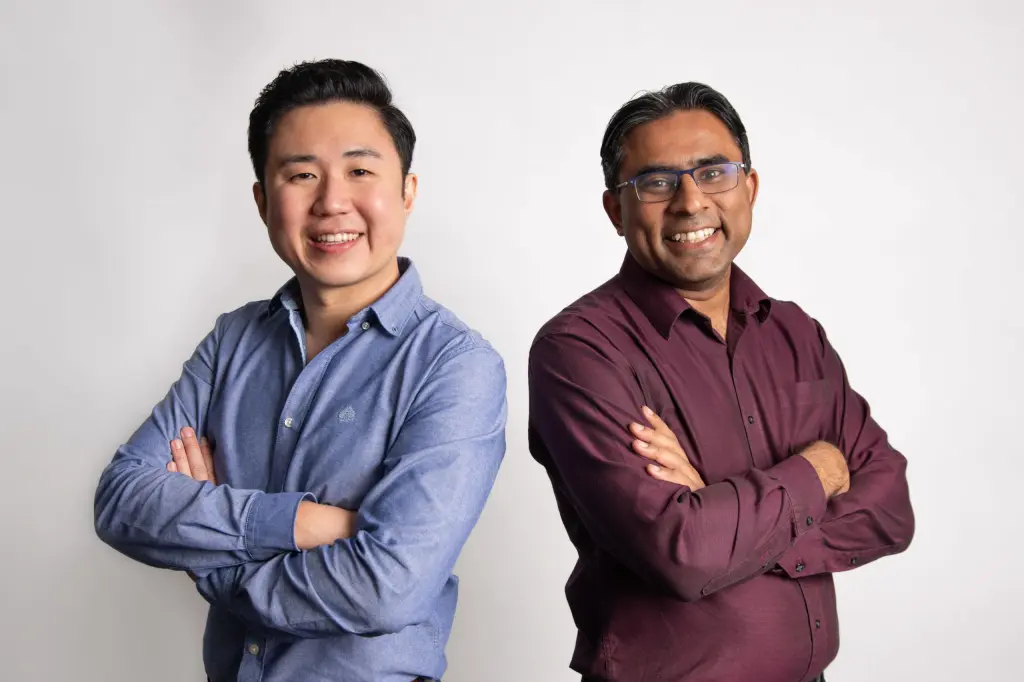
Vijay Chandrasekhar, CEO and co-founder of Cosmos Innovation (right), with co-founder Joel Li / Photo credit: Cosmos Innovation
However, amid the turmoil, Chandrasekhar also spotted an opportunity: He believed that the company needed to develop its AI process optimization platform for solar cells. He was right. With the upgrade in its tech, the firm achieved up to a 10x improvement in development time and major improvements in target performance metrics.
That said, developing the AI technology was expensive, given the time and resources required to collect proprietary data sets and build up the unique AI capabilities required.
That’s why Cosmos Innovation sought a partnership with the Agency for Science, Technology, and Research (ASTAR), a public sector agency in Singapore that aims to advance scientific discovery and develop innovative technology.
Through the agency’s Growing Enterprises through Technology Upgrade (GET-Up) program, Cosmos Innovation gained access to R&D lines and key experimental data. ASTAR’s Institute of Microelectronics also enabled the firm to build its AI process optimization capabilities rapidly. On top of this, the company could tap into a deep bench of top AI talent via the agency’s Institute for Infocomm Research.
These avenues “played a critical role in helping us build up our AI capabilities in the early days,” says Chandrasekhar.
The company’s AI proof points, which were built during its partnership with ASTAR, enabled the CEO and his team to attract a set of global investors for the firm’s series A round. Today, it counts Temasek Xora – the early-stage arm of Temasek – Innovation Endeavors, Two Sigma Ventures, DeepMind CEO Demis Hassabis, and MIT researcher Tomaso Poggio among its backers.
The firm has since transitioned to focusing on next-generation solar cells as its core product, and it’s built the world’s first self-learning fab – a factory for making advanced electronic products – in Singapore to accelerate the commercialization of these solar cells.
But Chandrasekhar makes it clear that the GET-Up program still offers vast benefits to the firm even now, particularly in areas where cutting-edge AI capabilities play a crucial role in solving last-mile engineering challenges.
Gaining global recognition
Chandrasekhar isn’t alone in understanding the importance of innovation in overcoming business hurdles. Tan Ser Hean, managing director of Abrasive Engineering, knew it was paramount to stay ahead when the company faced roadblocks in its global commercialization ambitions in 2017. The Singapore-based firm manufactures surface treatment equipment used by companies in the basic metal working industry, the electronics sector, and other segments.
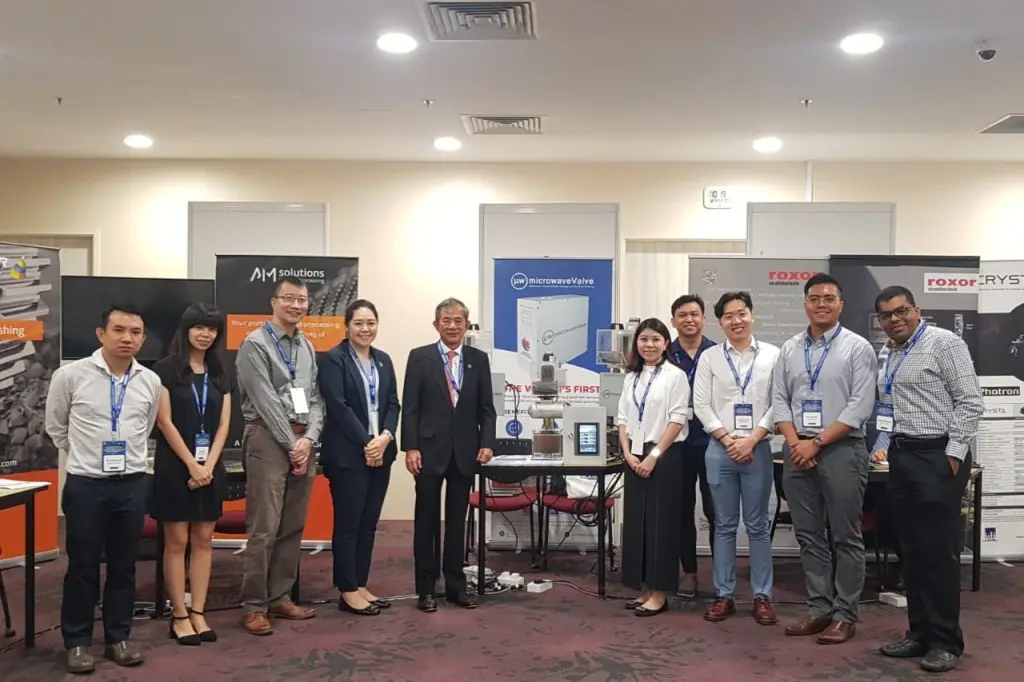
Tan Ser Hean, managing director of Abrasive Engineering (fifth from left) at an international conference in 2019 / Photo credit: Abrasive Engineering
“We encountered challenges in streamlining product development, reducing time to market, establishing credibility, and accessing funding for research and development,” explains Tan.
Seeking an innovative solution, Abrasive Engineering turned to ASTAR’s GET-Up program.
“[ASTAR’s] Operation and Technology Roadmap initiative provided us with a strategic review of our current business operations and technology capabilities,” he explains. This allowed the firm to anticipate future challenges and capture new market regions, sectors, and products.
The company was also given access to ASTAR’s research pool, cutting-edge R&D tools, state-of-the-art facilities, and crucial government funding, which allowed Abrasive Engineering to tackle its concerns head-on.
Tan says the impact can be seen in hard numbers.
“Financially, the program resulted in the generation of intellectual properties and a remarkable US$2.2 million increase in revenue within four years,” he points out. Tan adds that the company also expanded into new regions and secured purchase orders worth US$2 million for its projects.
Continuous innovation
Having made significant headway in developing its AI platform technology, Cosmos Innovation is already planning its next step in capturing the solar cell market.
“We plan to go beyond the R&D phase and scale to pilot lines, subsequently building AI-first gigafactories in the coming years,” says Chandrasekhar.
Abrasive Engineering’s Tan also revealed that the company is striving to continue with its global expansion by growing its product line.
That said, he is keenly aware of how resource-intensive Abrasive Engineering’s ambitions will be, so continuing its partnership with ASTAR will be crucial to achieving its goals.
“We strongly believe our collaboration with public agencies such as ASTAR enables us to stay at the forefront of advanced manufacturing, offering cutting-edge solutions that address industry challenges, enhance productivity, and keep us relevant in the future economy,” he says.
Click on the company logos to learn more about Cosmos Innovation and Abrasive Engineering.
Abrasive Engineering and Cosmos Innovation are just two of more than 2,000 budding businesses that ASTAR has partnered with through the GET-Up program, which last year celebrated 20 years of working with local enterprises to improve their global competitiveness.
Today, ASTAR continues to work with Singapore-based firms across all stages of development, providing them access to human capital, shared R&D resources, and technology capabilities to achieve a competitive advantage.
“The journey ahead will require building an extensive set of new capabilities, and we are excited to continue partnering with the GET-Up program and ASTAR’s research entities on this journey,” says Chandrasekhar.
The Agency for Science, Technology, and Research (ASTAR) enhances scientific innovation and technology development to boost economic growth and societal well-being, bridging academia and industry, and fostering collaborations with the research community, public agencies, multinational corporations and local enterprises for impactful outcomes in Singapore and beyond.
Its Growing Enterprises through Technology Upgrade program is a proactive integrated approach that helps boost the global competitiveness of Singapore-based technology-intensive enterprises by equipping them with the necessary skills and expertise for the knowledge-based economy.
Learn more about the GET-Up program and get in touch with the team here.
This content was produced by Tech in Asia Studios, which connects brands with Asia’s tech community. Learn more about partnering with Tech in Asia Studios.
Stay updated on the go with our mobile app.
Get latest insights with smoother, more personalized experience through TIA mobile app.
Recommended reads
 The truth about AI language models: No one wants to pay for them
 Tracking AI hiring in Singapore: OpenAI, Anthropic, and more
 Korea’s physical AI ambitions meet the factory’s bottom line
 SEA financials tracker: Moladin’s revenue rises 6% in 2025
 On‑demand services lift Line Man Wongnai’s 2025 revenue to $544m
 Flipkart’s costly late push into quick commerce and food delivery
 Inside Singapore’s government team that kills its own products
 Once an IPO hopeful, SCI Ecommerce nears collapse
 Who’s betting big on ChatGPT ads? Not Asian brands
 VC tracker: Granite Asia launches US$50 million fund





Editing by Stefanie Yeo, Winston Zhang, and Jaclyn Tiu
(And yes, we’re serious about ethics and transparency. More information here.)