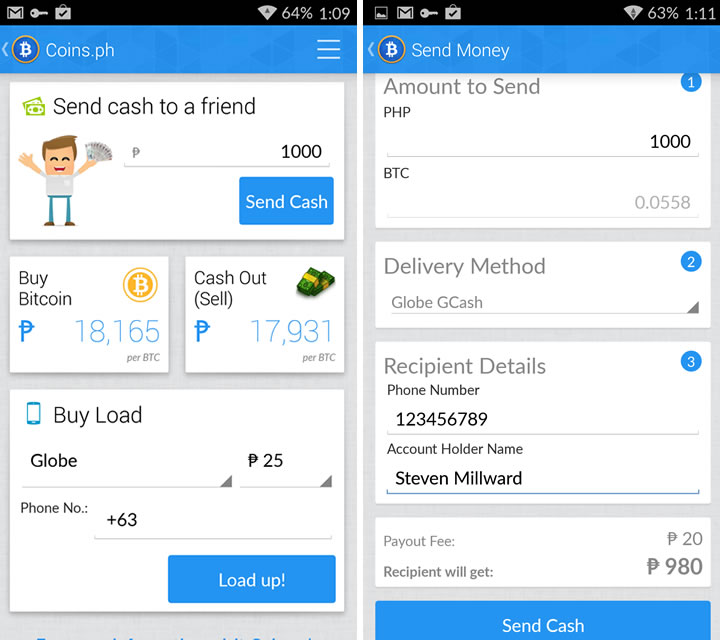
Yesterday, Coins.ph, the Philippines largest Bitcoin exchange, launched what it says is the first mobile Bitcoin wallet designed specifically for emerging markets. The new wallet allows customers to shop at online merchants who accept bitcoins, but the real emphasis is on sending cash to family and friends, paying bills, and instantly topping up prepaid phones.
“Bitcoin is used differently in different markets,” says Coins.ph founder Ron Hose. “There’s a very important difference between Bitcoin in the Philippines and Bitcoin in the US or Europe.”
Essentially, there are three types of markets for Bitcoin. In the US and Europe, Bitcoin is used as a currency and can be used to buy and sell goods and services. The second, in countries like China, Bitcoin is largely bought, sold, and mined as a speculative investment. But in emerging markets like the Philippines and other Southeast Asian countries, Bitcoin is gaining steam as a financial medium for largely unbanked populations.
Money transfers and bill payments are major pain points that Bitcoin solves for the 75 percent of the Philippine population that remains unbanked. With the new wallet, Hose says users can avoid the long lines at banks and high fees that come with over-the-counter remitters like Western Union.
See: 12 Philippine companies that should really start accepting Bitcoin
Leaving banks out of the equation
The remittance service is especially useful for the country’s huge number of freelancers, who often receive wages from overseas. International incoming transfers amounted to US$23 billion in 2013 and domestic transfers reached as high as US$60 million, Hose says. Using the Coins.ph wallet, that money can be sent from anywhere in the world and be picked up the next day at those retail stores, delivered door-to-door, or deposited into 24 different banks. No bank account needed.
The app also allows for cash-to-cash remittances, which allows the user to initiate a remittance in the app and then deposit cash into a Bitcoin ATM to fund it. The ATM prompts the customer to scan the app’s QR code, and the transaction is instantly complete. The bitcoin exchange rate is locked in, so the cryptocurrency’s price volatility is irrelevant.
That’s an important factor when Coins.ph tries to get the public to trust in the complex Bitcoin network. “It’s not important what Bitcoin is,” Hose says. “What’s important is what it does for you.”
He’s confident Bitcoin can take off and make a real difference in the Philippines and beyond. The startup is now going strong in Thailand as well, although it can only operate in Baht according to local law, cutting off international remittances. Hose says he’s looking at Malaysia and Indonesia as potential markets in the near future. He points to Facebook as proof that Southeast Asians are open to adopting international trends.
“Facebook has 92 percent market penetration [in the Philippines]. It’s higher than all traditional banks, and it doesn’t have a single branch in the country.”
The Coins.ph wallet is available for free on Google Play.
Editing by Steven Millward
(And yes, we’re serious about ethics and transparency. More information here.)





Stay updated on the go with our mobile app.
Get latest insights with smoother, more personalized experience through TIA mobile app.