Rita Liao · · 6 min read
How Alibaba’s Dingtalk became China’s largest enterprise messenger app with 100m users

Alibaba’s Dingtalk app now boasts of 7 million enterprise clients – including the Chinese police. / Photo credit: Dingtalk
Tencent’s WeChat has become the default messaging app of everyday life in China, but there’s one territory that it has yet to conquer: the workplace.
There’s a list of reasons why WeChat might not be the best tool for work. Take file transfers, for example: it only allows files under 20MB to be sent among users.
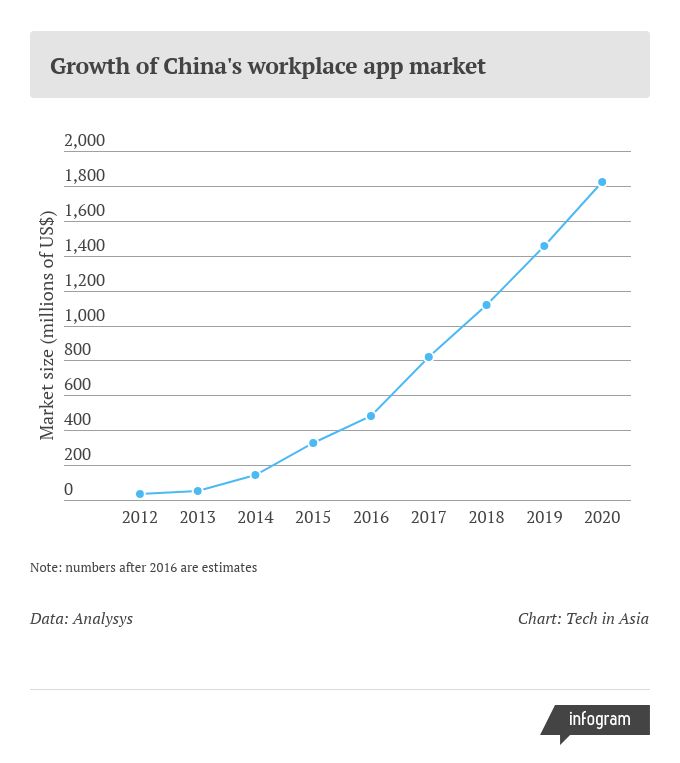
Meanwhile, Tencent’s archrival Alibaba – an unlikely candidate for blockbuster social apps because of its focus on retail – has quietly grown Dingtalk into a dominant player in China’s US$1.12 billion market for workplace apps. Launched in late 2014, Dingtalk counted 7 million enterprise clients in June and surpassed 100 million registered users last December, according to an internal message that CEO Chen Hang sent to his staff.
 Like WeChat, which has branched out to offer a host of services spanning ride-hailing to hospital queuing, Dingtalk isn’t just for text messaging.
“Enterprise software-as-a-service belongs to the PC era,” Dingtalk vice president Zhang Sicheng told Tech in Asia recently at TechCrunch Hangzhou. “Your entire company is run on the internet today.”
The idea is that in the future, people will do much of their work from inside the chat app. This could include basic tasks like file sharing, as well as other functions that weren’t traditionally handled by enterprise apps – such as booking business trips and procuring office stationery.
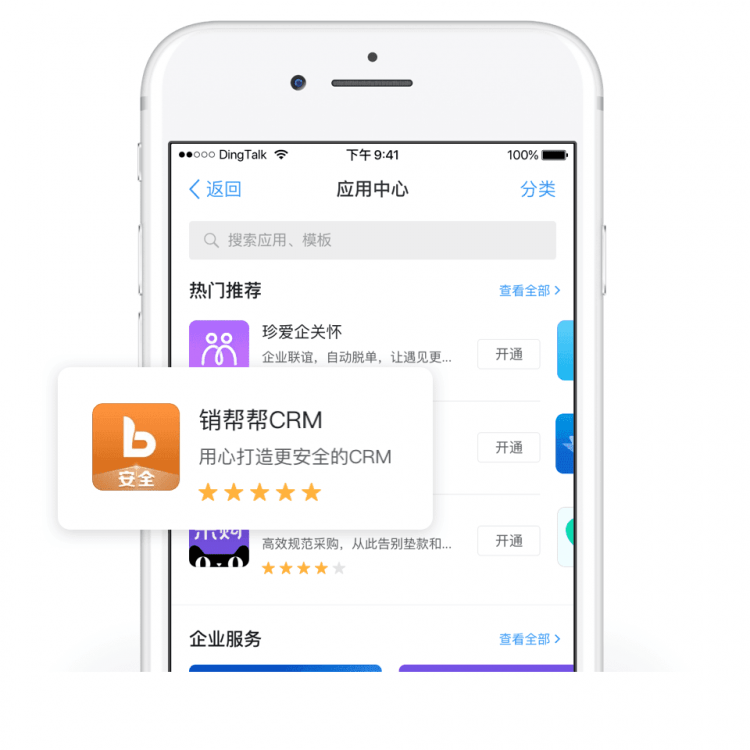
Dingtalk’s app store features third-party providers that offer everything from customer relationship management to matchmaking services. / Image credit: Dingtalk
Like Alibaba’s other services, be it ecommerce marketplaces Taobao and Tmall or logistics network Cainiao, Dingtalk adopts an “asset-light” approach that brings third-party suppliers onto its platform. The app still runs some of the core functions in-house – messaging being one – but it doesn’t want to do everything itself.
“Enterprise security, for example, has become in demand these days. But Dingtalk isn’t going to provide the service. Our partners are,” says Zhang.
Dingtalk’s app store features third-party providers that offer everything from customer relationship management to matchmaking services.
Failed attempt to challenge WeChat
It may be tempting to see Dingtalk and WeChat as rivals because messaging lies at the core of both, but the former wasn’t designed to take on the latter. Workplace activities are, for the most part, separate from personal ones. People booking a hotel room for vacation may not bother getting a receipt as they would if they were booking it for a work trip.
Quiet ascent





Stay updated on the go with our mobile app.
Get latest insights with smoother, more personalized experience through TIA mobile app.