- Premium Content It takes our newsroom weeks - if not months - to investigate and produce stories for our premium content. You can’t find them anywhere else.
 Jum Balea · · 7 min read
A closer look at Gojek’s huge growth numbers
Indonesia’s homegrown behemoth Gojek in February revealed that it recorded over US$9 billion in annualized transactions for all its business segments by end-2018. The figure has been widely cited as an indication of Gojek’s scale, but how exactly is it calculated?
Tech in Asia has obtained Gojek’s 2017 financial data that sheds some light on how the company approached its transaction figures then and what this means for its more recent numbers.
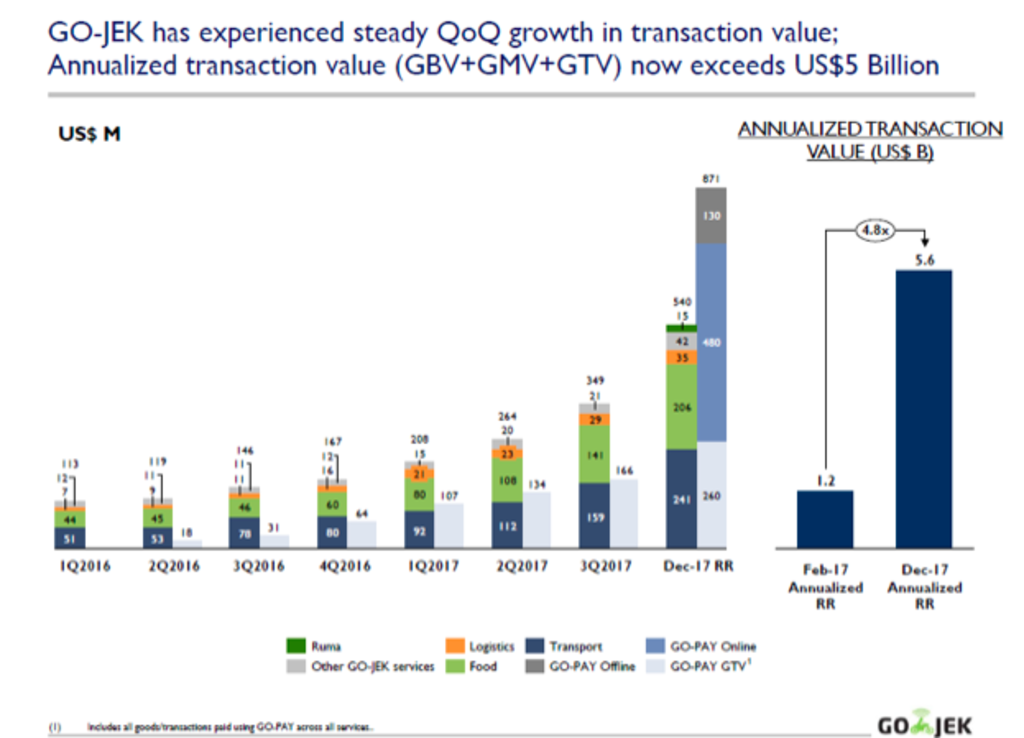
In the slide, Gojek said it achieved US$5 billion in annualized transaction value by end-2017 (let’s call it “ATV”), which was derived by summing up its Q42017 run rate figures (US$540 million + US$871 million) and extrapolating them to a whole year.
The three components of ATV are as follows:
- Gross booking value (GBV), for its transportation and logistics services
- Gross merchandise value (GMV), for its food delivery service
- Gross transaction value (GTV), for its payments service
Where it gets complicated is that it added GTV (right-hand column), which includes transaction values of Go-Pay and two leading Indonesian payments firms it acquired in December 2017. Specifically, the GTV’s components are:
- Go-Pay GTV – all transactions paid using the e-wallet across all Gojek services (as noted in the slide)
- Go-Pay Online – transactions processed by Midtrans, a payment gateway that handles payments to thousands of online merchants in Indonesia
- Go-Pay Offline – transactions processed by Kartuku, which handles offline payments to merchants
Its method of counting ATV as used in 2017 appears to allow for the possibility of double counting. It raises a question: why were the transport, logistics, and food bookings processed by Go-Pay counted as an additional set of transactions?
To answer this, a person familiar with the document told Tech in Asia that the chart was designed to show the effect of acquisitions on Gojek’s existing payments business. As such, one should not draw parallels between the US$5 billion ATV and the US$9 billion figure that Gojek reported for end-2018.
A more consistent approach would be to focus on the left-hand column for transport and other businesses rather than the right-hand column. If we do this, we end up with US$2.16 billion in annualized bookings in 2017, which was what customers spent on rides, food orders, and other Gojek services. That means the number for end-2018 represented over 4x year-on-year growth.
That also means that the acquisitions were most likely a big driver of Gojek’s overall growth in 2018.
Post-acquisitions, Go-Pay launched payments outside of the Gojek ecosystem, becoming a key client of Midtrans and Kartuku. Go-Pay is now used by third-party online merchants as a payment method, and offers QR code for in-store payments.
Questions remain
It’s important to note that as of the beginning of 2018, Gojek changed its definition of GTV. GTV no longer just refers to payments but all of Gojek.
Numbers other players use
Better prospects ahead?
Stay ahead in Asia’s tech landscape
This is premium content. Subscribe to read the full story.
Tech in Asia obtains the Indonesian firm’s financial data that sheds light on how it calculates its key metric.
We know this is not ideal. ⌛ Sign up in 20 seconds. Cancel anytime.
Our subscriber community includes professionals from these companies:





Stay updated on the go with our mobile app.
Get latest insights with smoother, more personalized experience through TIA mobile app.