Kylee McIntyre · · 4 min read
In the heart disease capital of the world, a new wearable plays it close to the chest

Photo credit: szefei / 123RF.
You awake to commotion – your mother’s woken up in the middle of the night and is having trouble breathing. She struggles to sit up, holding her hand to her chest. You rush her to the hospital. As you hold her hand, you can feel her pulse racing – all symptoms of an incredibly quick heartbeat. When you both get there, she feels fine. She can walk around and speak to you. Every reading turns up normal. This is the third time this has happened this month.
You’re ready to go home and dread it at the same time – you know this is going to happen again.
This time’s different, though. A doctor hands you a triangular device with little sticky cups on the back. If this happens again, he says, come back, but stick this under her collarbone before you get here.
Two weeks later, you and Mom are on another run to the hospital. This time, when you get there, the doctor’s ready with a printout. “I know what to do,” he says.
This is how medical hardware startup Ten3T was able to help a patient in Delhi, India, recently.
Once stuck on the body, Ten3T’s wearable monitoring device, Cicer, can measure ECG (electrocardiogram, or your heart rhythm), heart rate, blood oxygen, and temperature. It’ll analyze those in real time and have a report ready in 30 seconds. Physicians can then know what’s happening, even if they’re not with the patient at the time.
Clinical beginnings
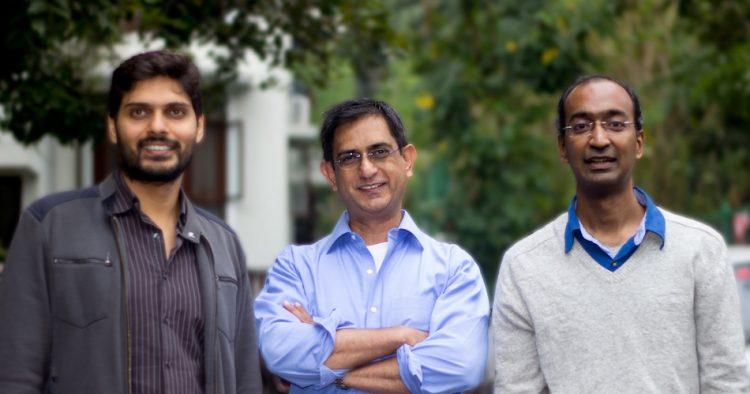
Ten3T’s co-founders. Photo credit: Ten3T.
A heart beats an average 103,000 times per day, hence the name Ten3T (10-3-thousand), an indication about how serious the startup is about marrying medicine to tech. After getting his medical degree, Dr. Sudhir Borgonha, co-founder of the Bangalore-based startup, went to MIT to study management. He has worked at hospitals in the US and served in executive and clinical research roles in India, the UK, and the US. Over time, he realized there was a huge space in medical tech that startups could fill.
Tech in the average clinic today would be great for the 1970s – but it’s pitiful today.
“Tech and medicine have to interface a lot more,” he tells Tech in Asia. Tech in the average clinic today would be great for the 1970s – but it’s pitiful today. People in the community assume it’s only Johnson & Johnson or Philips who get to build medical gizmos.
Sudhir experienced regulatory problems with his last company, and then started Ten3T with his newfound knowledge. With Rahul Shingrani and Prasad Bhat, he began developing Cicer two years ago with the aim of creating a medical-grade device that could be used to help patients. Cardiac health, especially in the heart disease capital of the world, was an obvious place to start.
Self-funded for two years, the startup raised seed funding in December from Pi Ventures and angel investors. Pi Ventures focuses on companies implementing machine learning, AI, and Internet of Things (IoT) in their ideas.
Critical care





Stay updated on the go with our mobile app.
Get latest insights with smoother, more personalized experience through TIA mobile app.