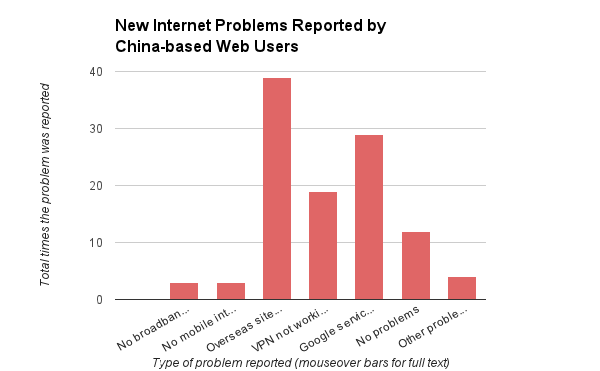
Beijing takes the 18th Party Congress (the once-a-decade leadership transition) pretty seriously. And since this year it’s worried about everything from ping pong balls to boats, it’s probably no surprise that the government is taking the internet pretty seriously too. Last week, I wrote a story about what appeared to be new interference with the internet, and we were surprised by how many readers commented that they were experiencing internet problems, too. So we dug a little deeper using Google and Weibo surveys (you can still submit your own response if you haven’t; we’d love to keep adding to this data set) and discovered that among our first 40+ respondents, virtually everyone is having problems:
(Users in China who can’t see that graph can click here to view a non-interactive image version)
Users could select as many issues as they were experiencing, so the graph above indicates the total number of times each problem was reported. And we specifically asked users what has changed about their internet recently, so although (for example) overseas sites can be slow all year round, our user responses here indicate that they are slower than usual, slow enough that users noticed a change.
It’s clear that most people aren’t experiencing a total internet blackout, but VPNs not working, and Google services not working all seem to be fairly common issues. Moreover, it seems that overseas sites loading more slowly than usual is a nearly universal issue, and many users also reported frequent disconnections when attempting to connect to overseas sites. Users in Beijing and Shanghai seemed to be most affected, with several users outside those two cities reporting no issues.
Now, obviously this is a highly unscientific poll with a small sample size and a self-selecting audience. But it seems pretty clear at this point that Beijing is indeed messing with the internet, with an apparent special emphasis on making overseas sites and blocked sited difficult to access. That’s probably not a surprise, especially given the recent reports in the Western press about the immense personal wealth of several of China’s top leaders. But it looks like readers in Beijing and Shanghai are in for a rough November. Hopefully, things will return to ‘normal’ once the leadership transition is complete.





Stay updated on the go with our mobile app.
Get latest insights with smoother, more personalized experience through TIA mobile app.