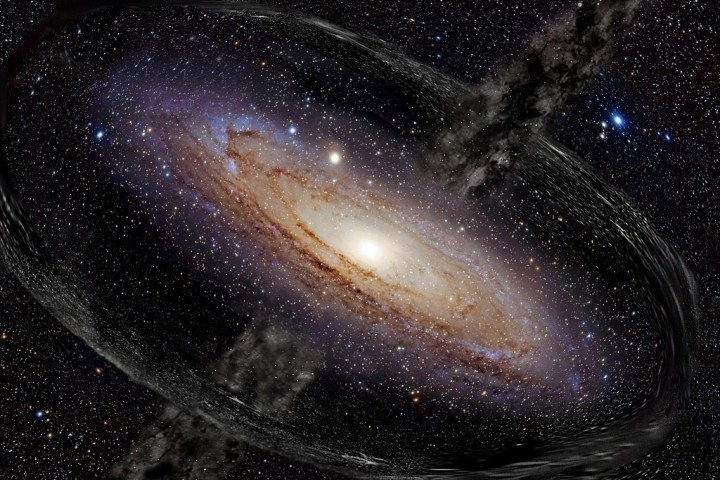
Image by Maxwell Hamilton
Scientists in China announced Tuesday that the country’s space-based search for dark matter has officially begun. Wukong, a Chinese satellite launched last week to search for evidence of dark matter, is successfully communicating with earth.
Wukong is officially called the Dark Matter Particle Explorer, but it takes its more-popular nickname from the iconic Journey to the West character. The satellite is the first in a series of five space science satellites China plans on launching, and its mission is to detect high-energy particles and y-rays that might be seen as evidence of the existence of dark matter.
Dark matter is a theoretical form of matter that has thus far proved unobservable, but scientists think it probably accounts for most of the mass of the universe. When observing the galaxy, physicists have noted that gravitational effects often seem to suggest the presence of far more mass than is apparent in the observable matter (stars, gas, rocks, etc.) we’d expect to be causing gravity.
The existence of dark matter would explain this discrepancy, but dark matter – if it does exist – isn’t visible with telescopes and doesn’t emit light or radiation. Scientists think it’s likely made mostly of a new type of subatomic particle, and that it could be shooting off particles or producing y-rays, so the Wukong satellite is designed to detect those. Information it collects, when combined with data from other equipment searching for dark matter (like the Alpha-Magnetic Spectrometer on the International Space Station) could confirm some of scientists’ theories about dark matter.
Or it could do nothing at all. Since science has yet to successfully find dark matter, it is impossible to know what might be most effective in detecting it.
Still, the Wukong satellite is an ambitious attempt by China’s space program to probe the unseen depths of the universe for answers, and it won’t be the only one. In June, China plans to launch a satellite that will test whether quantum entanglement can be used over such great distance to effectively “teleport” information from one place to another instantaneously.





Stay updated on the go with our mobile app.
Get latest insights with smoother, more personalized experience through TIA mobile app.