Peng T. Ong · · 5 min read
Why Southeast Asian companies are missing some of the best opportunities in tech
This article is co-authored by Helen Foo.

Photo credit: The Daily Dot
The rapid rise of entrepreneurial technology talent in Southeast Asia in recent years has been remarkable, but the long-standing issue of there being too few women in the industry means female participation and the value they create have clearly not reached full potential.
Technology companies are missing out on these opportunities, and we think it is a problem that, if not handled properly and promptly, will harm the industry in the long run.
This underrepresentation of women in science, technology, engineering and mathematics (STEM) jobs is a global problem, recent data from the Unesco Institute of Statistics shows. Globally, less than one in three researchers in these fields worldwide is female. Researchers are defined as professionals engaged in the creation of new knowledge, products, and systems, among other things, as well as in the management of STEM projects.
The situation in Southeast Asia
But the problem is more acute in this part of the world: only 23 percent of STEM researchers in East Asia and the Pacific are women. In South and West Asia, the proportion lowers to 19 percent.
We have picked out relevant data for Southeast Asian countries to show the variation within the region, as, for instance, only 20.7 percent of science researchers in Cambodia are female, while the percentage in Myanmar is almost 86 percent. In general, we can see in the bar chart below that only a handful of countries in Southeast Asia have achieved gender parity. Gender parity is achieved when 45-55 percent of employees in these positions are female.
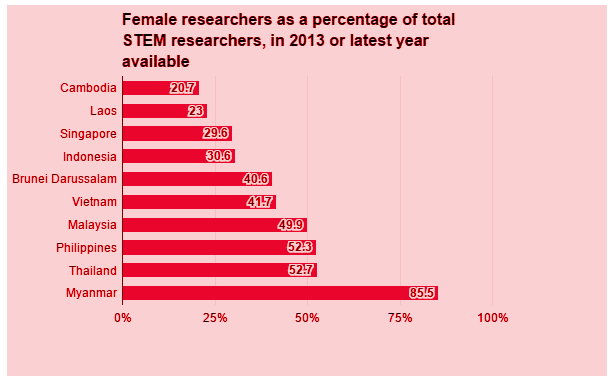
Data source: UIS Factsheet Nov 2015
Even though the above statistics seem to reflect a high involvement of females in science in Myanmar, a United Nations report suggests that the vast majority of tech startups in Myanmar are run by men, with only a handful of female entrepreneurs.
Shifting labour market in favour of jobs in the STEM fields
In addition, considering how the world economy and labour markets are being shaped and will likely be shaped in the future, we have no grounds to be be optimistic.
A recent World Economic Forum (WEF) report suggests that the world economy will lose over 5 million jobs by 2020, as automation and a general trend to cut out middlemen will take its toll on 15 major developed and emerging economies. On top of that, the report – called the Future of Jobs – highlights that a rising number of jobs will come from STEM fields, where women are grossly underrepresented. The rise in availability of jobs in these areas is outpacing the rate by which women are currently entering these technical jobs.
This puts women “at risk of missing out on tomorrow’s best job opportunities and aggravating hiring processes for companies due to a more restricted talent pool”, said the report, which surveyed chief human resources officers from the 100 largest global employers in the 9 industries surveyed.
Female leaders and business profitability
Having women in the highest corporate offices is correlated with increased profitability, according to a new study of nearly 22,000 publicly traded companies in 91 countries. An increase in the share of women from zero to 30 percent in top management positions would be associated with a 15 percent rise in profitability, it said.
Effect of education on grooming females in STEM fields





Stay updated on the go with our mobile app.
Get latest insights with smoother, more personalized experience through TIA mobile app.