Guest Contributor · · 3 min read
Why companies shouldn’t use someone else’s terms of service as their own
All of you would have heard of the furore over the change in Instagram’s terms of use last December, and many pixels have been burnt over it.
With the exception of law geeks like me, most individuals wouldn’t bother to read the terms of use/service because they are usually composed of incomprehensible legalese. Understandably, people only start paying attention when there is a controversy. However, whether you are a startup or a user, I think it is important to comprehend what you’re signing up for, or what kind of terms would your startup need.
It is getting easier to do so as most large web services these days usually have their terms written in plain English. Google, Facebook, Twitter, Github are good examples. Others such as Yahoo! and LinkedIn have a more “traditional” format. I find that Terms of Service; Didn’t Read (TOS;DR) is a very helpful resource which distills the key features of each terms of use from various online services.
The site goes, “‘I have read and agree to the Terms’ is the biggest lie on the web. We aim to fix that.”
What not to do
I recently chanced upon an interesting app called Jam, which is made by Dreamwalk Pty Ltd, an Australia-based company. You pick a genre of music, sing whatever you want into the app, and it autotunes your voice along with backing instruments to generate a somewhat polished song in the genre of your choice.
The app is pretty cool but I noticed the following in its terms of use:
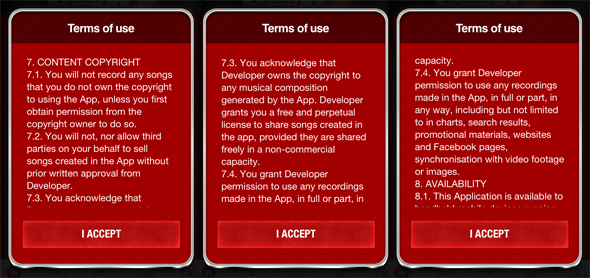
Clause 7.1 is reasonable because that’s a standard practice for any service to protect itself from liability. The real mind-boggling terms are 7.2 and 7.3.
Essentially, they require you to perform only your own original compositions, AND that they own anything you record using their app, AND they are also free to use your performances in data analytics. Draw your own conclusions about the nature of their business model.
Best practices
Startups do not have the luxury of ignoring their terms of use, or simply “borrowing” them from somewhere else online. Copying and pasting is dangerous and can easily expose your fledgling service to liability. Twitter made this very mistake when they adopted their initial terms of service from Flickr, without tailoring the terms to their specific requirements.
You will have to think very carefully about your business model and whether your terms of use/service addresses the legal issues that may occur.
Do you sell physical goods or virtual goods? Do you use a third party carrier or do you have your own delivery service? Are you a platform that facilitates transactions, or is your revenue from the provision of services? Do you have advertising? Do you collect personal information?





Stay updated on the go with our mobile app.
Get latest insights with smoother, more personalized experience through TIA mobile app.