- Insights This article was written by a TIA community member. Insights pieces undergo the same rigorous editorial process that newsroom-produced articles have.
 Gen Ping Liu · · 4 min read
Mapping Singapore’s ‘fintech + AI’ landscape
Singapore has become the regional fintech hub in Southeast Asia. In recent years, artificial intelligence has also gained significant traction in the financial sector, given the treasure trove of data available and its pervasive impact on the industry.
We at Vertex Ventures believe that the confluence of fintech and AI – what we call “fintech + AI” – presents a major opportunity for the transformation of the financial sector, affecting every part of the user’s journey and further enhancing Singapore’s lead as the regional fintech hub.

Photo credit: Lenny K Photography
Defining fintech + AI
It won’t be easy to define the boundaries for fintech + AI startups. If viewed as a spectrum, there are two generic types of startups at the extremes. At one end, there are AI-intensive startups that focus on providing technology or services to help financial institutions (FIs) transform into AI enterprises. At the other end, there are the AI-light startups that combine the power of AI with business model innovation to compete head-on with traditional FIs.
I always look at the full spectrum to understand how AI can help FIs or aid startups competing with them. In general, startups can be classified into a few categories:
- Those who focus on achieving “alpha” status (seeking above-market returns)
- Firms that assist with lending activities (similar to achieving alpha status, but in the lending space)
- Those who want to achieve “beta” status (generally companies that help personalization while at least achieving market returns)
- Companies that manage risk (regulation and compliance-related startups)
- Those seeking a position as a general tech provider that can help to achieve any of the above
- A segment that enables front-end customer relationship development and management (since these can be quite general, I have placed them in the last bucket)
An overview of fintech + AI startups in Singapore
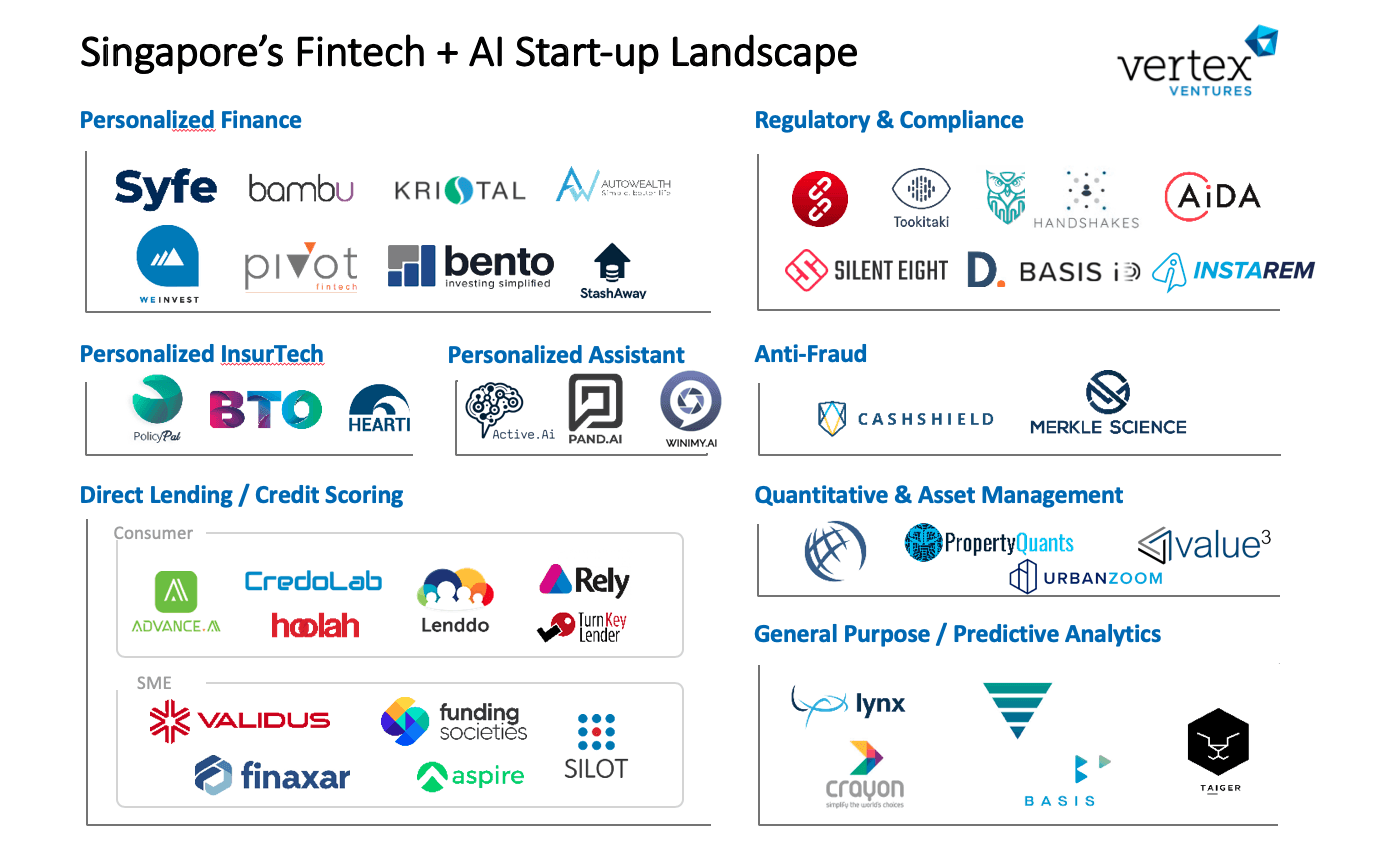
Photo credit: Vertex Ventures
Based on my research to date, there are about 40 fintech + AI startups from the AI-light to AI-intensive. They can be categorized into these segments for ease of understanding:
- Personal finance. This segment, especially the robo-advisory category comes out on top as the most active. This is related to Singapore’s position as the region’s wealth management hub and one of the world’s leading finance centers. This is indeed a real opportunity for the developed Singapore market, but regional adoption remains nascent as most emerging markets require time for its people to understand the concept of wealth management. Cracking the code for educating and onboarding the populace in emerging markets will offer significant opportunities.
- Regulatory, compliance, and fraud detection. This comes in as the second most active category. This is because regulatory compliance, especially in anti-money laundering, has always been the top concern in Singapore. Leveraging AI to improve accuracy while lowering compliance costs naturally becomes a priority. Going forward, the key challenge lies in addressing the different customization needs of different FIs.
- General purpose/predictive analytics. As a general category, this segment comes third – a reflection of the strong technology talent pool in Singapore and the potential, sizeable opportunities to serve FIs or other industrial sectors.
- Credit scoring/direct lending. While lending to small and medium-sized enterprises has attracted much attention in Singapore since 2016, consumer lending remains relatively muted. The sector has gone through a mania phase in other ASEAN countries, especially Indonesia with over a few hundred lending players in 2018. But it is no surprise that this remains a small category in Singapore, given the country’s well-established banking/lending system and robust regulatory oversight. Many people may also be unaware that consumer lending is regulated by the Ministry of Law rather than the Ministry of Finance in Singapore. It’s also only recently that the regulations in the space have been relaxed.
- Quantitative and asset management: This is perhaps the most interesting sector for many in terms of generating a direct return, but it is among the most difficult sectors to crack (as seen in the billions of dollars invested by Wall Street firms). I believe the private asset sector thesis remains an interesting one, as regional startups do have their advantages when it comes to local data access.
The above is intended to serve as an overview for the fintech + AI sector in Singapore. It’s not a complete landscape mapping, and any suggestions/comments on missing startups are welcome.
Singapore as the regional leader in fintech + AI
Singapore has many attributes that give it an advantage in developing its fintech + AI space: the heft of its financial sector, a deep fintech talent pool, and significant initiatives to build its AI capabilities and cluster.
In addition, Singapore’s regulator, the Monetary Authority of Singapore (MAS), has adopted a very open mindset and takes an active approach in driving industry development. The department is willing to embrace innovation, establishing funds to help FIs pilot test different technologies, encouraging a risk-taking mindset.
MAS only intervenes when risks are deemed excessive. It also has initiatives to drive certain key AI research directions such as explainable AI or federated AI, and to encourage the financial industry to open up their infrastructure, although this remains a key challenge.





Stay updated on the go with our mobile app.
Get latest insights with smoother, more personalized experience through TIA mobile app.