 Steven Millward · · 2 min read
China’s Didi now sees 10m daily rides. That’s way more than Uber’s global 2m
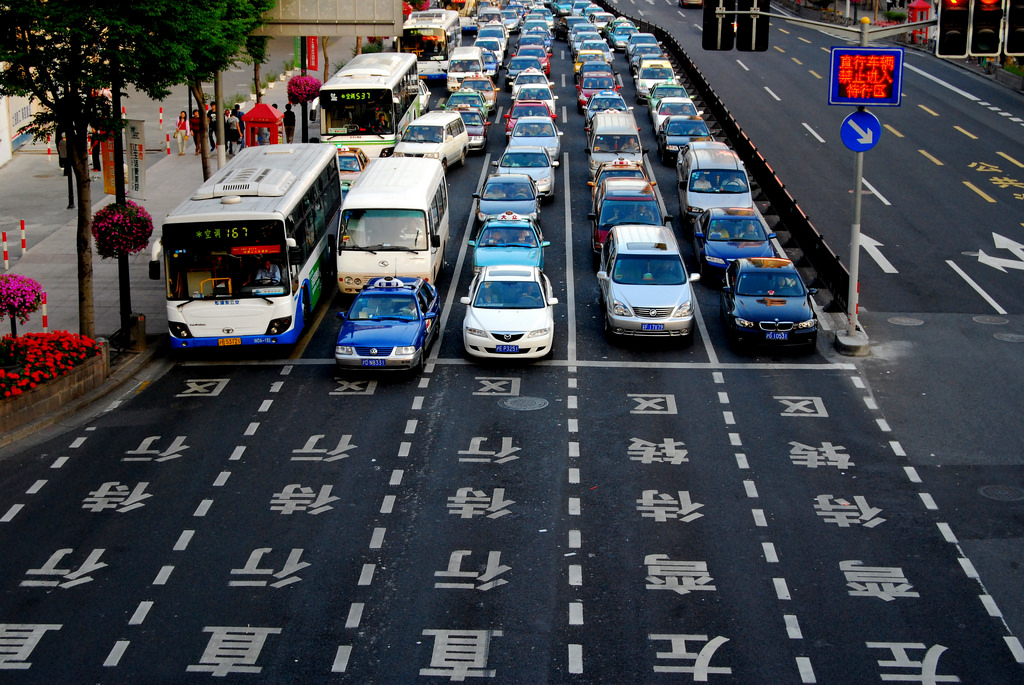
A junction in Shanghai. Photo credit: Carlos ZGZ.
China’s homegrown ride-hailing app Didi Kuaidi is now seeing 10 million rides each day, the startup said today. That’s up from six million daily rides in September. Didi connects riders with taxis, Uber-esque private cars, and even commuter shuttle buses.
It’s about the same as daily passenger traffic on Tokyo’s subway.
In Beijing and Chengdu (which Uber said last year is its top city) alone, the app “exceeded 1 million rides per day,” said a Didi statement.
Didi claims that figure means the popular app – Uber’s arch-rival in the country – is second only to Alibaba’s Taobao in terms of the number of online transactions.
Ten million rides per day also represents “eight times that of the daily rideshare traffic in North America and approximating the peak daily passenger volume on China’s national railway system during the 2016 Spring Festival.” That’s Chinese New Year. It’s about the same as “daily passenger traffic of the world’s busiest subway in Tokyo,” it added.
Uber last revealed its global daily tally in September when it was doing two million per day.
See: Didi Kuaidi completed 1.4 billion rides in 2015
Hitching a ride
Didi also hailed the growth of its carpooling option, first rolled out three months ago, which allows riders to opt to share the car with a random person in order to reduce the cost of the fare. The ride could be up to 60 percent cheaper.
Shared rides now account for 1.57 million of its daily total even though the feature is available in just 15 cities – not the 400-odd cities that the rest of the app covers.
Carpooled rides make up 1.57 million of Didi’s daily total.
Didi claims that carpooling has kept its drivers more active, allowing them to increase income by 30 to 40 percent.
At present, about half of all passengers requesting a car opt into carpooling, if one is available. “Carpooling rides require ten times more computing resources than non-carpooling rides,” said the Beijing-headquartered startup.
While Uber doesn’t cover as much ground in China as Didi, the US-based startup claims it’s growing fast and rivalling Didi in terms of private car rides. Uber is now available in 22 mainland Chinese cities, which will soon expand to 55 as it experiments with province-by-province expansion.





Stay updated on the go with our mobile app.
Get latest insights with smoother, more personalized experience through TIA mobile app.









📅 Upcoming Events
22 October 2026
Payoneer x CSPN Summit 2026