Guest Contributor · · 12 min read
Overview of Angel Investing in Singapore

Angel investor and professor Dr. Wong Poh Kam here provides an overview of the angel investing scene in Singapore. An extended version of this article will appear as a chapter in a forthcoming book on Angel Investing in Asia, edited by John Lo.
As in other newly industrialized economies in Asia, business angel investing in early stage start-up companies has been relatively new in Singapore. This is due to the fact that the phenomenon of high tech start-ups is itself relatively new in Singapore, having really taken off only since the late-1990s as the Singapore economy began its shift towards a knowledge-based, innovation-driven economy. While business angel investment deals are known to have existed in the 1980s and early 1990s, they were mainly in the traditional trading and manufacturing sectors, as was found in a study of 29 angel investors.
While there are no reliable statistics on the number of business angel investors and their contribution to venture investing in Singapore, some indicative figures can be culled from the annual Global Entrepreneurship Monitor (GEM) study on Singapore that I conducted for the period 2000-2006.
Informal investments
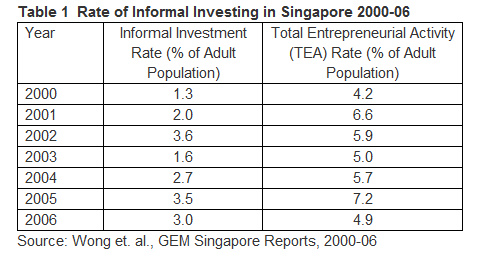
As can be seen in Table 1, based on the Global Entrepreneurship Monitor (GEM) study, the prevalence of informal investment (Informal investors are defined as those who have in the past three years invested in an entrepreneurial business venture started by someone else, excluding the purchase of publicly traded shares or mutual funds) in Singapore appears to have increased over 2000-06, with the informal investment rate rising from 1.3% of the adult population to a high of 3.5% in 2005, before falling slightly to 3.0% the following year. Nevertheless, this was still below that of advanced economies such as USA and other Asian NIEs such as Taiwan, China and Korea.
Table 1 also shows that the informal investment rate is somewhat correlated with the rate of entrepreneurial activity in Singapore, as measured by the total entrepreneurial activity (TEA) rate (The Total entrepreneurial rate (TEA) rate measures the proportion of a nation’s adult population that is engaging in entrepreneurial activities in one of two ways: in the process of starting up a business or running a newly formed business less than 3.5 years old with significant ownership).
Several studies of advanced economies (see e.g. Wetzel 1983; Bygrave et al 2002) have estimated that the total amount of informal investment is several times the size of the formal venture capital (VC) industry. Based on GEM estimates, Singapore is no exception. The relative size of the informal investment market in Singapore is estimated to be several times larger than the market for formal VC investments. Although informal investment as a proportion of GDP has fallen over time, from 2% of GDP in 2000 to just over 1% in 2006, it nevertheless far outweighs the amount of venture capital (VC) investment, which has generally been less than 0.2% of GDP from 1999 to 2005.
The GEM data suggest that the majority of informal investments in Singapore were based on social ties. About 42% of informal investors in Singapore were related to the investees, with another 52% being social acquaintances (work colleagues, friends or neighbours), leaving only 6% to be socially unrelated (strangers or others). If we regard this last category to be true business angel investors, then the incidence of such business angel investors is probably in the range of 1 in 1000.
Development of the Business Angel Investment Community: From Individuals to Groups and Networks
The Early Growth of Business Angel Investment
While there are no reliable data on the emergence and growth of business angel investors in Singapore, anecdotal evidence suggests that the first major wave of angel investment in technology companies emerged in the mid-1990s, after a number of indigenous technology/manufacturing companies successfully went IPO. Some of these successful entrepreneurs subsequently became business angel investors, funding the next wave of technology-based start-ups that emerged in Singapore as part of the global dot.com boom. For example, the three co-founders of Creative Technology, arguably the first successful home-grown high tech firm in Singapore (having pioneered PC soundcard and became the global market leader), had all engaged in angel investment activities after the company went IPO in 1994, with one of them (Chay Kwong Soon) establishing a formal investment fund (Enspire Capital) to do so. Other examples of successful technology entrepreneurs-turned angel investors in the late 1990s include Gay Chee Cheong and Tommy Goh. After leading a contract manufacturing firm, JIT Electronics, to successful IPO and subsequent acquisition by Flextronics in the late 1990s, they co-founded a venture investment fund, 2G Capital, to invest in technology start-ups and growth companies.





Stay updated on the go with our mobile app.
Get latest insights with smoother, more personalized experience through TIA mobile app.