- Premium Content It takes our newsroom weeks - if not months - to investigate and produce stories for our premium content. You can’t find them anywhere else.
 Melissa Goh · · 7 min read
Cash flow issues forced Geniebook to take its product public. Now it’s profitable and expanding
For the founders of Singapore edtech startup Geniebook, the call to work in education came early.
“We were lucky to stumble upon what we truly believed in at a young age,” shares Neo Zhizhong, who co-founded the company with Alicia Cheong. The duo graduated with degrees in business administration and finance, respectively, but spent eight years teaching at School Plus, the local tuition center that they founded together in 2007 after graduating.
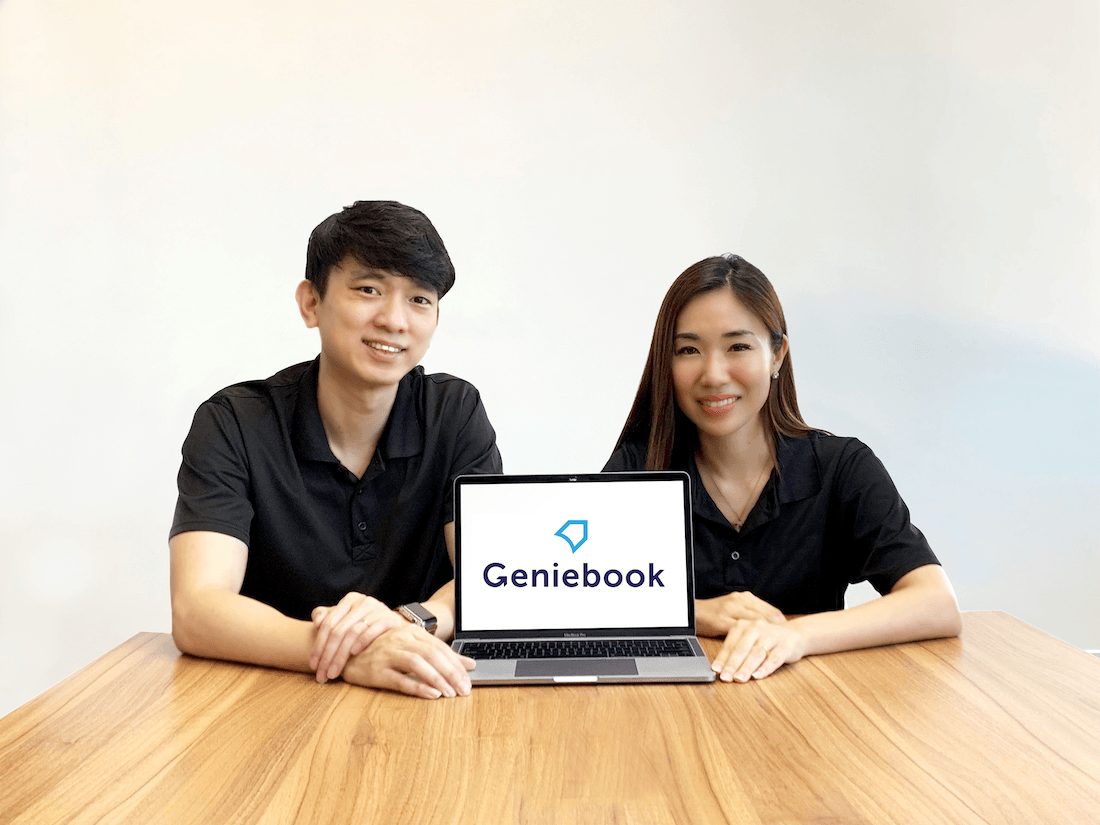
Geniebook co-founders Neo Zhizhong and Alicia Cheong / Photo credit: Geniebook
The co-founders still sit on the board of School Plus, but these days, their efforts are wholly focused on advancing Geniebook’s AI-enabled learning software.
The online tool makes studying personalized for children between 9 to 16 years old (between Primary 3 and Secondary 4 under the Singapore academic system) by generating a customized set of questions that target each student’s learning weaknesses. Core subjects on offer are English, mathematics, and science for primary school students, as well as physics, chemistry, biology, and mathematics for secondary school pupils.
Geniebook currently has 50,000 registered users in Singapore and is used by parents who purchase the software for their children, as well as students in School Plus. (The firm declined to disclose the number of monthly active users). Business has also been brisk – revenue grew 8x in 2018 and 6x in 2019.
In May, the startup raised S$1.5 million (US$1.1 million) in a pre-series A funding round led by private investment company Apricot Capital. The funding marked a turning point: just two years ago, the startup’s negative cash flow issues had threatened to sink the entire business.
Carving out a niche
Geniebook is riding on an edtech wave that’s rising in prominence.
Globally, the industry is expected to grow 60% to US$40 billion by 2022, up from US$25 billion in 2019. Within Asia Pacific, that figure is expected to increase more than twofold to US$9 billion within the same time period, higher than the US$3.5 billion this year, according to market research company Frost & Sullivan.

Photo credit: 123RF
“Higher internet penetration, social media, and [the] role of AI in personalization of content is driving the growth,” Abhineet Kaul, the senior director for public sector and government at Frost & Sullivan Asia Pacific, tells Tech in Asia. Kaul adds that a “focus on lifelong learning” will continue to drive growth in the sector.
Gaps in education exist and are sizable as the success of regional startups have shown.
Jakarta-headquartered Ruangguru, which is valued at around US$500 million, offers online education videos for over 15 million registered users. Along with that, it runs a private marketplace that links students to tutors, an online test platform, as well as corporate learning programs.
“We thought we were killing it”
Once bitten, twice shy
Stay ahead in Asia’s tech landscape
This is premium content. Subscribe to read the full story.
The Singapore edtech company has found its own niche and that’s in personalized education.
We know this is not ideal. ⌛ Sign up in 20 seconds. Cancel anytime.
Our subscriber community includes professionals from these companies:





Stay updated on the go with our mobile app.
Get latest insights with smoother, more personalized experience through TIA mobile app.











📅 Upcoming Events
22 October 2026
Payoneer x CSPN Summit 2026