Rebecca Liew · · 5 min read
Beyond carbon neutrality, this Taiwanese telco is leading the charge for net zero

The world is heating up – literally.
Scientists estimate that average global temperatures will rise by around 1.5 degrees Celsius by the year 2050. Meanwhile, corporations are facing increasing pressure to be accountable for their carbon emissions not just from climate-change bodies but also from customers.
This might mean eradicating entrenched business practices that favor financial growth at the environment’s expense and putting real effort into reversing the damage that’s already been done. Confronting this reality are companies in the information and communications technology sector, which rely heavily on power-hungry data centers for their business operations.
“High power consumption and carbon emission are inherent in 5G telecommunications,” acknowledges Jamie Lin, president of Taiwan Mobile (TWM).

Jamie Lin, president of Taiwan Mobile / Photo credit: Taiwan Mobile
In order to combat this problem, a growing number of companies in Asia are seeking carbon offsets to lower their emissions.
Beyond that, TWM is leading the charge for net zero, a state in which emitted greenhouse gasses are balanced by their removal from the atmosphere.
But for a telco giant whose business is built on supplying mobile data and internet services to users, which are all powered by metric tons of electricity, is achieving net zero a realistic goal?
A catalyst for change
In the last 110 years, Taiwan’s annual average temperature has gone up by 1.6 degrees Celsius, well above the global average of 1.07.
As a foundational part of the local information and communications technology industry, TWM “deeply understands the risk that the increase in carbon emissions poses to the environment,” Lin says. “We must strive to reduce the burden on the environment caused by the company’s own operations, taking into account the vision of sustainable development and taking care of the Earth.”
Seeing the need to double down on sustainable development, TWM established a cross-business management unit in early 2016 to handle all environment-related matters.
The following year, the telco firm unveiled Zetta Connected 2030, an initiative built on five pillars: responsible enterprise, joint innovation, taste of future, benefit to society, and greener footprint.
We must strive to reduce the burden on the environment caused by the company’s own operations.
To design clearer sustainability goals, the company also turned to a framework developed by the Task Force on Climate-Related Financial Disclosures (TCFD), which helps corporations to measure climate-related risks and opportunities.
According to the TCFD framework, the estimated total investment from 2022 to 2030 of TWM in its sustainability measures will exceed NT$12.6 billion (US$420 million). “With more customers relying on Taiwan Mobile’s network services and new technology applications, the operating cost will be higher if we don’t actively conserve energy, reduce carbon emission, and use green electricity,” Lin says. “It’s the way to go.”
These milestones would soon pave the way for something bigger.
At the forefront
In May 2022, the firm’s board of directors set the goal of hitting net zero by 2050. This was the latest milestone in a series of steps taken to commit to environmental sustainability. In 2017, TWM submitted the pledge to the Science Based Targets Initiative (SBTi), which helps organizations set targets to reduce emissions.
Committing to the TCFD framework took place between 2018 and 2019. In 2022, the company also joined RE100, a global initiative that guides corporations to commit to using 100% renewable energy. TWM is the first telco operator in Taiwan to join.
Attaining net zero requires careful planning, which is why TWM has taken a methodical approach to the process, guided by carbon reduction goals set out by SBTi.
“By 2030, up to 20% of the company’s energy needs should come from renewable sources,” Lin elaborates. “By 2035, that should increase to 60%.”
TWM aims to reach 100% renewable energy by 2040 and then gradually move towards net zero by 2050. It is also looking to generate 70% green energy at its own power plants.
Steady steps
Accomplishing these incremental goals starts with education, which is why the telco firm set up a department dedicated to the assessment, construction, and operation of renewable power plants.
With this in place, it has begun looking for green electricity suppliers. Internally, it also holds regular training courses to educate its suppliers on the management of greenhouse gasses and carbon emissions.
Last year, the company concluded an audit to examine the carbon emissions of its 137 suppliers. It also conducted on-site inspections and then drafted carbon reduction goals and recommendations for each supplier.
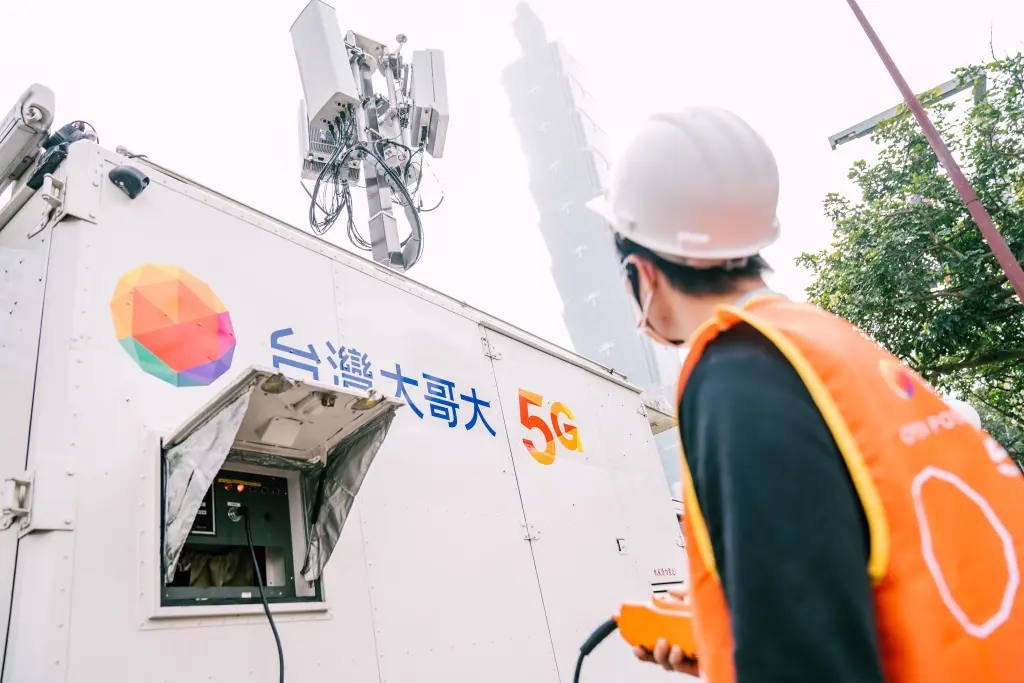
Photo credit: Taiwan Mobile
Between 2019 and 2021, TWM also organized annual forums on the circular economy, bringing together participants from the industry, the government, and the academe. These culminated in 14 major suppliers committing to three pledges: to use less virgin raw material, to boost efficiency, and to recycle.
Lin explains that through these initiatives, the firm has shown its partners how to improve the quality of their reviews and demonstrated the impact of carbon emissions in the supply chain to suppliers.
“Our company’s principles have always been grounded in sustainability while staying honest and practical,” explains Lin, stressing that corporate growth and sustainable development should go hand in hand.
From 2022 to 2030, TWM expects to commit up to NT$15 billion (US$499 million) to construct its own power plants, purchase green energy, and curb carbon emissions. Despite these numbers, TWM believes that pursuing emission goals does not necessarily mean high costs, pointing to local initiatives that are helping to support this mission.
“For instance, under the idea of ‘no ESG, no money’ promoted by the local banking industry, a company can obtain loans at a relatively low interest rate when it takes concrete actions related to sustainable development,” Lin shares. “That could mean tens of millions of dollars’ worth of savings on the part of the company, a real benefit from working to ensure sustainability.”
Towards a net-zero future
Though these moves may appear to be broad strokes, the gears continue to shift behind the scenes and have produced results. Lin shares that the company has been generating green power since 2015, and in 2021, TWM committed to increasing the use of green energy and cutting operational emissions, with the goal of using 100% green energy by 2030 for the company’s Cloud Internet Data Center server facilities.
TWM also saved 10.547 million kilowatt hours in 2021 – nearly 5,295 metric tons in reduced carbon emissions – by adopting energy-saving methods when building base stations and implementing other carbon-reducing measures such as the use of specialized heating, ventilation, and air conditioning equipment and lighting systems.
“By 2040 at the latest, the company will use nothing but renewable energy,” says Lin. “This would meet our goal of producing 70% of our own renewable energy, contributing to reaching the final goal of net zero by 2050.”
He reiterates that net zero cannot be a solo effort.
“TWM has been working with its suppliers on reducing carbon emissions, including continued efforts to promote carbon emissions investigation,” he says. “It’s estimated that by 2030, Taiwan Mobile’s suppliers will reduce carbon emissions by 20% compared to the levels in 2020.”
Currency converted from New Taiwan dollar to US dollar: US$1 = NT$30.01.
Taiwan Mobile Co (TWM) is a top telecom operator that provides mobile, fixed-line, cable TV, and broadband services. As a forerunner in digital innovation, TWM is repositioning itself as a next-gen tech company that will lead the next revolution in the internet, telecommunications, and ecommerce as well as media and entertainment.
Find out more about TWM’s initiatives to achieve net zero here.
This content was produced by Tech in Asia Studios, which connects brands with Asia’s tech community. Learn more about partnering with Tech in Asia Studios.
Stay updated on the go with our mobile app.
Get latest insights with smoother, more personalized experience through TIA mobile app.
Recommended reads
 Indonesian AI startup goes global
 Forrest Li on scaling Sea, building smarter bots, and founder grit
 An AI assistant that joins sales calls and scores team skills
 SGX’s CEO says it doesn’t need a unicorn to win
 SMEs want AI too, but not the kind Big Tech is selling
 Oatside’s alt-milk rise hits a profitable gear
 Alibaba’s financial health in 12 charts
 Asia’s telcos bundle AI into mobile plans. Will it pay off?
 M-Daq chases bigger clients as revenue falls, losses grow
 VC tracker: Accel raises US$3.5b, including US$550m for India





Editing by Winston Zhang, Stefanie Yeo, and Eileen C. Ang
(And yes, we’re serious about ethics and transparency. More information here.)