- Premium Content It takes our newsroom weeks - if not months - to investigate and produce stories for our premium content. You can’t find them anywhere else.
 Lokesh Choudhary · · 4 min read
Can chiplets power China’s genAI ambition?
Baidu, ByteDance, Tencent, and Alibaba have collectively spent US$1 billion to acquire approximately 100,000 A800 processors from US chipmaker Nvidia.
Additionally, these firms have purchased another US$4 billion in graphics processing units (GPUs) set to be delivered by 2024.
This comes just before the US ban on exports of Nvidia’s A100 and H100 chips.
Nvidia office / Source: Nvidia
That’s why Chinese companies are now exploring alternative options that may not rely on traditional GPUs.
One such option is chiplets. Chinese authorities are increasingly emphasizing the importance of the tech, as per a Reuters report. There has also been a growing number of policy documents emerging from China that mention chiplets, and Chinese companies are investing in or acquiring firms working on these units.
A chiplet is a small, individual semiconductor die or module that is used as a building block to construct a larger and more complex integrated circuit.
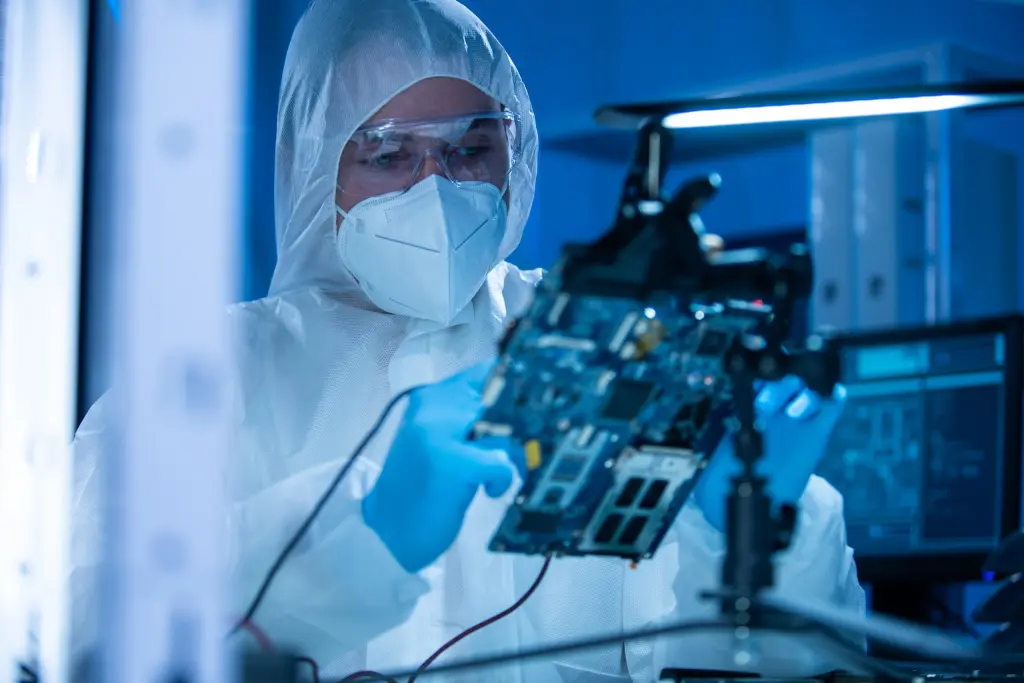
Microelectronics engineer working in a lab/ Photo credit: Shutterstock
Instead of designing and manufacturing a single chip to perform all functions, chiplets can be combined or stacked to carry out a similar purpose.
Chinese companies like Chipuller are trying to beat US chipmakers by manufacturing these units. Recently, the company acquired 28 patents – either owned by Silicon Valley-based firm zGlue or developed by individuals named in zGlue’s patents.
China’s purchase of chip packaging equipment – which can assist in large-scale chiplet manufacturing – is also ramping up, rising to US$3.3 billion in 2021. However, that number fell last year to US$2.3 billion, according to the earlier Reuters report.
Chinese companies craving for chiplets
One of the advantages of chiplet technology is its flexibility, believes Bob Grim, vice president of strategy and corporate communications at Canada-based chips startup Tenstorrent.
“One of the major challenges that Nvidia faces is the incorporation of very expensive memory into their chips, specifically high-bandwidth memory,” he tells Tech in Asia. Grim believes a large portion of Nvidia’s customer base doesn’t necessarily require high-bandwidth memory.
Chiplets a cheaper option?
China may lose chiplets battle too
Stay ahead in Asia’s tech landscape
This is premium content. Subscribe to read the full story.
Chinese firms are turning to chiplets for their genAI GPUs after the US imposed restrictions on locally made chips. But is it a viable alternative?
We know this is not ideal. ⌛ Sign up in 20 seconds. Cancel anytime.
Our subscriber community includes professionals from these companies:





Stay updated on the go with our mobile app.
Get latest insights with smoother, more personalized experience through TIA mobile app.