- Premium Content It takes our newsroom weeks - if not months - to investigate and produce stories for our premium content. You can’t find them anywhere else.
 Jack Ellis · · 6 min read
Bike-sharing may struggle to survive amid toughening regulation
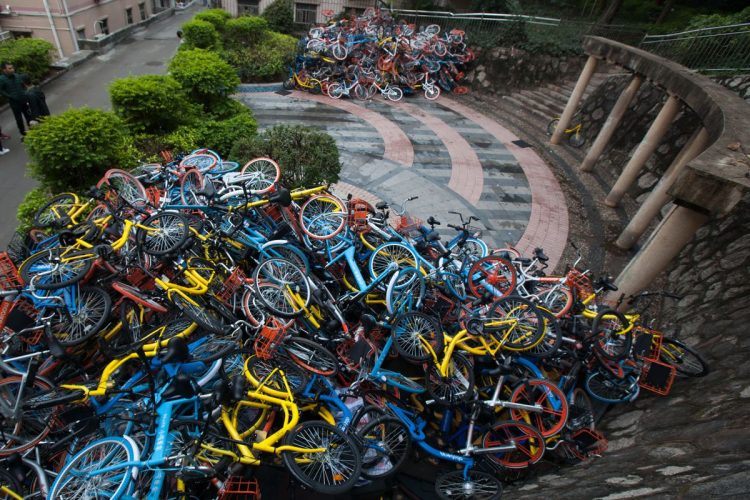
Photo credit: Silent Hill / Imagine China
When oBike abruptly announced that it was pulling out of Singapore in June this year, it pointed the finger at the country’s evolving regulatory framework for bike-sharing services.
At the time, oBike said it did not expect to “fulfill the new requirements and guidelines released by LTA [Singapore’s Land Transport Authority] towards dockless bicycle sharing.”
The Singapore parliament passed a law in May directing the LTA to develop more stringent rules for bike-sharing apps and their users.
While other operators have highlighted their concerns about the new rules, it’s now emerging that there was more to oBike’s untimely exit. The Singapore police is investigating the startup for allegedly transferring customer deposits to an overseas entity to avoid repaying them. This followed an earlier controversy that saw deposits being used to buy subscription packages without customers’ prior knowledge.
Tragedy of the commons
What this all points to is the fundamental “cash crunch” problem faced by the bike-sharing business model. Startups operating in this space have mirrored the cash-burning tactics of their ride-hailing counterparts, offering seemingly endless discounts and free rides in an effort to draw users away from the competition.
Unlike other sharing economy models, bike-sharing isn’t an asset-light business. Bicycles are purchased, owned, and maintained by the startups themselves. This contrasts with the likes of Airbnb and Grab, where most of the key assets – real estate and cars, respectively – are privately held and are being crowdsourced into commercial use.
Another issue highlighted by Lawrence Cheok, senior research manager of digital commerce at International Data Corporation, is the so-called “tragedy of the commons,” where the self-interest of participants who share resources ends up destroying their shared ecosystem.
“In an efficient market, consumers and suppliers acting for their self-interest create value for each other,” he told Tech in Asia. “However, this isn’t the case for bike-sharing.”
$60 for every shared bicycle deployed will make an environmentally friendly mode of transportation significantly more expensive.
Users routinely fail to return bikes to designated parking areas because they are situated too far from their destination. As a result, dockless bikes have suffered high rates of loss, damage, and theft, further raising costs for bike-sharing companies, Cheok said.
The knock-on effect of this is that tons of dockless bikes – damaged or otherwise – are cluttering public spaces, blocking rights of way, and polluting rivers, lakes, and other areas of natural beauty.
“The widespread abuse and indiscriminate parking of shared bikes is a serious social problem as can be seen from the experiences of the Chinese cities,” transport economist and CEO of Crucial Perspectives, Corrine Png, told Tech in Asia. “Left unchecked, it will eventually provoke a serious consumer backlash, so Singapore’s LTA is correct in seeking additional regulations.”
However, stricter rules add yet more costs for already cash-strapped operators.
Reduced fleet sizes
Avoiding the death spiral
Survival fight
Stay ahead in Asia’s tech landscape
This is premium content. Subscribe to read the full story.
Operators need to cut costs and find new revenue streams – and fast.
We know this is not ideal. ⌛ Sign up in 20 seconds. Cancel anytime.
Our subscriber community includes professionals from these companies:





Stay updated on the go with our mobile app.
Get latest insights with smoother, more personalized experience through TIA mobile app.








📅 Upcoming Events
22 October 2026
Payoneer x CSPN Summit 2026