- Premium Content It takes our newsroom weeks - if not months - to investigate and produce stories for our premium content. You can’t find them anywhere else.
 Putra Muskita · · 8 min read
Bukalapak is Indonesia’s newest unicorn. Here’s what’s next for them
When Bukalapak raised an undisclosed funding round in January 2018, it also joined an exclusive club: Indonesian unicorn.
The ecommerce marketplace became just the fourth Indonesian startup to be valued above US$1 billion, joining Go-Jek, Traveloka, and rival Tokopedia.
It’s an important achievement – and a welcome change. Bukalapak is locally prominent, but from an international perspective, it has long operated in the shadows of Tokopedia and regional players Shopee and Lazada. Now, it’s getting more attention from the media, prospective employees, as well as stakeholders like the Indonesian government, says co-founder and president Fajrin Rasyid.
At the same time, Rasyid insists that unicorn status was never the destination.
“For us, becoming a unicorn is like stopping at a gas station during a road trip,” he says. “Building a business is not about getting investments, it’s about serving our customers. Raising money is just one way [to help us] do that.”
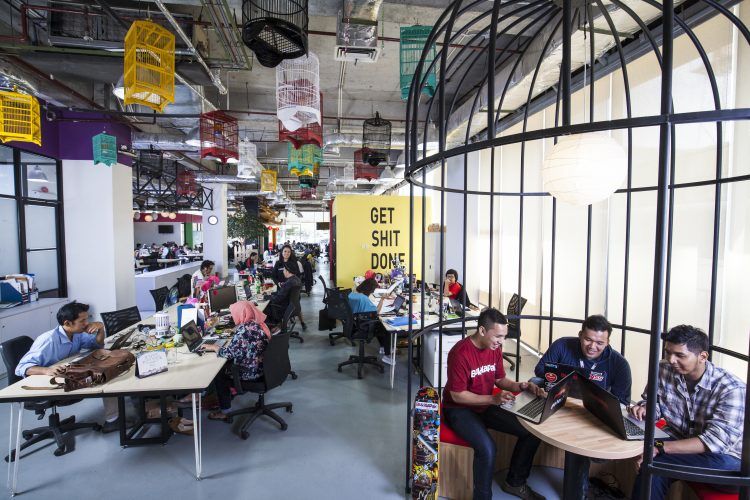
Bukalapak headquarters in Jakarta / Photo credit: Bukalapak
Bukalapak intends to do so through strategies like fintech offerings (such as e-wallet BukaDana and mutual funds product BukaReksa), artificial intelligence (to enhance user experience), and government services. It has also set up an R&D center in the Indonesian city of Bandung.
But there’s also a larger ambition: venturing offline. Indonesia’s ecommerce industry may seem huge at first glance, but according to McKinsey & Company, it only represents 3 percent of total retail in 2017. Doing retail would allow Bukalapak to significantly expand its customer base.
“If we only focus on online commerce, the potential is not as big,” says Rasyid. “Can we do something about [overall] retail?”
Venturing offline with Mitra Bukalapak
Bukalapak’s offline strategy is synonymous with Mitra Bukalapak, a program the company first introduced in late 2017, and in which it is investing US$70.5 million.
Through Mitra Bukalapak, which translates to “Bukalapak partner,” the company ties up with small offline businesses around the country for two purposes. First, the program lets a warung or roadside kiosk sell Bukalapak-powered digital goods – phone credits, train tickets, electricity tokens – to offline customers.
Second, it lets these offline businesses purchase inventory, such as instant noodles, cigarettes, or fast-moving consumer goods, through the Mitra Bukalapak app. These goods are fulfilled directly by distributors on the Bukalapak platform.
Offline customers, especially those unaccustomed to online shopping, can also ask a Bukalapak partner to make an online purchase from the Bukalapak platform on their behalf.
Rasyid claims that since its inception, Mitra Bukalapak has more than 500,000 participating small businesses. It is growing faster than its ecommerce business, though the gross merchandise volume (GMV) is still catching up. “Of course, consumers who shop at Mitra Bukalapak partners have smaller ticket sizes compared to those who shop on our online platform.”
“We’re not trying to become a super app”
The advantage of having smaller funding
Stay ahead in Asia’s tech landscape
This is premium content. Subscribe to read the full story.
For the ecommerce marketplace, the way forward is to venture offline.
We know this is not ideal. ⌛ Sign up in 20 seconds. Cancel anytime.
Our subscriber community includes professionals from these companies:





Stay updated on the go with our mobile app.
Get latest insights with smoother, more personalized experience through TIA mobile app.











📅 Upcoming Events
22 October 2026
Payoneer x CSPN Summit 2026