Everyone knows that data is the new oil, and it has only become more important with the rise of AI. After all, even the most powerful large language model (LLM) is effectively useless without the right training set.
However, as AI marches on, a new challenge has emerged – a lack of connected data.

Philip Rathle, CTO of Neo4j / Photo credit: Neo4j
“Data mostly sits in silos, and unless you connect them, the AI is only going to know about what’s happening inside of a given function,” says Philip Rathle, CTO at graph database management system Neo4j.
“Most companies are now in a state where, in order to get more out of AI, their data landscape probably isn’t connected up the way it needs to be.”
Missed connections
The challenge, says Rathle, exists at both the enterprise and technical level.
On an enterprise level, data exists in silos to keep things organized and make it easier for people to look up previous iterations. Companies often have separate systems for different functions, and each has its own database. AI can’t see the complete picture when these systems don’t talk to each other.
At a technical level, the limitation lies in the databases used by businesses today. Most databases in use are relational, where data is stored essentially as tables.
“The relational database was originally designed to digitize forms that were on paper, that were filling up warehouses,” explains Rathle.
While relational databases work well for what they were built to do, their use has become increasingly limited, as they don’t capture the context and relationships between data that are crucial for making effective decisions.
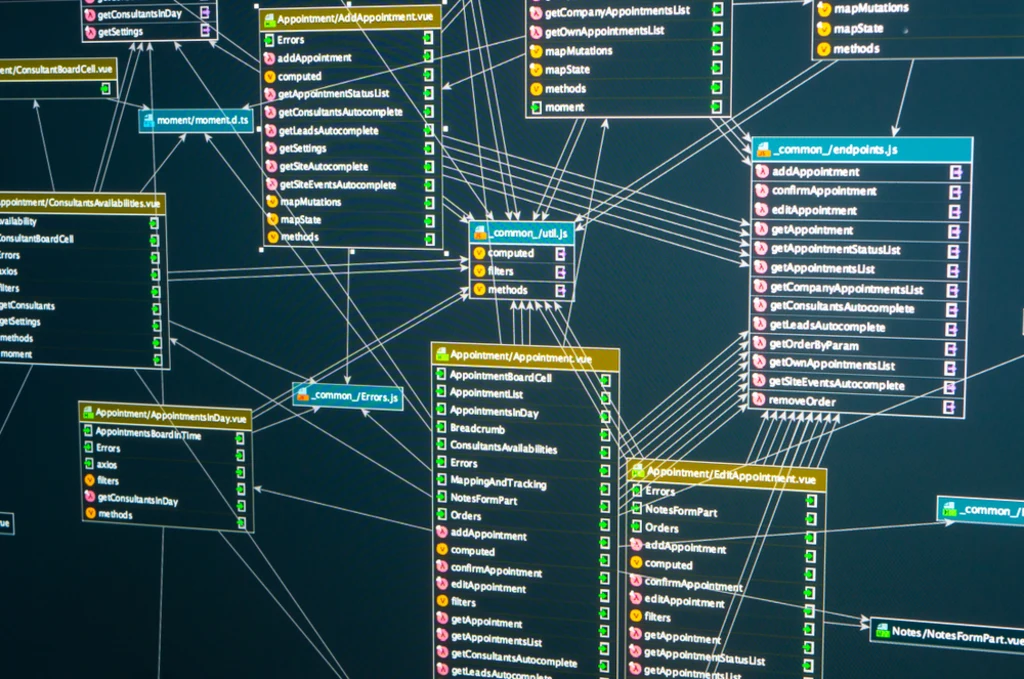
Things can get complicated really fast with relational databases. / Photo credit: Yurich / Shutterstock
Consider this scenario: A shipping company typically manages an intricate network of vessels, ports, and customers across the globe. One of its biggest challenges is optimizing shipping routes while considering a myriad of other factors.
In a relational database system, this information – vessels, routes, schedules, and more – would be stored in separate disconnected tables that aren’t reflective of how interconnected real-world shipping operations are.
While a human could easily look at the different graphs and draw conclusions – for example, that going through Route A would pose piracy risks – the AI cannot. The tech would require making complex connections across several tables to execute real-time route planning, which would make it increasingly slow and ineffective the more data there is.
This issue has become even more apparent with the rising importance of retrieval-augmented generation (RAG). RAG refers to using external knowledge bases to improve an LLM’s accuracy and relevancy.
AI can do much for us, but it has its limitations. / Photo credit: Koshiro K / Shutterstock
While LLMs such as Open AI’s GPT and Meta’s Llama can answer general queries, they do hallucinate and are reliant on their training data. For these LLMs to be useful to a company, they need to be able to draw on a base of relevant and current knowledge.
It’s similar to knowing your friend’s circumstances before giving advice on their job search – you can give much more targeted and useful guidance if you know their specific concerns and challenges.
Siloed data leads to a lack of this context, which in turn creates problems with using AI effectively.
A better approach
So how can businesses better store and manage their data? The answer lies in graph databases.
These “store data as nodes and relationships, similar to how people naturally sketch information on a whiteboard,” explains Rathle. “Rather than spreading related data across separate tables, graph databases explicitly capture connections as core building blocks of the database itself.”
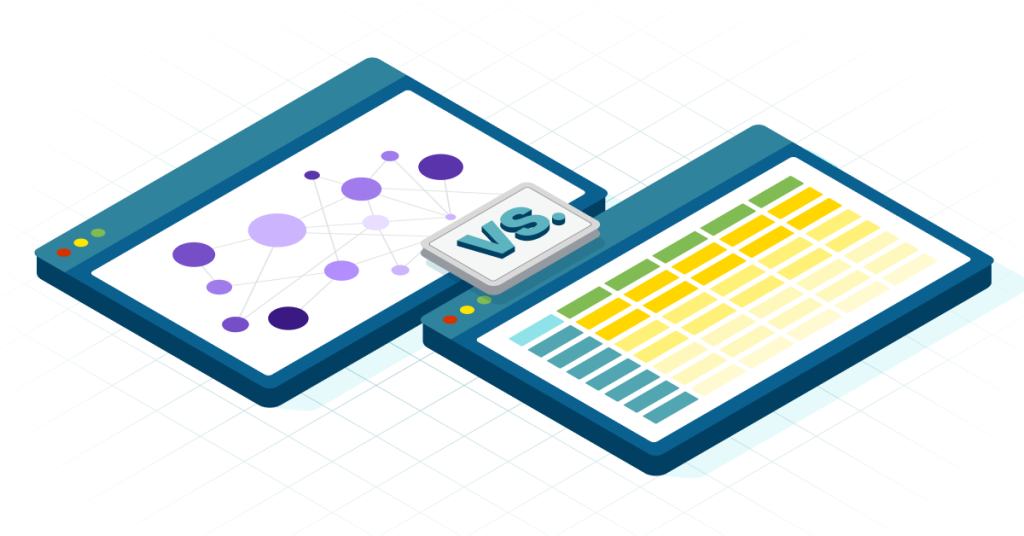
Graph databases store data as nodes, versus relational databases, which store this information as tables. / Photo credit: Neo4j
Think of them as mindmaps, with the connections between the different pieces of information also stored as part of that data. This is especially important for AI, and more specifically, RAG, which needs more accurate and contextual data in order for businesses to use AI more effectively.
What this means for our shipping company example is that information on vessels, routes, schedules, and customers exist as an integrated network rather than isolated tables.
This allows AI to navigate directly through connections, accelerating complex tasks by eliminating the need to “join” different tables to see the relationships each time – the database can simply follow pre-established pathways between connected data points.
“With graph databases, you can often run 1,000x faster on 10x less hardware,” explains Rathle. “When you can do something 1,000x faster, it creates entirely new possibilities.”
It’s also easier to evolve the data once it’s in a graph and it’s simpler to connect graphs to one another to provide a more “coherent cross-functional view,” he adds.
In the context of our shipping company, the graph on routes can connect into a customer graph, underneath which is one for the company’s products and suppliers. The more data is connected, the more opportunities become unlocked, whether in innovation or bottom-line savings.
Shipping aside, the applications of graph databases are numerous.
For instance, Neo4j has helped DXC Technology, an IT consultancy, to enhance talent management efforts in its offices in Asia and the Middle East.
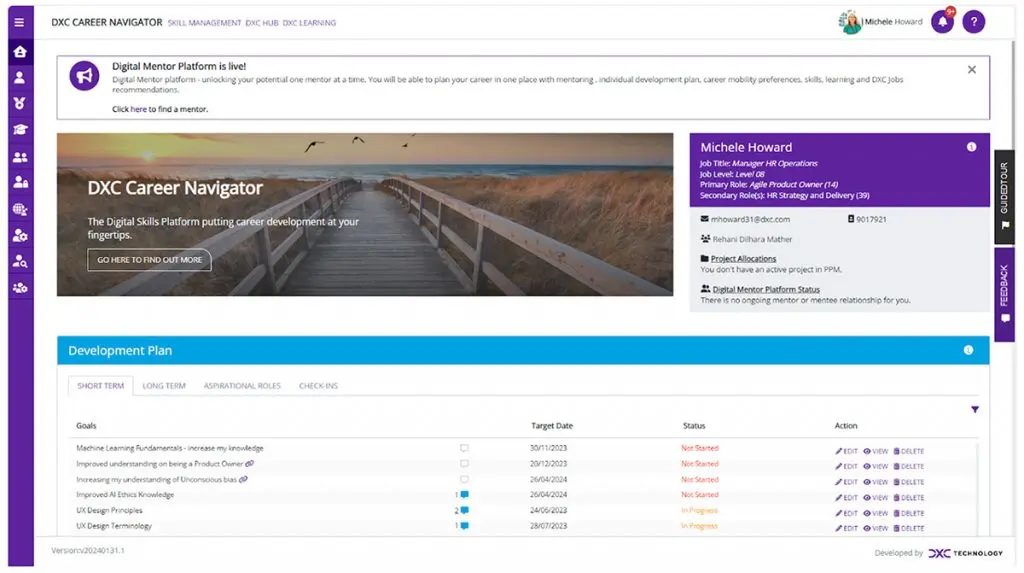
DXC Technology’s Career Navigator platform, built by leveraging Neo4j’s technology. / Photo credit: DXC Technology
Using a graph database, DXC Technology connected its employee data, organizational chart, job scopes, and available job opportunities – among other data – to create an application to help employees navigate their career journeys more effectively. These data sets are all in hierarchies that can be connected together to form a graph.
“The application gave managers more visibility into employees’ skills, and allowed people to understand what skills they needed to get to a particular role in the company. It also gave employees better visibility on open positions and the opportunities available for them to develop their own careers,” shares Rathle.
As a result, DXC Technology saw a 12% improvement in internal hiring and a reduction in employee attrition by 40%, creating a win-win scenario for both the companies and its employees.
A connected future
Graph databases and connected data will become increasingly important on the road ahead, especially as businesses aim to leverage AI solutions more effectively.
Rathle points to Swedish buy now, pay later pioneer Klarna as an example of what the future could look like. Klarna recently announced that it had chosen to stop using many of its SaaS providers, instead leveraging graph databases and Neo4j’s solutions to develop an in-house AI stack to consolidate its data and use it more effectively.
“Companies essentially are taking back their data, connecting it, centralizing it, and making it available to AI,” he says.
And as AI marches on, Neo4j has its eyes set on a major goal: to be at the heart of the data that’s powering these new innovations.
“Our company mission statement from day one has been ‘help the world make sense of data’,” Rathle concludes. “With the right data and tools, we can create entirely new possibilities that no one had ever dreamed of.”
The IMDA Accreditation program was launched in 2014 to accelerate the growth of promising Singapore-based enterprise tech companies. It helps them establish their credentials, build business traction, compete in the global market, and gain more opportunities to showcase their solutions to spur adoption. Learn more about how IMDA Accreditation can grow and accelerate your business.
Neo4j is the graph database and analytics leader, uniquely optimized to handle complex data relationships – it is essential to the new data stack. To find out more about how you can work with Neo4j to unleash the power of graph databases and analytics, visit its website.
This content was produced by Tech in Asia Studios, which connects brands with Asia’s tech community. Learn more about partnering with Tech in Asia Studios.
Stay updated on the go with our mobile app.
Get latest insights with smoother, more personalized experience through TIA mobile app.
Recommended reads
 Indonesian AI startup goes global
 Forrest Li on scaling Sea, building smarter bots, and founder grit
 An AI assistant that joins sales calls and scores team skills
 SGX’s CEO says it doesn’t need a unicorn to win
 SMEs want AI too, but not the kind Big Tech is selling
 Oatside’s alt-milk rise hits a profitable gear
 Alibaba’s financial health in 12 charts
 Asia’s telcos bundle AI into mobile plans. Will it pay off?
 M-Daq chases bigger clients as revenue falls, losses grow
 VC tracker: Accel raises US$3.5b, including US$550m for India





Editing by Winston Zhang and Jaclyn Tiu
(And yes, we’re serious about ethics and transparency. More information here.)