- Premium Content It takes our newsroom weeks - if not months - to investigate and produce stories for our premium content. You can’t find them anywhere else.
 Putra Muskita · · 8 min read
Explaining the fast rise of Kredivo, Akulaku, and Oriente to the $500m club
It’s common knowledge that Indonesia – along with other parts of Southeast Asia – has a large underbanked population with little access to credit. This has led to the rapid growth of fintech startups in both the payments and lending spaces, especially peer-to-peer (P2P) lending.
But handing out loans to these consumers is risky – many of them are first-time borrowers, which means there is little – if any – credit history available on them to speak of. How can a lender predict whether the borrower can pay back the loan?
“Pay-later” startups have emerged to tackle this problem. Instead of lending cash to a consumer, they let them buy now and pay later through a variety of online and offline merchants.
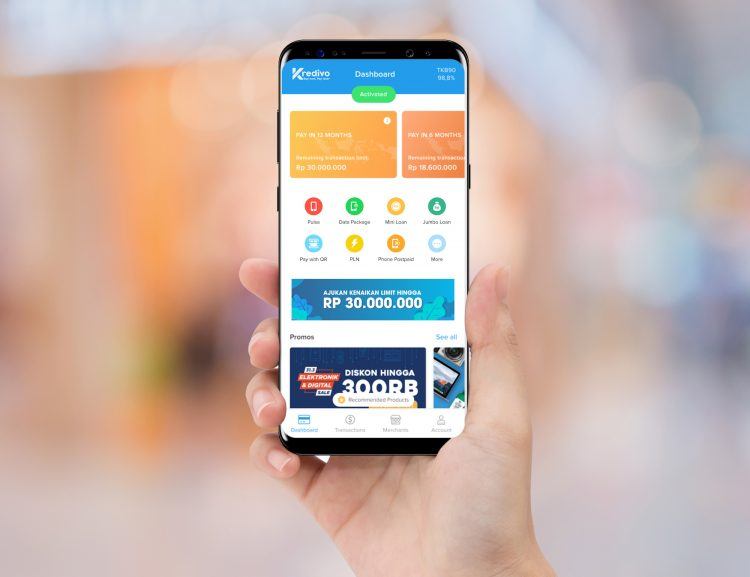
Photo credit: FinAccel
This has caught on in the West, where companies like Affirm, Afterpay, and Klarna have amassed billion-dollar valuations, as well as in China (Ant Financial has a pay-later product called Huabei).
Pay-later products are starting to become a force in Indonesia. New players like Akulaku, which is backed by Ant Financial, and Kredivo, which just raised a US$90 million series C round, are both reportedly valued at around US$500 million. And Hong Kong-based Oriente, which was co-founded by Skype co-founder Geoffrey Prentice and operates in Indonesia and the Philippines, raised US$105 million late last year – industry sources claim the company is also valued around the US$500 million range.
A more low-risk approach?
The pay-later product takes on different meanings in developing countries like Indonesia vs. the developed world. In the US or Europe, these products are a zero interest, user-friendly alternative to credit cards for consumers to finance their purchases. In Indonesia, however, the service allows many people to partake in borrowing to fund purchases for the very first time.
“[In emerging markets] pay-later solutions enable millions of credit-invisible consumers to break away from the shadow banking industry and the predatory terms of loan sharks,” says Oriente’s Prentice, whose company offers a pay-later feature through its Finmas product in Indonesia. “For financially illiterate consumers, giving them a transparent and simple solution becomes invaluable because they like the predictability of these payments and knowing exactly when they will end.”
But the inherent risk is there as well: These consumers are borrowing for the first time, which means they lack credit histories as well as sufficient knowledge in managing finances.
“These are markets in which financial literacy gap is desperately low,” says Prentice. “In markets like Indonesia, where more than 70 percent of adults turn to informal lending sources (including loan sharks) and are beset by exorbitant interest rates and predatory terms, the use of alternative data to build a financial identity is essential.”
Many types of lenders
Many lenders tend to focus on “productive loans” (i.e., loans that help to increase business and economic activities) such as funding a housewife’s budding home business. This is an approach favored by the bigger P2P players like Koinworks, Amartha, or Funding Societies’ Indonesian offshoot Modalku.
Of course, this doesn’t mean that loans to individual borrowers can’t be productive – there have been a couple of startups that focus on education loans, for example.
There are also a number of companies focusing on consumptive loans, which are used for things like the borrower’s daily needs and are disbursed in the form of cash.
These players often don’t publicly disclose their credit scoring methodology, though it is understood that they use a variety of digital data points found in a user’s mobile phone. It is unclear how effective these data points are – or even what kind of data points are used – and inaccurate scoring could lead to bad debt. Some of these players (especially those unlicensed by OJK, Indonesia’s financial services authority) have been hit by misconduct allegations.
The giants are coming
Stay ahead in Asia’s tech landscape
This is premium content. Subscribe to read the full story.
Pay-later products may be the low-risk approach to solving financial inclusion in countries like Indonesia.
We know this is not ideal. ⌛ Sign up in 20 seconds. Cancel anytime.
Our subscriber community includes professionals from these companies:





Stay updated on the go with our mobile app.
Get latest insights with smoother, more personalized experience through TIA mobile app.








📅 Upcoming Events
22 October 2026
Payoneer x CSPN Summit 2026