
With shopping app downloads soaring worldwide, the mobile commerce (m-commerce) industry is seeing massive growth and is on track to overtake ecommerce by 2020.
Those who download m-commerce apps are sticking around, too. In fact, a quarter of them continue using shopping apps even after a day, and it takes a full week before retention rates drop to 14%, according to a recent report produced by mobile marketing firms Adjust and Liftoff. That gives shopping apps the highest retention rates among all app categories.
Ajit Pawar, Adjust’s partnerships manager for Southeast Asia, explains m-commerce’s growing appeal. “Mobile is the essential go-to for inspiration and purchasing decisions and allows for easy shopping on the go. Users will often browse in their downtime when they are primed to shop, and being free of high-friction physical boundaries like checkout lanes or parking lots creates a smoother path to purchase than ever,” he says.
An Asian explosion
The Asia-Pacific m-commerce industry is especially booming. The cost per install for shopping apps in the region comes in at US$3.17 – cheaper than in North America, Latin America, and Europe as well as in the Middle East and Africa (EMEA).
According to Pawar, this is due to the rapid adoption of mobile phones by a large portion of the region’s population.
“Many Southeast Asian consumers didn’t follow the typical pattern of going from PC to laptop to mobile, but jumped straight to smartphones,” he says. “This makes it a mobile-first economy – you could [even] say mobile-only.”
Growing incomes and increasing buying power are contributing as well to the popularity of shopping apps in Asia. The rise of digital payments also provides underbanked populations access to financial services, and supportive government initiatives have helped shape the fintech sector, making payment integrations within shopping apps easier than ever.
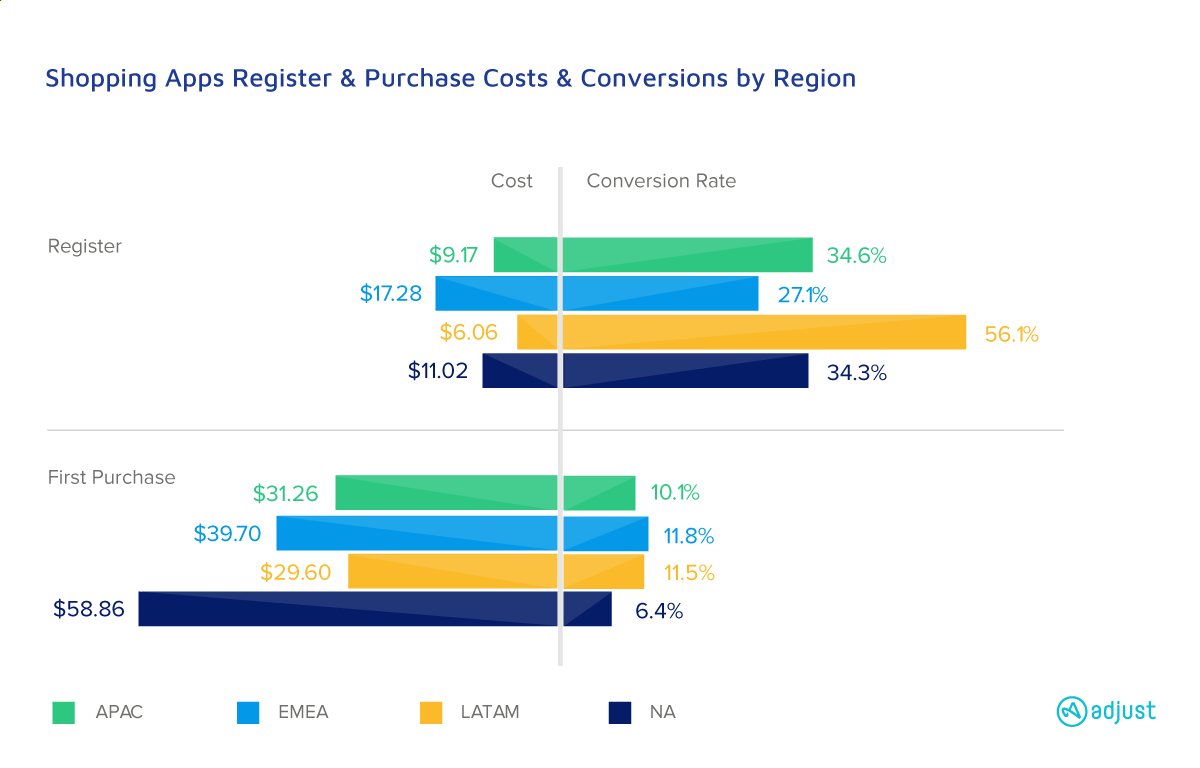
Shopping apps’ register and purchase costs and conversions by region / Image credit: Adjust
These factors, along with low customer acquisition costs and high conversion rates, make Asia one of the most lucrative regions for shopping apps.
Indonesia: Southeast Asia’s most dynamic market
Across the region, Indonesia stands out as a particularly dynamic market.
Cost per install and first purchase in the archipelago is lower compared to other countries, and nearly 10% of users make a purchase after installation.
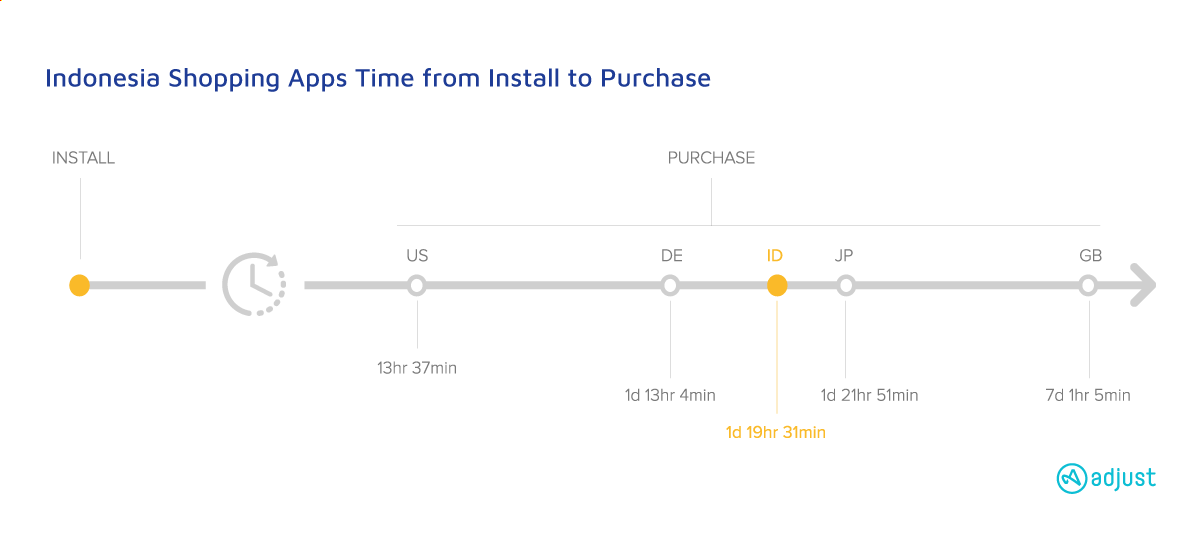
The average time that users take to go from install to purchase in Indonesia / Image credit: Adjust
According to Adjust data, Indonesian users contemplate their shopping decisions for more than a day before they make their first purchase – longer than shoppers in the US and Germany but way ahead of those in Japan and the UK.
Capitalizing on market opportunities
Despite the robust growth in m-commerce, consumers – especially high-value, brand-loyal users who are looking to repurchase – aren’t going to wait around.
Marketers need to focus on keeping customers further down the funnel, helping apps remain top of mind, and nudging users to convert.
EMEA sees the highest retention rates across the board, while Asia Pacific and North America are mostly tied after a week. A month after apps are downloaded, EMEA, Asia Pacific, and North America’s retention rates are on par.
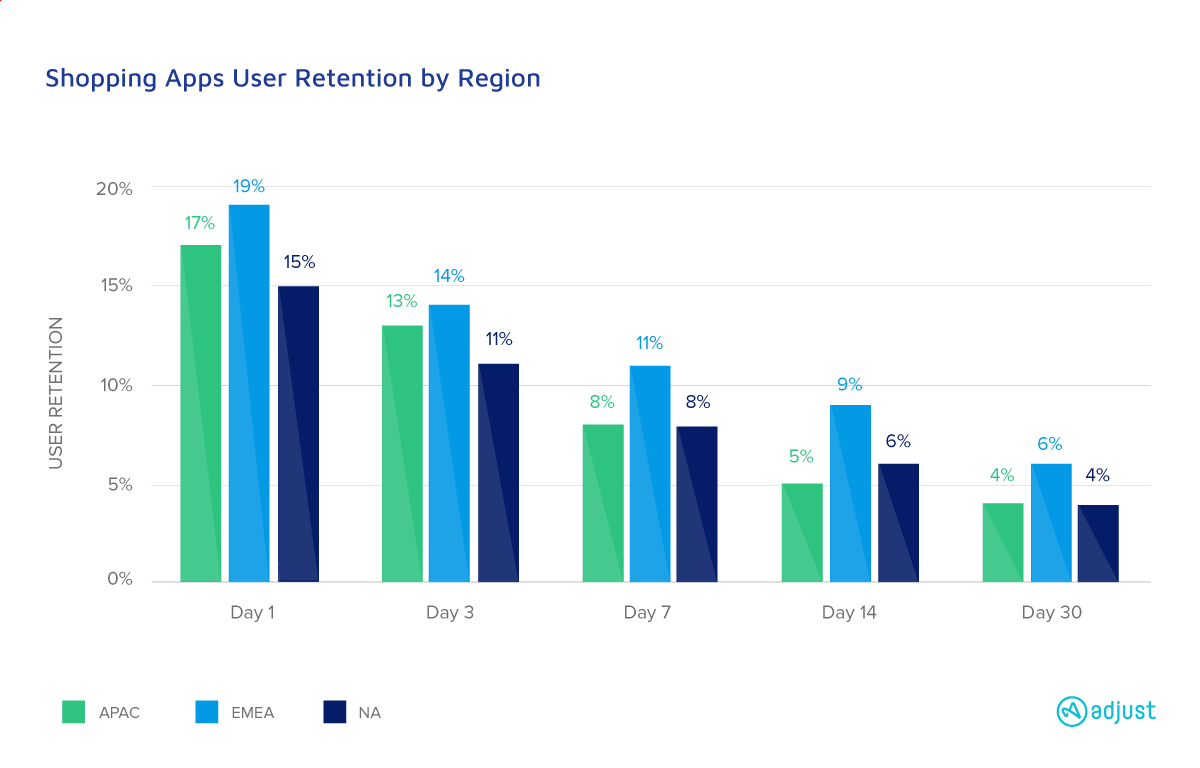
Shopping apps’ user retention by region / Image credit: Adjust
“Although shopping has become an integral and essential part of daily life for consumers, there’s still room for retention rates to grow,” Pawar urges.
He gives marketers some tips to increase and maintain the user retention rates for shopping apps.
1. Create week-long engagement campaigns
Because shopping apps’ user retention drops to 14% after a week, it’s important for marketers to create campaigns and push out messages to engage consumers during this time.
“Churn is an unavoidable part of a user’s lifecycle. But it’s important to bear in mind that an app user’s lifecycle isn’t a linear journey,” says Pawar. “Just because a user loses interest in an app for a certain number of days doesn’t mean they will never come back.”
2. Observe the customer journey
Pawar suggests that marketers use data to find and target users who churn just before the “sweet spots” in the customer journey. For instance, Adjust research found that the best time to engage with users is 28 days after they download a shopping app.
For customers who’ve fallen off the path, retargeting can also help. When a user’s cart is full or they’ve shown an interest in a product, remarketing can help give users that nudge to buy.
3. Improve UI/UX
M-commerce is a competitive space. This means the user interface and experience need to be on point or customers might switch to a competitor.
“Any barriers to purchase – such as having to register for an account or not offering preferred payment methods – are surefire ways for users to drop their baskets during the path to purchase,” says Pawar.
As such, he suggests that marketers look for those moments when users leave and never return. In those instances, the user experience should be optimized because “in almost every app experience, users can find frustration,” Pawar adds.
The big picture
Despite the importance of maintaining a shopping app’s user retention, these platforms are just one of many touchpoints for online retailers. With more channels and touchpoints, it can be hard to attribute the decision to purchase to any one channel.
“It’s important to work with a solid cross-platform analytics provider that pinpoints your most valuable network partners, ads, emails, and deals – whether they come from desktop, mobile, tablet, or even TV,” says Pawar. “By tying the user journey across web and app, brands will gain a more complete picture of user journeys across platforms. This, in turn, will lead to more informed marketing decisions and ultimately drive higher return on ad spend.”
For more on global m-commerce trends and benchmarks, download the 2019 Mobile Shopping Apps Report on Adjust’s website.
Stay updated on the go with our mobile app.
Get latest insights with smoother, more personalized experience through TIA mobile app.
Recommended reads
 Indonesian AI startup goes global
 Forrest Li on scaling Sea, building smarter bots, and founder grit
 An AI assistant that joins sales calls and scores team skills
 SGX’s CEO says it doesn’t need a unicorn to win
 SMEs want AI too, but not the kind Big Tech is selling
 Oatside’s alt-milk rise hits a profitable gear
 Alibaba’s financial health in 12 charts
 Asia’s telcos bundle AI into mobile plans. Will it pay off?
 M-Daq chases bigger clients as revenue falls, losses grow
 VC tracker: Accel raises US$3.5b, including US$550m for India





Editing by Nathaniel Fetalvero, Jaclyn Teng, Eileen C. Ang
(And yes, we’re serious about ethics and transparency. More information here.)