- Insights This article was written by a TIA community member. Insights pieces undergo the same rigorous editorial process that newsroom-produced articles have.
 Jack Chan · · 4 min read
Blockchain startup founders on the technology’s applications beyond coins
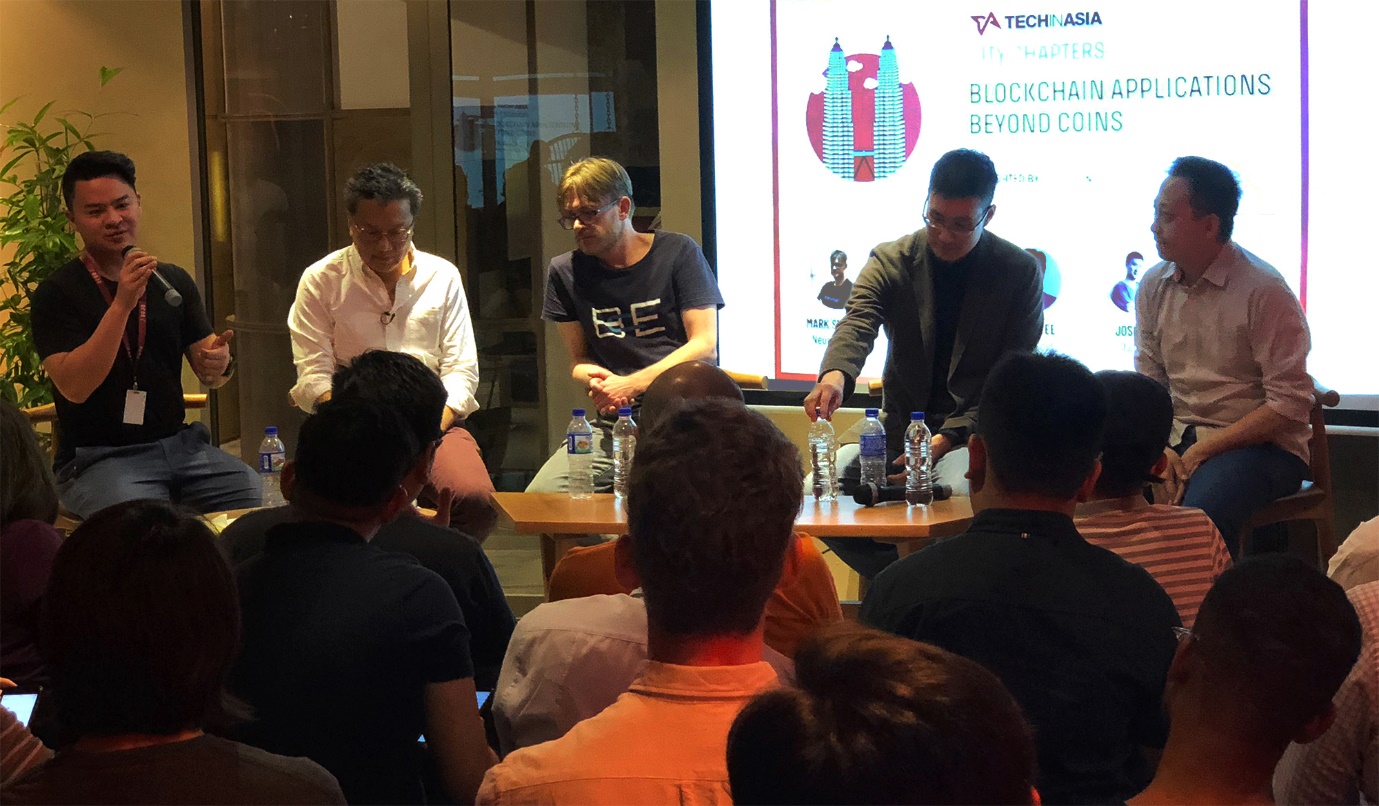
(L-R) The author, Robin Lee (HelloGold), Mark Smalley (Neuroware), Josh Wei (OwlTing Group), and Matthew Tan (Etherscan).
Blockchain has indeed caused as much excitement as confusion for spectators throughout the last 12 months. When the price run-ups have been compared to the Dotcom bubble and even Tulip mania, it is high time for startups and industry players to start asking basic questions and understand the fundamentals of this technology.
Tech in Asia City Chapters (Kuala Lumpur) recently organized its second founders’ meetup, discussing blockchain applications beyond coins. The panelists were from Neuroware, Etherscan, HelloGold, and OwlTing Group—four Asian startups that built their businesses around blockchain technology. Here are some insights from the discussion.
Transfer of value is still the primary application
While the promise of blockchain outside fintech is often hyped up, Matthew Tan (founder and CEO of Etherscan) thinks there has been no so-called killer application outside the realm of “transfer of value” yet. “The cold hard truth is, from a technical perspective, most of the tokenized projects do not need tokenization,” says Tan. “So, its most prominent use cases still stems from transfer of value, which extends toward crowdfunding and remittance.”
Coupled with the power of tokenization, blockchain has enabled an explosion of fundraising in the form of ICOs. However, Mark Smalley (co-founder and CEO of Neuroware) is not impressed by the development of ICOs thus far. “Of the 436 ‘utility’ tokens launched in 2017, only 20 of them provide any utility beyond the fact that they can be traded on an exchange,” he says. “In addition, 46 percent of those ICOs have already ‘vanished’ and no longer provide any value of any kind.”
Securities Commission Malaysia’s pilot program
In November 2017, the Securities Commission Malaysia announced a new pilot project which will use blockchain technology to make unlisted, over-the-counter markets more transparent.
Smalley, whose company was appointed as the sole technical advisor to the project, shed more light on its program objectives.
“The end goal is to replace the need for ICO, create something very similar in a regulated environment [with less] friction, and create better liquidity.” Neuroware is currently dealing more specifically with the equity crowdfunding companies in the ecosystem to create a secondary market for all stakeholders.
It is extremely challenging to have a functioning secondary market without an intermediary. However, according to Smalley, with the use of blockchain technology as a neutral environment, it allows for more trust between the companies.
We can then tokenize equity legally. So by law, the tokens can be recognized as equity shares of privately listed companies. With that, investors and issuers can trade equity instantaneously. Suddenly, we have a secondary market for private entities, not just publicly listed companies.
Potential solution to the unbanked
Given its ability to remove the need for third parties and middlemen, blockchain has been touted as a possible solution to reach the 2 billion unbanked population. According to Robin Lee (co-founder and CEO of HelloGold), blockchain enables them to scale faster and have a lower cost base, allowing them to reach a wider demographic. Customers’ records are also immutable, so this gives them added protection from potential hacking.
HelloGold uses a financial inclusion play. By using gold they “want to create real asset products for the underserved and the unbanked.”According to Lee, “Tokenization allows us to provide our customers freedom and potentially leverage on the powers of microfinancing.”
Mitigate food supply risk
Food safety is becoming a crucial issue today. Every year, more than 600 million people fall ill globally as a result of contaminated food, according to the World Health Organization (WHO).
Non-fungible tokens create digital scarcity





Stay updated on the go with our mobile app.
Get latest insights with smoother, more personalized experience through TIA mobile app.







📅 Upcoming Events
22 October 2026
Payoneer x CSPN Summit 2026