C. Custer · · 2 min read
Google Notifies Chinese Users of Blocked Search Terms, But Does it Matter?
Earlier today, Google announced that it had begun offering a service on google.com.hk that highlights and warns mainland Chinese users of search terms that are likely to result in a failed connection (in other words, search terms that are censored). The service allows users to continue with the search if they so choose — the censorship, after all, isn’t on Google’s end — but the idea is that warning users of problematic terms will result in a less frustrating experience when they’re searching for innocuous words that happen to include a “sensitive” character.
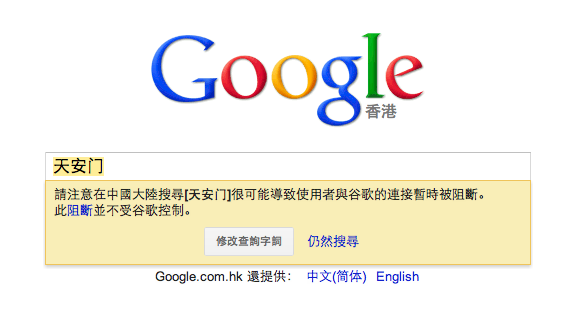
Google warns me that searching for 'Tiananmen' probably isn't going to end well.
It’s a nice gesture, but I can’t help but thinking it’s a fairly futile one, for two reasons. The first is that Google is already a very minor player in China’s search market, which is dominated by Baidu. There are certain demographics with which Google is popular, but by and large, Chinese net users have moved to Baidu and they aren’t likely to notice the changes at all.
The second is that the censorship of specific search terms isn’t really the problem. In my experience, and the experience of many of my friends, google.com.hk often returns a failed connection no matter what you search for. I highly doubt this is a problem on Google’s end; I suspect that, like the throttling of Google’s gmail, it’s a GFW feature that’s intended to frustrate people away from Google without actually blocking it outright. This morning, for example, as I was testing Google’s new warning feature, every search term I submitted returned a failed connection. Terms with Google’s warning didn’t work, but totally innocuous terms without the warning also failed to work.
This afternoon, the site seems to be back to normal, but nobody likes a search engine that only works some of the time, and there’s nothing Google’s warning system can do to help with that.
Since we’re talking about it though, the timing of this feature is also worth discussing. As @niubi and other commentators have pointed out, it certainly seems possible that Google was holding out on this announcement until after China had approved the Motorola merger — this is, after all, a public finger in the eye of China’s censorship apparatus, even if it isn’t likely to affect the search habits of many Chinese. Of course, they could have announced the new feature on “May 35th”; that would have been an even bigger “Fuck you!” in the direction of the Chinese government. But I can’t help feeling this is mostly just PR posturing for foreign audiences. The warning system is a nice enough touch, but at this point Google is already basically out of the game.





Stay updated on the go with our mobile app.
Get latest insights with smoother, more personalized experience through TIA mobile app.