Josh Horwitz · · 10 min read
Unblockable? Unstoppable? FireChat messaging app unites China and Taiwan in free speech… and it’s not pretty
Over a week ago a messaging app for the iPhone called FireChat launched and quickly attracted attention from the international tech media. Created by Open Garden, a team of developers based out of San Francisco, the app lets users engage in anonymous group messaging by leveraging iOS7’s Multipeer Connectivity Framework which allows iPhone users to connect with each other not just via wi-fi, but through peer-to-peer connections and Bluetooth.
The app attained rapid traction around the world, likely the result widespread media coverage and a strong novelty pull – chat without the internet. But it’s taken on a greater sense of urgency in the Chinese-speaking world – specifically in Taiwan, where it shot to the top of the App Store’s social networking charts over the weekend, surpassing reigning chat king Line.
Surpassing Line’s App Store rankings in Taiwan is no small feat, especially considering FireChat went live only eleven days ago. With over 17 million registered users within a population of about 23 million people, Line likely has its strongest market penetration in Taiwan – it even has its own museum exhibition in Taipei.
How did this little-known app come to take over Taiwan, and what does its rapid rise in the island imply about its future?
What does FireChat look like from a practical standpoint?
Before we go right into how and why Taiwan residents are using FireChat, let’s briefly explain what FireChat looks like from a practical standpoint in its current iteration.
The FireChat of March 2014 basically consists of two “group messaging modes” inside a single app. The first mode is accessible under a tab titled “Everyone,” and it’s more-or-less a circus where users are free to blabber on to anonymous strangers without the guidance of a moderator. Users are placed in a chatroom based on their geographic region, which is determined by a special algorithm. Each “Everyone” group chat is capped at 80 members, so there are likely a number of parallel chats going on in the various regions at any given time. It’s worth noting right now that the algorithm doesn’t always separate regions by country – Canada and the US are classified as the same region, so folks from Vancouver can message New Yorkers in “Everyone” mode.
In addition to “Everyone” mode, FireChat offers a “Nearby” mode. In this mode, iPhone users with FireChat installed can connected to other FireChat users not only via wi-fi, but via bluetooth or peer-to-peer networks (using Apple’s Multipeer Connectivity framework). The addition of the latter two forms of connectivity limits each user’s ‘chat-reach range’ to about 100 feet at a maximum. As a result, if you’re alone in your apartment or walking on a side street, chances are pretty high that you’ll be all alone if you check into “Nearby” mode.
Nevertheless, FireChat’s “Nearby” mode is what gets tech enthusiasts excited. As the technology grows more robust, connectivity ranges will increase. As a result, over time mobile phone users can potentially connect to one another without remaining at the mercy of an internet connection. Furthermore, while this “Nearby” chatroom, like the “Everyone” tab, is still a messy group chat, it’s possible Open Garden might roll out person-to-person chat in the future. Or, even further in the future, a single device connected to the internet might provide all nearby devices access to the internet, even if said nearby devices aren’t themselves connected to a wi-fi network.
How is FireChat relevant to Taiwan?
Since it’s basically just an anonymous group messaging app in its current iteration, FireChat remains quite rudimentary right now. As a result, upon its launch, most English-language coverage of FireChat tended to focus on hypothetical use-cases for the present – “This could be cool at a conference where there’s lousy wi-fi…” – or the future – “This could be useful in five years from now if you’re lost in the woods and need to call for help…”
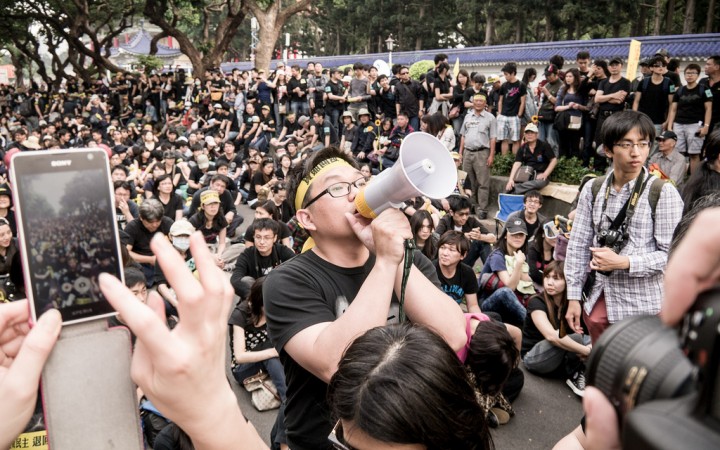
But Taiwan iPhone owners didn’t have to wait for an excuse before downloading FireChat – the perfect opportunity had already arrived. Over the past several weeks students and citizens have been protesting inside and surrounding the island’s Legislative Yuan (think Parliament), voicing opposition to agreement that would loosen trade restrictions with China (and that was passed without undergoing due process in the legislature). This student movement has been dubbed the “Sunflower Movement” by domestic media and has since been adopted by the movement itself.
As an anonymous group messaging app that’s not reliant on internet connectivity, FireChat – in theory – makes an excellent tool for communicating during a political rally – especially one that might get dangerous.

One country, two systems, one FireChat
FireChat and the Great Firewall





Stay updated on the go with our mobile app.
Get latest insights with smoother, more personalized experience through TIA mobile app.