Adinda Pryanka · · 3 min read
Building an AI-native telecom infrastructure
This article is a part of Startup Spotlight, a series that features young, up-and-coming startups.

Image credit: Timmy Loen
While building voice-based AI products, Suman Gandham and Vikash Srivastava discovered a limitation.
Telecom infrastructure heavily choked the performance of their models. They launched Vobiz.ai to build an AI-native communication stack, building the infrastructure behind voice AI from the ground up.
😟 Problem
Most existing telecom systems were built for human conversations and traditional call centers. Retrofitting these legacy networks for AI causes high latency and limits scalability. Developers struggle to deploy reliable, high-volume voice applications.
💡 Solution
The startup builds an infrastructure layer exclusively for voice AI workloads, enabling developers to deploy voice capabilities quickly and reliably. The platform offers developers several specialized capabilities, including:
- Instant Direct Inward Dialing (DID) provisioning and Session Initiation Protocol (SIP) connectivity.
- Real-time call streaming optimized to match fast AI response cycles.
- Native integration of Indian regulatory workflows spanning consent, recording, and traceability.
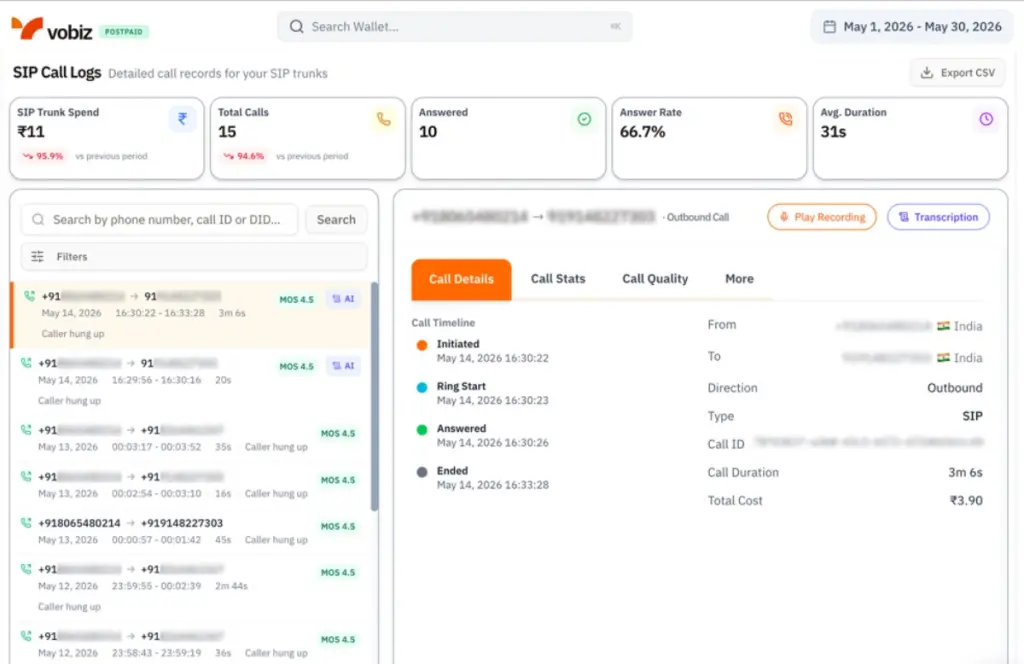
Image credit: Vobiz.ai
📊 Market size
The global voice AI sector is projected to reach US$32.47 billion by 2030. This expansion represents a compound annual growth rate of 29%. Industries ranging from Banking, Financial Services, and Insurance (BFSI) and logistics to healthcare and retail are actively deploying AI agents for high-volume calling.
🤝 Team
- Suman Gandham. Co-founder and CEO. He previously founded India’s first consumer neobank, Finin. He has over five years of hands-on experience in Voice over Internet Protocol (VoIP), SIP, and real-time communications.
- Vikash Srivastava. Co-founder and CTO. He brings over a decade of experience architecting high-scale communication platforms.
🚀 Traction
- Accumulated over 5,000 platform signups.
- Achieved month-on-month growth exceeding 80% in both revenue and call volume.
- Scaled call volume rapidly from 100,000 per week to over one million per day.
🏆 Competition
The startup competes with Twilio, Exotel, Plivo, Telnyx, and Ubona. Incumbents optimize their voice stacks heavily for human interaction flows.
Vobiz.ai integrates telephony, continuous audio streaming, and compliance into a single stack for low-latency AI performance, with India-specific regulatory workflows built directly into the platform.
💰 Financials
🚩 Risks





Stay updated on the go with our mobile app.
Get latest insights with smoother, more personalized experience through TIA mobile app.