 Michael Tegos · · 4 min read
The explorer who built two companies from his search for the tomb of Genghis Khan
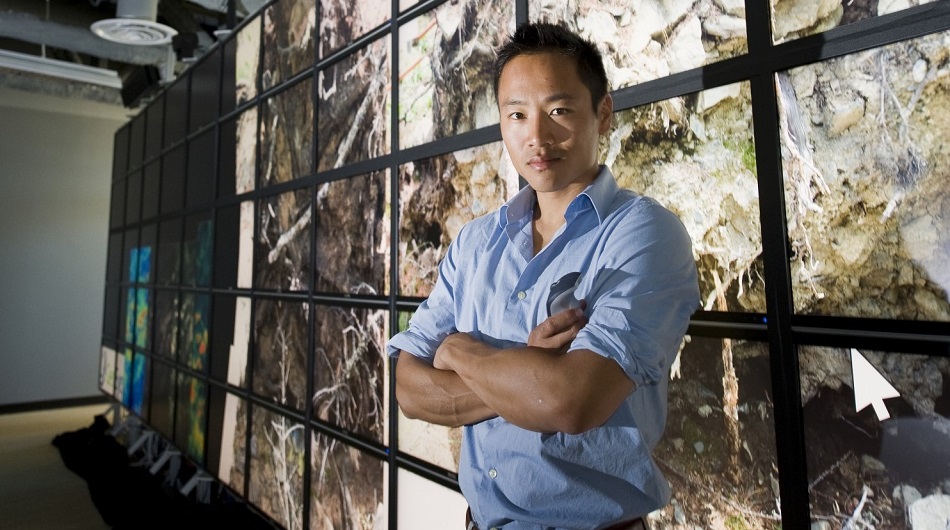
Albert Lin. Photo credit: Calit2 / Erik Jepsen.
There’s a reason that starting a business is called a “venture” – it implies embarking on a journey that involves risk, stepping into the unknown. In many ways, entrepreneurs are as much explorers – of new ideas, markets, or products – as people who literally venture forth in uncharted waters.
Albert has braved the uncharted both in the field and in technology.
Albert Lin is an explorer in both senses. An engineer with a PhD in material science, a research scientist at the University of San Diego, an emerging explorer of the National Geographic Society, and an entrepreneur, Albert has braved the uncharted both in the field and in technology. He’s slated to share more about his experiences at a talk in Singapore on August 30.
As a member of the National Geographic Society, Albert is part of a heritage that goes back to one of the world’s most eminent technologists and entrepreneurs; Alexander Graham Bell, who was the Society’s second president from 1898 to 1903.
“You wonder why a technologist would be associated with the National Geographic Society,” Albert tells Tech in Asia. “I think that we innovate, we build technologies with a purpose: to feed our curiosity, to look further, go deeper. We build these tools and we innovate because we’re problem solvers, but ultimately we’re driven to answer that desire to see what’s beyond the unknown.”
Down to the Valley
We talk a lot about Silicon Valley around here, but Albert is best known for another one: the Valley of the Khans project was a quest to discover the tomb of Genghis Khan. Albert traveled to Mongolia numerous times, exploring remote regions and learning more about the culture of the nomadic people there. In the process, he became entranced by the legend of the 12th century Mongolian warlord.
“I spent multiple summers on these epic expeditions in these very remote regions in Mongolia. I fell in love with this culture and history, which I thought of as my own,” he says.
There was a problem, however: the region in Mongolia where the tomb is supposed to lie is considered sacred ground by the locals, so much so that any disturbance to it would have dire cultural consequences – and that’s without even touching the legends about it bringing about the end of the world!
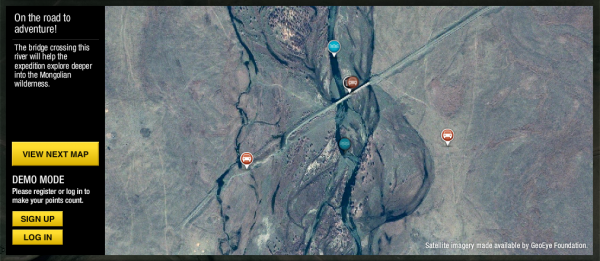
Users were called upon to mark interesting landmarks on satellite imagery to help with the search. Image credit: National Geographic.
So Albert and his team came up with a way of doing non-invasive research using satellite imagery and ground-penetrating radar. He was inspired to do that by fellow National Geographic Society member and University of San Diego researcher Maurizio Seracini.
Maurizio and his team have been searching for years for a long-lost masterpiece by Leonardo Da Vinci, a painting called The Battle of Anghiari. In 2012, the team announced they believed it was hidden in a wall cavity in Florence, Italy, by scanning the wall with high-frequency, surface-penetrating radar.
The techie approach led to a new problem for Albert’s team: the immense volume of data to go through. “It was the needle in a haystack problem, where you don’t even know what the needle looks like,” he says.
Adventure capital





Stay updated on the go with our mobile app.
Get latest insights with smoother, more personalized experience through TIA mobile app.











📅 Upcoming Events
22 October 2026
Payoneer x CSPN Summit 2026