 Michael Tegos · · 4 min read
How GoPro, Nest, and Fitbit dominate their markets – and you can too
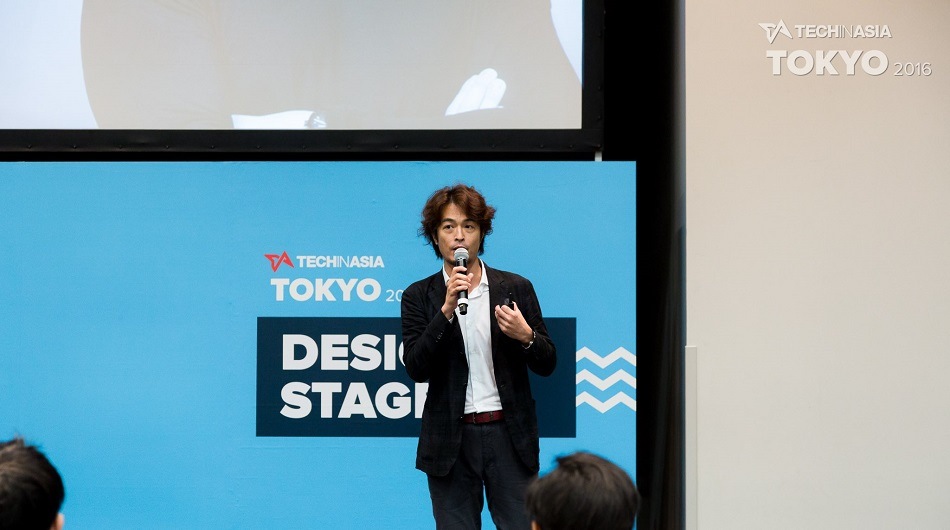
Hardware Club general partner and manufacture lead Jerry Yang on stage at Tech in Asia Tokyo 2016. Photo credit: Tech in Asia / Michael Holmes.
Backing hardware startups is a bit of a puzzle these days, so Hardware Club general partner Jerry Yang fittingly kicked off his talk at the Tech in Asia Tokyo 2016 Design Stage with a quiz.
People think that if you want to be successful as a hardware company, you have to be like Apple.
Jerry (no relation to the Yahoo co-founder; otherwise “I would be at the main stage”) showed the audience a slide displaying a revenue of US$1.9 billion for 2015 and asked everyone which company they thought it was. The answer was fitness tracker beast Fitbit.
Next up was a slide showing a market share of close to 50 percent. The answer there was GoPro in the action camera market.
Jerry said this is the kind of scale and dominance Hardware Club wants its hardware portfolio to achieve. And while the above examples’ success is a tall order, it’s actually based on some very simple factors.
“People think that if you want to be successful as a hardware company, you have to be like Apple, Samsung, Sony, or Toshiba,” Jerry said. “That’s not the case. You can generate a lot of return for your investors and for your team if you do the right thing to scale into dominance.”
Self defense
The two main questions a hardware startup has to ask themselves in the beginning, according to Jerry, are these:
- How do you scale your business?
-
How do you defend your business?
The riddle of scale for a hardware business is not much different than a software startup, Jerry said, but defending it is a bigger challenge.
Fitbit, GoPro, smart home Google acquisition Nest were recruited as examples to illustrate Jerry’s points.
First, you have to increase switching costs – otherwise known as your customers switching to a different product or brand. Nest’s Dropcam, for example, keeps customers in its ecosystem by adding a secure cloud storage component to its security camera product.
Second, a unique user interface / user experience offering is as essential to hardware as it is to software. When Nest co-founder Tony Fadell designed the company’s smart thermostat, he didn’t just add online connectivity to a regular old thermostat. He designed a user interface with the simplicity and elegance he had previously helped put into the iPod.
High efficiency





Stay updated on the go with our mobile app.
Get latest insights with smoother, more personalized experience through TIA mobile app.













📅 Upcoming Events
22 October 2026
Payoneer x CSPN Summit 2026