 Eva Xiao · · 5 min read
This founder used to make VR mazes for mice. Now he’s trying to create life from scratch
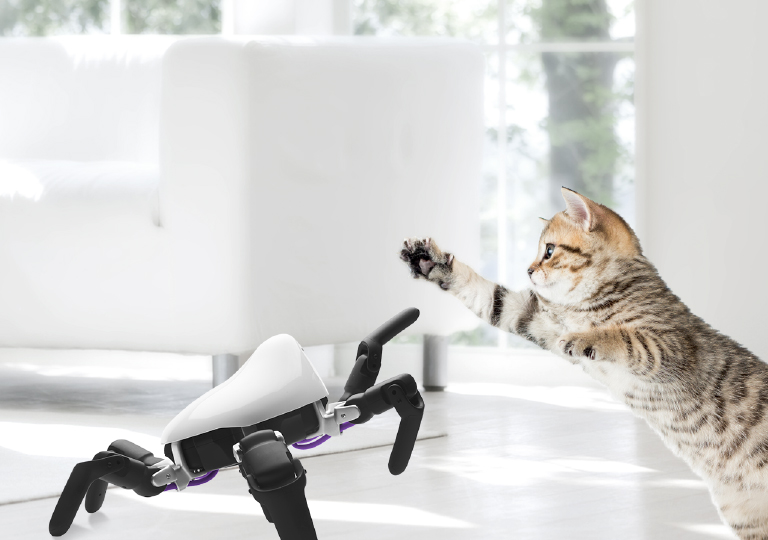
Alert – hostile agent! Photo credit: Vincross.
Since he was young, Sun Tianqi has always wanted to create life. “Creating a living being is a power that only God has,” he told me. “Humans cannot create organisms.”
But that’s exactly what his robotics startup Vincross aims to do.
The Beijing-based startup’s first product, a six-legged robot called HEXA, will be Vincross’s first attempt. Reminiscent of a tarantula, HEXA is an all-terrain robot that can navigate through different environments using lasers. It also supports various machine learning algorithms and image, video, face, and voice recognition, which means it can inch around precipices, avoid falling off a table, and recognize who you are.
“My research on artificial intelligence, neuroscience, neural modeling, and later on, machine learning – all of it centered around one thing,” he says. “I wanted to create a creature.”
Tianqi isn’t a typical computer scientist. Before founding Vincross in 2014, Tianqi studied mice, specifically how decision-making manifested itself in their neural signals. At Tsinghua University, he created a virtual reality maze for mice, tricking them into believing that they were running into walls, avoiding dead-ends, and eating food.
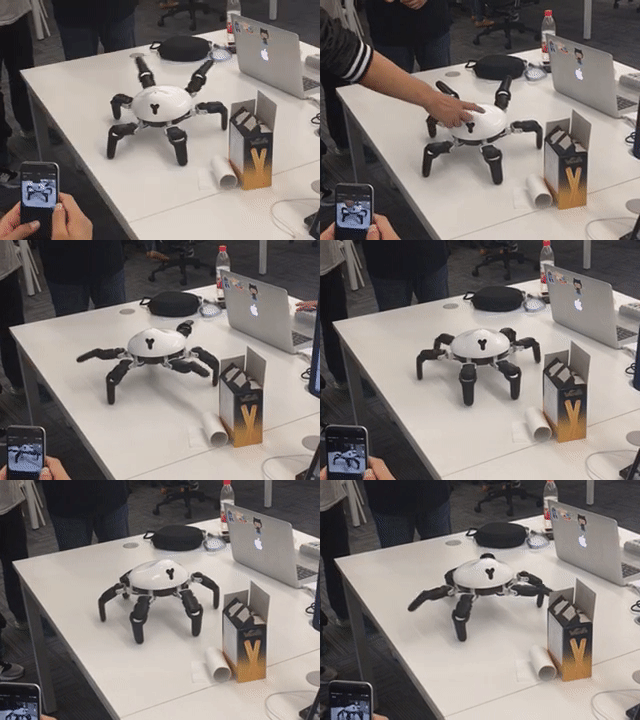
HEXA doing a little dance in front of its creators. Photo credit: Vincross.
Before that, Tianqi was a computer science major. He discovered Alan Turing during his undergraduate years and fell in love with Turing’s work. He spent an entire year translating the Turing biography Enigma of Intelligence into Chinese.
“As his disciple, I felt like I should do something for him,” Tianqi told Tech in Asia.
Turing wasn’t Tianqi’s only role model. He named his startup after another idol, Leonardo Da Vinci. Vincross is a portmanteau of Vinci and crossbow, the latter a reference to a Da Vinci invention.
“I discovered that AI had a lot of interesting philosophical questions,” says Tianqi. “So during college, I temporarily left the technological side [of AI] to study philosophy.”
Human sacrifice
Humanism is one of the main drivers behind Vincross’s robotic endeavors. For example, Tianqi believes that robots can offer humanity value in exactly three different areas, one being the prevention of human sacrifice.
“Arguing whether we should sacrifice one or five people will always be wrong,” says Tianqi. “The right answer is that we can sacrifice robots, not any humans.”
Human mentors





Stay updated on the go with our mobile app.
Get latest insights with smoother, more personalized experience through TIA mobile app.








📅 Upcoming Events
22 October 2026
Payoneer x CSPN Summit 2026