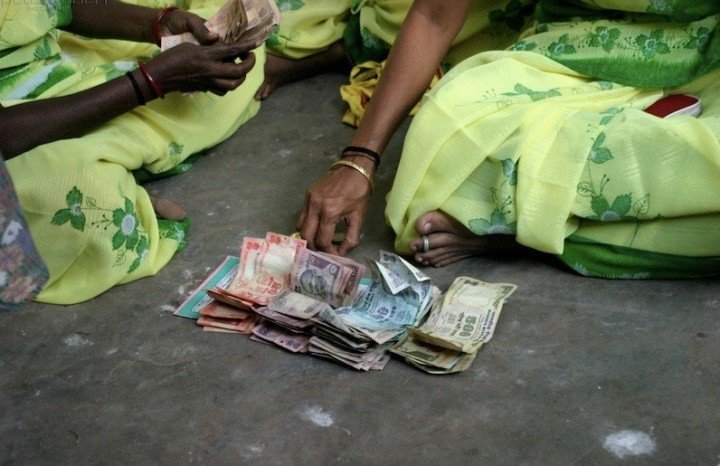
Most of India still pays for things with cash. Photo credit: Peter Haden
The dream of a cashless society for India is not too far off.
This past weekend, the National Payments Corporation of India (NPCI) – essentially the guys who run all of the retail payment systems in India – hosted a hackathon for developers to work with their latest release, the Unified Payments Interface (UPI).
The UPI is a technology that allows bank-to-bank and bank-to-mobile wallet transfers with minimal identification. It is open source, which means that competing banks can include it in their apps and transfer money between each other. The UPI is set to officially launch in April.
The National Payments Corporation of India (NPCI) is set up by the Reserve Bank of India (RBI), India’s central bank, and the Indian Banks’ Association (IBA), an association of Indian banks and financial institutions. The NPCI runs India’s RuPay system, a scheme similar to that of MasterCard or Visa. The NPCI mandates that all mobile wallets adopt the UPI within three years and it will earn US$0.01 for every transaction conducted on the platform.
The API, once integrated into apps, can also be adapted to allow wallet-to-wallet transfers. Rumor has it that many of India’s major mobile wallet players like Paytm and Freecharge have already jumped on this wagon.

Photo credit: Ken Teegardin
The UPI is built on the existing Immediate Payment Service platform (IMPS – so many acronyms!), which is currently India’s fastest method of conducting bank transactions. IMPS works at all hours of the day and promises instant transfers if both the banks of the receiver and the sender have it enabled. While this is convenient, it requires multiple layers of authentication.
The UPI eliminates these verification barriers. It lets people transact through a “virtual address,” which is the combination of three things: their Aadhar number (a digital identity scheme launched by the government), their bank account number, and their cellphone number. Once registered, these three identifiers will act as a “virtual address,” allowing a “one-click” transfer whenever required.
What is the fate of mobile wallets?

Photo credit: Images Money.
While the NPCI’s hope is that making it easier to transfer money electronically will reduce India’s dependence on cash, many of the country’s mobile wallets have come into popularity because of the difficulty of authentication.
A prime example of this happened in October 2014, when Uber was stopped from charging customers through credit or debit cards within India because it was routing their payments to its Netherlands-based headquarters. This violated the government’s two-step authentication process for CNP payments (card not present – transactions where both the merchant and the customer are not physically around) and opened up the possibility for fraud.
The government likes startups





Stay updated on the go with our mobile app.
Get latest insights with smoother, more personalized experience through TIA mobile app.