 Masha Borak · · 3 min read
In China, the smiley face emoji does not mean what you think it means
Sending an ordinary emoji like 🙂 to your WeChat friend in China seems simple enough. But your friend might give you a strange look for it – perhaps a real-life version of 🤔.
Turns out, WeChat, the country’s most popular social app, has its own etiquette for using emojis.
WeChat is omnipresent in China. With more than 1 billion monthly active users, the Tencent app lets people chat, pay bills, play games, shop, and access government services without ever leaving the app.
Consider 👋. It looks a little different in WeChat’s version but, at least, it’s not a biscuit. For many of us, this would simply mean that we’re happily waving goodbye. On WeChat, it could mean that you just said something really dumb and the sender doesn’t want to speak to you anymore. Ouch!
And as for the regular smiley face? That’s not for friends. That’s usually reserved for your boss.

We made these extra large to be extra creepy.
The WeChat Annual Data Report 2018 shows that emoji use does not differ purely by geography, but also by the users’ generation. The report – full of interesting numbers – analyzed which groups of users prefer which emoji, along with their daily habits (leaving some users wondering who stole their chat records).
For instance, those born after 2000 preferred to use the facepalm emoji: 🤦♀️. According to the report, this generation gets little sleep. They go to bed late and get up early – kind of what we would expect from overburdened Chinese school kids.
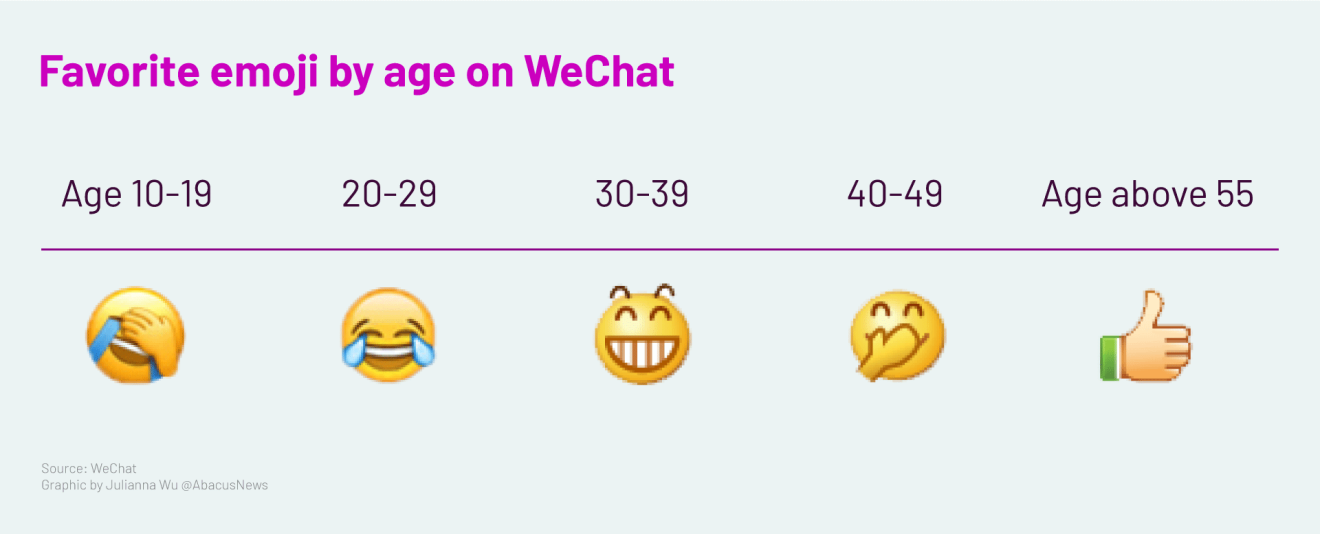
It feels like they get less happy the older they get.
Incidentally, the data also reveals that the post-2000 generation has a sweet tooth. WeChat Pay says the number of young people who pay for cold drinks and desserts has gone up by 230 percent since last year.
As for the generation born in the 1990s, their favorite emoji is the classic face with tears of joy: 😂. This emoji has lots of fans internationally. It was even Oxford Dictionary’s word of the year in 2015. WeChat says this generation is known to get out of bed pretty late and use public transportation quite often.





Stay updated on the go with our mobile app.
Get latest insights with smoother, more personalized experience through TIA mobile app.










📅 Upcoming Events
22 October 2026
Payoneer x CSPN Summit 2026