
Photo credit: Pure Content
When presented with the option of pay-per-click advertising vs search engine optimization (SEO), almost everyone I speak with opts for the latter. The justifications range from, “It’s free traffic, why not?” to “I don’t really click on ads anymore.” Totally valid, except that free traffic from Google isn’t really “free”. It comes at a price. I am also not referring to the price you pay for engaging a SEO agency. Assuming you are doing SEO in-house (which gives you more control over the quality), let’s explore the true costs of SEO.
You are sitting on thin ice
When I first started doing SEO seven years ago, it was for my tuition agency business. I bought an exact match domain, stuffed it with keywords, religiously built backlinks from a variety of sources, and crossed my fingers. My prayers were answered, and the website began showing up on page one of the Google search results page within a few months. Voila! I enjoyed free traffic (and leads) from Google while doing maintenance SEO work.
Good days don’t last. The tech giant started cracking down on greyhat methods, and people like us were affected. I learnt that the boundaries of white, grey and black areas will always change. I was just doing what everyone was doing, but it didn’t save me from Google’s massacre. They gave it an innocent name, Google Penguin. So my website was penalized, and a few months of effort went down the drain while I built a new website.
I was not the only one. There has even been reports of penalization of huge websites like Ebay’s, which caused them to lose $200m. BMW and Expedia were not spared either. The bottom line is that relying on Google for organic traffic is like sitting on thin ice. It is gonna break anytime.
You don’t choose when it rains
In my case, I was (still) considered lucky. My SEO efforts paid off, and my website ranked on Google for a considerable amount of time before it was dropped. For many others, they’ve experienced paying a fortune and not getting ranked, or their own efforts were simply futile. This is again because we are subjected to the whims of Google. They call the shots as to what websites appear. Granted, it may be the case of unskillful SEO implementation, but in many cases, we are just fighting a losing battle. We can save a lot of heartaches by doing a little bit of ground work in advance.
I have had people come to me with a set of keywords, hoping that these will allow their websites to appear on the first page. This is an example of a set of keywords someone once came up to me with:
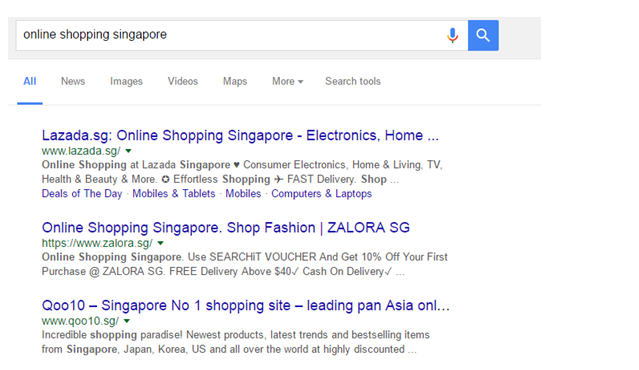
The top three results are household names. It is no coincidence. A little over 3 years ago, you might have seen websites like onlineshoppingsingapore.com on the results page, but Google has since gotten much cleverer than just looking at keywords now. It is able to provide users with what they actually want.
Businesses that are often talked about on the ground have a much better chance with Google. But you will ask, how does Google, a robot, know the sentiments of Singaporeans? Don’t forget that they have lots of user data, one of which being the search volume of every single key phrase. The number of people searching for “Zalora” is a whopping 110,00 A MONTH on average. This suggests to Google that “Zalora” is a strong brand! (You can check the popularity of your brand on keyword planner.)

Given that the first three websites in SERP corner more than 60 percent of the clicks and there is no way to outrank these brands, I discouraged the business owner from pursing SEO for this keyword in the first place.
Content rules
Given all that, is SEO dead?





Stay updated on the go with our mobile app.
Get latest insights with smoother, more personalized experience through TIA mobile app.