Jum Balea · · 4 min read
Investors agree Southeast Asia has a series B problem. Here’s what’s filling the gap.
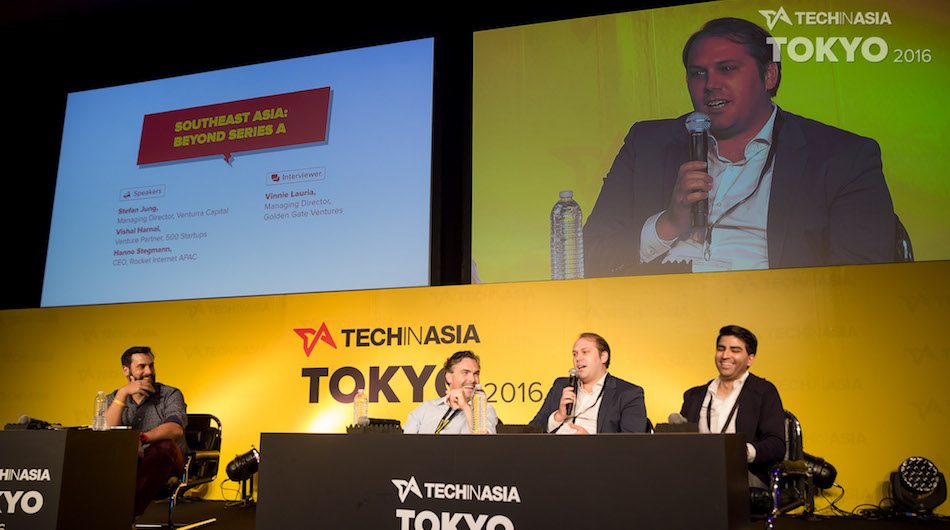
Investors talk about Southeast Asia beyond series A investments at the Tech in Asia Tokyo 2016. Photo credit: Tech in Asia / Michael Holmes.
Startups in Southeast Asia have seen an influx of funding at the seed and series A stages, but the same can’t be said for series B, experts observe.
“A lot of seed and series A investments have happened and many of these companies will get to series B stage, but we don’t have a lot of series B funds. There’s only a handful that are really dedicated to writing US$7 million, US$10 million, US$15 million checks in Southeast Asia,” Stefan Jung, a founding partner at Venturra Capital, said today at the Tech in Asia Tokyo 2016 conference.
Also onstage were Hanno Stegmann, CEO of Rocket Internet Asia-Pacific, and Vishal Harnal, venture partner at 500 Startups. Both agreed with Stefan’s view.
“It’s difficult in Southeast Asia,” Hanno noted. “There aren’t many funds that have the track record of doing multiple investments in the series B space. You have people like Sequoia and Softbank, then it gets thin.”
“We’ve made our study – there were around 100 series A investments in the last 12 months […] there should be companies coming up for series B. There’s still a lack of series B investors, not a lot of options to choose from,” Stefan further explained to Tech in Asia on the sidelines of the conference.
Non-VCs coming in
The investors don’t seem so worried though. They said they’re seeing “non-VC players” filling in the gap.
“We’ll probably see more rounds that are syndicated like US$4 million, US$3 million investments added up to get to US$10 million upwards. That means three to four entities investing together in one round – with no one clear investor leading it,” Stefan said.
“That’s exactly what we’re seeing in the last half of the year. Private equity funds that are interested in new tech investments saw the opportunity and have invested. There’s hedge funds. I’ve also seen a lot of strategic conglomerates looking at larger tickets,” he added.
For his part, Vishal shared, “We’re seeing corporates that are starting to invest in that stage, where there’s slightly more stability.”
Series B is probably the hardest round to raise. You can’t just be a founder who’s smart and with a great idea – your business must have traction. This is the stage where vision and promise must be replaced with hard numbers that show a clear path to success. In Southeast Asia, some of the companies that have raised this stage are Carousell, Ninja Van, and Bukalapak. Those past it and now in later stages include the likes of Grab, Go-Jek, and Tokopedia.
“If you raise series B, a large part of that fundraising is clearly for your path to profitability,” Stefan stressed.
Chinese particularly keen
In particular, Chinese VCs and late-stage companies are growing more interested in Southeast Asian startups. “We’re bumping more and more often into these companies. What they’re trying to do is shop around for startups that are at the later stage as well,” Vishal revealed. “Many of the VC firms in China or companies that are already valued at over a billion dollars who can’t push the envelope any further in their markets are looking at investing in Southeast Asia.”
He said the region holds huge potential – with its population of over 600 million, a rising middle class, and growing internet usage and smartphone adoption.
Hottest market





Stay updated on the go with our mobile app.
Get latest insights with smoother, more personalized experience through TIA mobile app.