Malavika Velayanikal · · 9 min read
What’s putting India on the world map for deep tech in healthcare

From affordable medical devices to applications of AI and genetics to diagnostics, health tech is taking on deeper problems than doctor appointments. / Photo credit: Daniel Frank
One in 17 women in the world are likely to develop abnormalities in the breast that can lead to cancer if not detected early, according to WHO. But regular screening with mammography is expensive and unavailable to many. As a result, in India and other developing countries, half of the women detected with breast cancer die within a couple of years, even though this is one of the most curable forms of cancer.
Mammography is also less effective in younger women because it’s harder to detect lumps when breast tissue is dense. Besides, it involves periodic exposure to x-ray radiation which can also contribute to cancer.
Bangalore-based startup Niramai has an alternative: non-invasive thermal imaging that shows lumps in the breast when analyzed by artificial intelligence. “What motivated us was that actually there is a technology limitation today which is not enabling early detection of cancer,” says Niramai CEO and co-founder Geetha Manjunath, who was the head of Xerox Data Analytics Research in India till the end of 2016.
The startup has two US patents for its methods of detecting breast tumors, and eight more are pending. Last April, it raised a seed round led by AI-focused early-stage fund Pi Ventures, which was also an early backer of Bangalore-based SigTuple that uses AI to improve the speed and accuracy of pathology. SigTuple raised a US$5.8 million series A round last year.
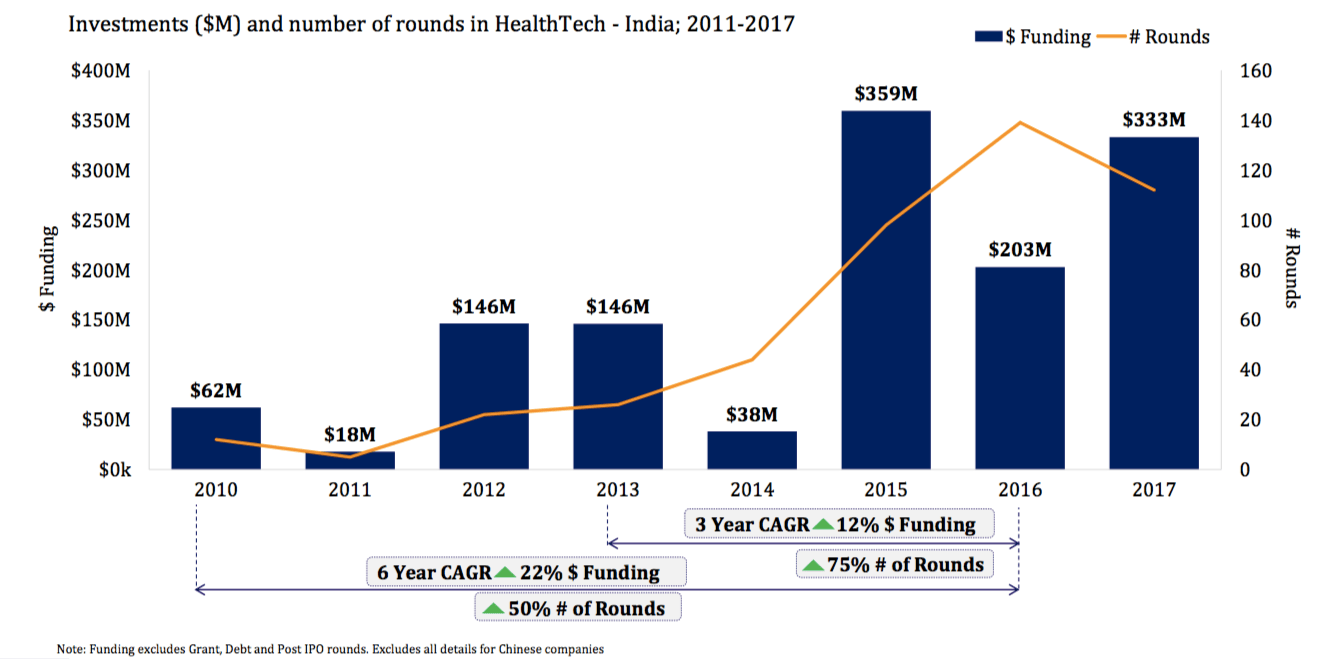
Niramai and SigTuple represent a new trend in the health tech sector, which was one of the hottest in India last year, with US$333 million in funding, according to data from venture capital analytics firm Tracxn. This was 61 percent more than in the previous year, and close to the level reached in 2015, which was the boom year for funding in India.
Source: Tracxn
Notable investments
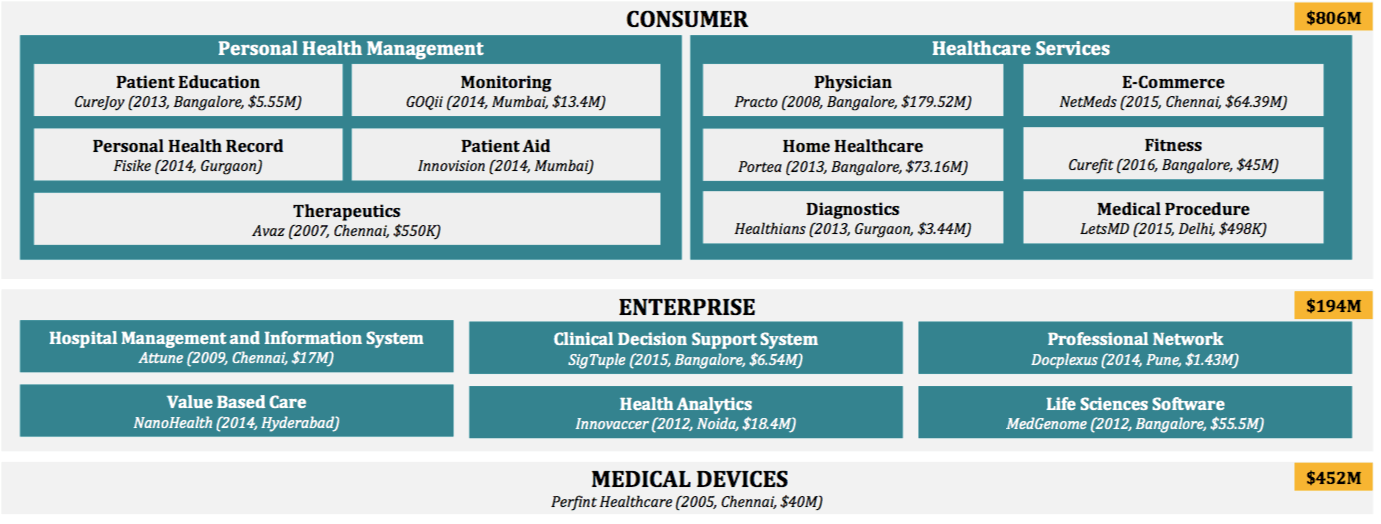
More than the amount of funding, what’s interesting is where the money is going. Doctor-appointment platform Practo raised US$120 million in 2015, accounting for more than a third of the total health tech funding that year, whereas funding has got diversified in the last couple of years.
From online platforms and marketplaces to medical devices and applications of deep tech like AI, internet of things, and genomics for analytics, investors see potential for startups to play a growing part in supplementing or even disrupting traditional healthcare systems that are inadequate for such a large, diverse country.
One of the biggest-funded startups last year was MedGenome, which raised US$30 million in a round led by Sequoia and Sofina. The Bangalore-based startup has developed genetic diagnostics for cancer, eye disorders, neurological problems, prenatal conditions, and metabolic diseases like diabetes. It has labs in India and the US for deep sequencing of DNA that enables testing for genetic biomarkers of a variety of diseases. As India’s top biotech hub, Bangalore is home to Biocon, which reported US$40 billion revenue in FY2017.
Sequoia also led a US$6 million round in Bangalore-based OncoStem, which uses genetic tests to predict the recurrence of cancer. A third bet by Sequoia in this space is Mitra Biotech, which had a US$27 million round in August 2016. Mitra personalizes cancer treatment by rapidly assessing the impact of specific drugs on cancerous tissue.
What investors see
Hubs attracting investors
Jury is out on viability





Stay updated on the go with our mobile app.
Get latest insights with smoother, more personalized experience through TIA mobile app.